
Most sewage cleanups happen in rooms where a crew can stand up, walk around, and roll equipment through a door.
A crawl space cleanup in Arvada, Colorado starts with none of that.
The work happens flat on a worker’s stomach, in the dark, on bare soil, with the floor of the house sitting inches above his back. This guide walks through what changes when sewage ends up under the house instead of in it, and why the whole approach has to change with it.
First, Picture the Space Under the House
A crawl space is the shallow area between the ground and the first floor of a home.
In many homes it is eighteen inches to three feet tall. Nobody stands in it. Most homeowners have never been inside theirs at all.
What is down there matters more than most people realize. The floor joists that hold up your rooms. The piers that support the beams. The ductwork that moves heated and cooled air. And nearly every drain line and water line the house owns.
Homes in the Hills at Standley Lake area and across Arvada, Colorado sit over crawl spaces like this, and when sewage appears under one of them, the job is different from the first minute.
Clearance Measured in Inches, Not Feet
Every tool, every hose, and every bag of removed material moves through the access hatch and across that low space by hand.
A technician works lying flat or on elbows and knees. Turning around can mean backing out and starting the approach again from a different angle.
That single fact changes the pace of everything. Work that takes minutes in an open basement takes far longer when each reach covers a few feet of ground and the ceiling is the underside of your floor.
A Floor Made of Soil, Not Concrete
A basement gives sewage a hard surface to sit on. A crawl space gives it dirt.
Soil and gravel absorb contaminated water instead of pooling it neatly. The liquid mixes into the top layer of ground, spreads sideways through it, and keeps moving long after the surface looks settled.
There is no floor drain to guide it and no slab edge to mark where it stopped. Reading the true edge of the affected area takes probing, moisture checks, and experience with how soil behaves.
Everything Down There Is Within Reach of the Water
In a basement, sewage mostly threatens what sits on the floor. In a crawl space, it threatens the structure itself.
The joists and beams are inches above the ground, not feet. The bottom of the ductwork hangs low. The insulation sits directly in the splash and soak zone, and the vapor barrier that was supposed to keep ground moisture down becomes the sheet that holds contaminated water against everything.
That is why a modest looking release under a house can touch more building material than a larger spill in an open room. The space compresses everything together, and the cleanup plan has to account for all of it at once.
How Sewage Ends Up Under the House
Homeowners are often surprised that the house above can look almost normal while the crawl space below is in trouble.
The reason is plumbing geography. The drain lines and the main sewer line run under the floor, and a blockage or a break below the house releases sewage at the lowest and weakest point it can find.
That point is usually under the house, not in it.
The Lines Under Your Floor Are the Low Point
When a main line blocks, wastewater looks for any opening: a loose joint, a cracked fitting, a cleanout cap that is not sealing.
Under a house, that release can run quietly for days. The rooms above may drain a little slowly and nothing more, while contaminated water spreads across the soil below.
Tree roots are a common reason the line blocks in the first place.
Tree roots cause more than 50 percent of sewer blockages, according to research published through the U.S. Forest Service.
Roots enter through tiny joints, grow into a mass inside the pipe, and catch everything that flows past. On a street with mature trees, the line under the house is exactly where that mass does its damage.
Why You Often Smell It Before You See It
The first sign of a crawl space backup is usually a smell, not a puddle.
Sewer odor rises through floor registers, gaps around pipes, and the access hatch itself. Homeowners notice it in a hallway or a bathroom and cannot find a source anywhere in the living space.
That smell is information. It means something below the floor has been wet with sewage long enough to announce itself, and it is the reason this kind of backup is often older than it looks when a crew finally gets under the house.

The Health Stakes Run Higher in an Enclosed Space
Sewage is hazardous anywhere. In a low, enclosed, unventilated space, every part of that hazard concentrates.
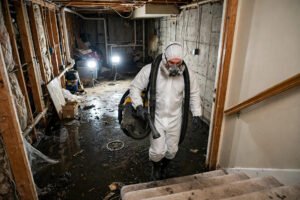
Category 3 water can carry bacteria, viruses, and parasites. In a crawl space, a worker’s face is close to the surface the whole time, which is why full protective gear, including a respirator, suit, gloves, and boots, is not optional down there.
It is also why this space should never be entered by a homeowner to investigate. The look is not worth the exposure.
Contamination You Cannot See From the Access Hatch
Standing at the hatch with a flashlight shows you the first few feet. It does not show you the far corners, the low spots behind piers, or how far the moisture traveled through the soil.
Sewage follows the slope of the ground and the path of the pipes. A dry looking patch near the hatch can sit ten feet from a soaked area under the back of the house.
Crews map the space properly by going in with lights and moisture readings, working pier to pier, until the wet edge is found in every direction.
Ductwork and Insulation Carry the Problem Upstairs
Two parts of the crawl space connect directly to the rooms above.
Insulation tucked between the joists absorbs contaminated moisture and odor, and fallen or soaked sections have to come out. Ductwork runs through the same space, and its joints and insulation wrap sit right where the moisture and odor collect.
That is how a problem under the house becomes a smell in the living room. Treating the crawl space fully, including the materials hanging in it, is what stops the house above from keeping the odor.
Getting the Sewage Out When Nothing Fits Through the Hatch
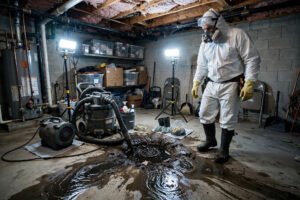
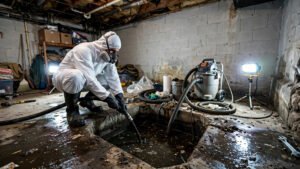
Extraction equipment is built for rooms. In a crawl space, the machines stay outside and only the hoses and the technician go in.
The hose is fed through the hatch and worked across the soil by hand, one section at a time. Pools hiding behind piers get found by feel and by light, not by walking around them.
It is slow, physical, methodical work, and it is the stage that decides how much of the ground itself is contaminated.
Extraction on Your Stomach, One Reach at a Time
A technician lying flat can reach a few feet in each direction. Then he backs up, repositions, and works the next patch.
Wet soil complicates the pass. Liquid sewage mixes into the top layer, so extraction takes the water and the worst of the slurry with it, and the crew judges as they go how much of the surface layer is too contaminated to stay.
Breaks are part of the method. Workers rotate out of the space regularly, because heat, posture, and air quality all limit how long anyone should work under a floor.
What Has to Come Out Through That Small Opening
Everything removed leaves the same way the technician entered: through the hatch, in sealed bags, one load at a time.
That includes the torn or soaked vapor barrier lying on the soil. It includes fallen insulation and debris that sewage reached. In spots where contamination soaked deep, it can include the top layer of soil itself.
None of it can be disinfected reliably in place. Porous material that sewage soaked into is removed, the same rule that applies in a basement, only slower because of the door it all has to fit through.
Cleaning and Sanitizing Surfaces You Cannot Stand Next To
Once the sewage and the ruined materials are out, the surfaces that remain get cleaned and then disinfected: joists, beams, piers, pipes, and the ground itself.
The order matters as much here as anywhere. Cleaning removes the soil load and residue first, so the disinfectant that follows can do its work on the surface instead of spending itself on the dirt.
For homes arranging sewage cleanup in a crawl space, this stage is worked joist by joist and pier by pier, at arm’s length, with the technician repositioning constantly to reach the next face of wood or concrete.
Soil, Wood, and Concrete Each Get Treated Differently
Wood framing is cleaned and treated, then checked again once dry, because grain holds moisture deep.
Concrete piers and block walls are hard surfaces, and they clean up well. The soil is the judgment call: surface contamination is treated, heavily soaked ground is removed, and a fresh vapor barrier goes down at the end to seal the clean surface.
Odor work lives in this stage too. A crawl space that still smells after cleaning is telling you a source remains, usually soaked insulation or a patch of ground that was missed behind a pier.

Drying a Space With Almost No Airflow
A cleaned crawl space is still a wet crawl space.
Joists, beams, and soil all hold moisture, and the low, still air under a house gives that moisture nowhere to go. Drying equipment has to be compact enough to fit the hatch and placed carefully, because a badly aimed air mover just stirs the far corner while the near corner stays wet.
The U.S. Environmental Protection Agency advises drying water-damaged areas and items within 24 to 48 hours to prevent mold growth.
That window is harder to honor under a house, which is exactly why crawl space drying is monitored instead of assumed. Readings are taken at the joists, at the piers, and at the soil surface, and equipment is adjusted until the numbers reach normal levels.
Why Moisture Hides Longer Under a House
Soil is a moisture reservoir. Even after the surface looks dry, the ground below it keeps feeding damp air upward into the framing.
Ducts complicate the map further, blocking airflow to whole sections of the space. A corner behind a duct run can stay wet days after the open areas read dry.
The final check matters here more than anywhere in the house, because nobody will casually notice a still damp crawl space later. The readings are the only witness.

What a Homeowner Can Safely Do While Waiting
Your part in a crawl space backup is smaller than in a basement backup, and that is by design.
Stop using water and drains, since everything you run travels through the lines below the floor. Keep people and pets away from the access hatch area, and keep out of the crawl space entirely.
Document from dry ground: photographs from the hatch opening without entering, notes on when the smell started, and which drains have been slow. That record helps the crew and helps you later.
Do not crawl in to look, do not aim a household fan into the hatch, and do not pour anything into drains to try to clear the line. Moving contaminated air and adding chemicals both make the professional work harder.
Knowing the warning signs you need professional sewage cleanup helps here too, because a crawl space problem usually whispers before it shouts.
How Long Crawl Space Cleanup Usually Takes
The honest answer is that the same stages take longer per square foot under a house.
Assessment and extraction usually happen on the first visit, but the extraction alone can take hours in a wide or low space. Removal and sanitization follow, worked section by section.
Drying runs for several days with check visits, since the soil and the still air slow everything down. The size of the hatch, the height of the space, and how far the sewage spread are the three facts that stretch or shorten the whole job.
One more factor surprises people: the weather above ground. Rain in the days after a backup raises the moisture under the house and can slow the drying readings, which is one more reason the crew verifies with measurements instead of calling the space dry on a schedule.
Who This Matters For in Arvada, Colorado
Homeowners with crawl space foundations come first, because the space under their floor is out of sight and easy to forget until it announces itself by smell.
Rentals, condos, and HOA-managed properties come next. A tenant may notice the odor while an owner or manager arranges the response, and a clear picture of what the crew will do under the building helps everyone plan.
Commercial properties follow, and they are never left out. Restaurants, retail spaces, offices, and light industrial buildings across Arvada, Colorado can sit over crawl spaces too, and the same careful, section by section approach applies at that scale.
The full range of sewage cleanup services includes crawl space work handled this same way, scaled to the building involved.
Sewage Cleanup Arvada Serving the Hills at Standley Lake Community and Beyond in Arvada
Sewage Cleanup Arvada serves the Hills at Standley Lake community in Arvada, Colorado, near local landmarks like Standley Lake, for homes close to the crossing of Simms St and W 86th Pkwy, at coordinates 39.85216, -105.13005.
Get Sewage Cleanup Hills at Standley Lake Service Now
Navigate from Hills at Standley Lake to Sewage Cleanup Arvada Now

Frequently Asked Questions About Sewage Cleanup in Arvada, Colorado
Can sewage back up into a crawl space without flooding the house?
Yes. The drain lines and the main sewer line run under the floor, so a blockage or break below the house can release sewage under the home while the rooms above show nothing worse than slow drains and a sewer smell coming up through the floor.
Does the soil under the house have to be removed during cleanup?
Sometimes the top layer does. If sewage only wetted the surface, the ground can be treated and covered with a fresh vapor barrier. Where contamination soaked deep, crews remove the affected soil in sealed bags as part of the job.
Is it safe to crawl under the house and look for myself?
No. Sewage is Category 3 black water, and a crawl space adds low air, poor light, and close contact with contaminated soil. Look from the hatch opening if you need to, take photos from there, and leave entering the space to a crew in full protective gear.
How long does crawl space sewage cleanup take?
Assessment and extraction usually start on the first visit, with removal and sanitization worked section by section after that. Drying normally runs for several days with check visits, because soil and still air under a house hold moisture longer than an open basement does.
Will the smell inside the house go away once the crawl space is cleaned?
In most cases, yes. The odor inside the home is usually rising from the crawl space through registers and pipe gaps, so once the source below is removed, sanitized, and dried, the smell above clears with it.
Sewage Cleanup Arvada, 5292 Ward Rd #2, Arvada, CO 80002. (720) 764-0457
Hours: Open 24 hours, 7 days a week for emergency service