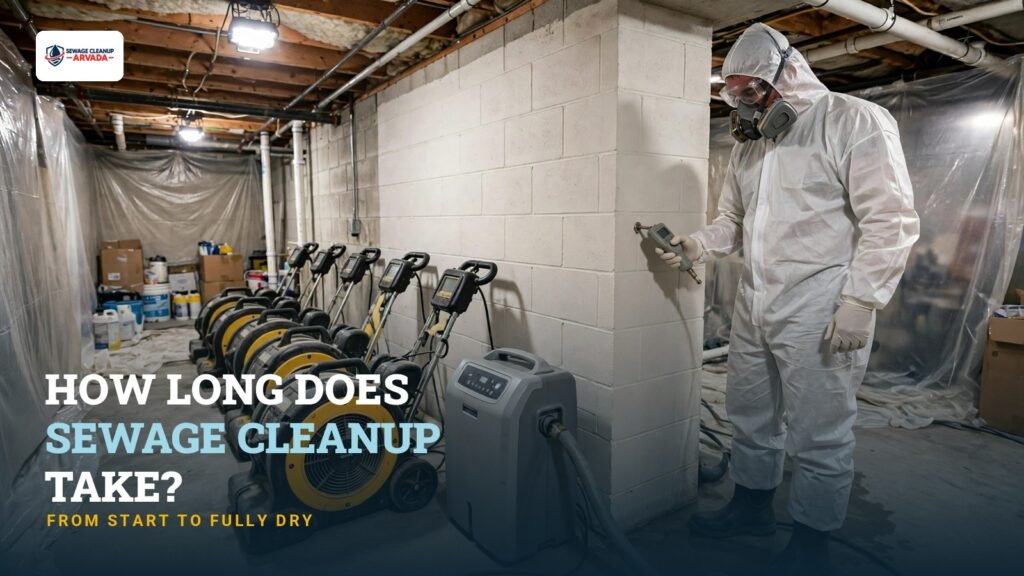
Most sewage cleanup jobs run on two different clocks. The hands-on work, assessment, extraction, removal, and sanitization, is usually finished within the first day or two. The drying that follows takes several more days, and the job is only complete when moisture readings confirm the structure is dry. For a typical home in Arvada, Colorado, the full timeline from the first call to a fully dry room often lands between three and seven days, and this guide shows where each of those days goes.
The Short Answer: The Work Is Fast, the Drying Is Not
Homeowners usually picture one long cleaning visit. A real sewage cleanup in Arvada, Colorado looks different.
Think of it as a short burst of intensive work, followed by a longer, quieter stretch where equipment runs and the structure gives up its moisture day by day.
The burst is measured in hours. The drying is measured in days. Confusing the two is why timelines surprise people.
More than 500,000 sewer backups occur each year in the United States, according to the Water Environment Federation.
Because backups are this common, crews work to a well-practiced routine. What changes from one Arvada, Colorado home to the next is not the routine. It is the size of the affected area, the materials the sewage reached, and how long the water sat before the first call.
The First Visit: Assessment, Containment, and Getting the Sewage Out
Day one decides almost everything about the timeline.
The crew starts by walking the affected area and the rooms around it. They map where the sewage entered, how far it spread on the surface, and which materials it touched.
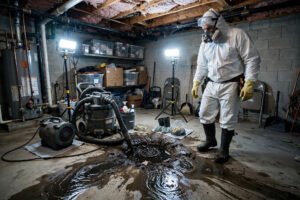
Then the area is sealed off with containment sheeting, and the standing sewage is extracted with industrial equipment.
What Happens in the First Few Hours
Assessment and containment usually take a few hours, not a full day.
The moisture checks matter as much as the visible damage. Sewage wicks into drywall, insulation, and under flooring, and the crew has to find those hidden paths before anyone can say how long the rest will take.
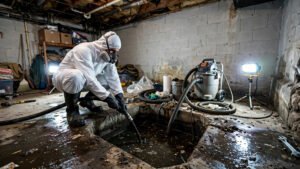
Extraction follows once the area is sealed. Removing the contaminated water itself is quick compared to everything after it, but it has to be complete, because every later phase depends on the liquid being gone.
Why the First Visit Sets the Pace for Everything After
The map drawn on day one decides the scope of removal, the layout of the drying equipment, and the number of drying days to expect.
A small backup caught early, on bare concrete, gives the crew a short map. A backup that sat overnight in a finished basement gives them a much longer one.
That is why an honest timeline can only be given after the first visit, not over the phone.

Removal and Sanitization: Day One Into Day Two
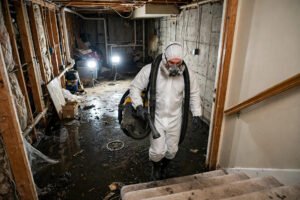
Once the standing sewage is out, the crew removes the materials that cannot be disinfected.
Carpet padding, affected drywall, and insulation come out because sewage soaks into them and no surface treatment reaches contamination inside a porous material.
After removal, the surfaces that remain are cleaned first and disinfected second, in that order, so the disinfectant works on the surface and not on the dirt covering it.
Why a Finished Basement Adds Hours
An unfinished basement is mostly hard surfaces. Concrete and tile can be cleaned and disinfected in place, which keeps this phase short.
A finished basement is built from porous materials. Carpet, padding, drywall, and insulation all hold sewage, and each one has to be cut out, bagged, and removed before sanitization can even start.
According to the Insurance Institute for Business and Home Safety, 68 percent of all drain system sewer backup claims started in the basement.
That figure explains the pattern crews see every week. The lowest room in the house collects the backup, and whether that room is finished or bare concrete is the single biggest factor in how long the hands-on work takes.

Drying: Where Most of the Timeline Actually Goes
When the room looks clean, the longest phase is only starting.
Walls, framing, subfloor, and concrete hold moisture the eye cannot see. Air movers and dehumidifiers are placed in a planned layout, and they run around the clock, pulling that moisture out of the structure and out of the air.
Several days of drying is normal. It is not the crew being slow. It is the materials giving up water at the speed materials do.
What the Equipment Is Actually Doing
Air movers and dehumidifiers do different jobs, and both are needed.
The air movers push air across wet surfaces so moisture evaporates out of the material. The dehumidifiers then pull that moisture out of the air, so it leaves the room instead of settling into the next surface.
A household fan only does the first half of that work, and does it without a plan. Professional drying is a loop: evaporate, capture, measure, adjust. That loop is what runs for several days, and it is why the equipment stays where the crew placed it.
The Window That Starts the Drying Clock
Drying has a deadline built into it, and it starts the moment the water arrives, not the moment the equipment does.
That window is why the first visit happens fast and why drying equipment goes in on the same visit whenever possible. Every hour of delay before drying starts is an hour added to the risk at the other end.
Check Visits and the Final Moisture Reading
Drying is monitored, not assumed.
The crew returns for short check visits, takes moisture readings across the previously wet materials, and adjusts the equipment layout if any area is drying slowly.
The job ends when those readings match the levels in unaffected parts of the home. Not when the surface feels dry, and not when a set number of days has passed. The readings decide.

What Makes One Sewage Cleanup Take Longer Than Another
Two homes on the same street in Arvada, Colorado can have timelines that differ by days. The reasons are consistent.
How Far the Sewage Traveled
Distance is the first factor. Sewage that stayed in one bathroom is a short job. Sewage that crossed a finished basement, wicked up two walls, and ran under flooring is a long one, even if the visible puddle looked similar at first glance.
Hidden travel adds the most time, because it is usually found in stages, and each newly found wet area joins the drying plan.
The Hours Before the First Call
The timeline does not start when the crew arrives. It starts when the sewage arrives.
Sewage that was extracted within the first hours has had little time to wick upward or soak deep. Sewage that sat through a weekend has reached further into every porous material it touched, and that depth shows up later as extra removal work and extra drying days.
This is the factor homeowners control most. A fast first call is worth more than any other single decision in the whole timeline.
The Materials It Touched
Porous materials slow everything twice. They extend the removal phase, because they have to come out, and they extend the drying phase, because the structure behind them has to dry once they are gone.
Hard surfaces do the opposite. A backup across tile and concrete can move from extraction to drying in a single visit.
Weather and the Ground Outside
Colorado Front Range weather plays a quiet role. Heavy rain and spring snowmelt can saturate the ground around a home, and a structure dries more slowly when the air and soil around it are wet too.
A repeat backup during the same wet period resets the clock entirely, which is why the line problem behind the backup has to be addressed, not just the water inside the home.
A Phase by Phase Look at the Full Timeline
Put together, a typical timeline for a sewage cleanup in Arvada, Colorado reads like this.
Day one: assessment, containment, extraction, and the start of removal. By the end of the first visit, the sewage is out, the area is sealed, and the drying equipment is usually running.
Day two: removal is finished if it was not completed on day one, and sanitization is completed. The room is clean. It is not yet dry.
Days three to five: drying, with short check visits for moisture readings. Quiet days for the homeowner, active days for the structure.
The final day: readings confirm the materials are dry, equipment comes out, and the space is handed back. Rebuilding what was removed, such as drywall and flooring, is a separate step that starts after this point.
One caution about that last step: rebuilding on a guessed dry date is how mold problems get built into walls. The verification reading is the gate. However long the drying took, the rebuild waits for the numbers, and a homeowner should be glad it does.
Homeowners arranging sewage cleanup in Leyden Rock or anywhere else in the city will hear this same shape of timeline, with the drying days flexing up or down based on the factors above.
How the Timeline Changes by Room
The same backup behaves differently depending on which room it lands in.
A Bathroom or Laundry Room Backup
A backup in a bathroom or laundry room is usually the shortest version of this job.
These rooms are small, mostly hard surfaced, and built to handle water. Tile, sealed floors, and a single wall or two mean less removal, and the drying area is compact. The hands-on work often fits inside day one, and drying finishes at the shorter end of the range.
The catch is use. That room is out of service for the whole timeline, which matters more in a one-bathroom home than the number of days does.
A Finished Basement Backup
A finished basement is the long version.
More square footage, more porous materials, and more hiding places for moisture all stack together. Removal takes longer, the drying layout is bigger, and the check visits have more readings to take.
This is the version of the job that most often reaches the five to seven day end of the range, and occasionally passes it when hidden moisture keeps appearing in the walls.
What You Can Do to Keep Your Own Timeline Short
You cannot dry a wall yourself, and you should not try. But the homeowner controls the first hours, and the first hours set the total.
Call as soon as you notice the problem. Every hour sewage sits, it soaks deeper, and deeper soaking means more removal and more drying days.
Stop using water and drains. Every flush travels through the same blocked line and can add to the backup while you wait.
Keep people and pets out of the affected area, and take photos and notes from a dry, safe spot. Documentation takes minutes and protects you in every conversation that follows.
Acting on the warning signs you need professional sewage cleanup early is the single biggest timeline saver there is. A backup caught at the slow-drain stage rarely becomes a five-day job.
Once drying starts, leave the equipment alone. Switching it off overnight or moving it to a quieter corner restarts the clock on the area it was drying.
Small practical things help more than people expect. Clear a path from the door to the affected area before the crew arrives, moving only dry items from clean rooms. Make sure the crew can reach the driveway, the gate, and the water shutoff. Decide where pets will spend the first day. Each of these removes a delay on day one, and day one delays echo through the whole schedule.
Also write down what you noticed and when: which drain backed up first, when the water appeared, and whether it is still rising. Two minutes of notes on day one can save the crew an hour of detective work, and that hour comes straight off your total.
Who This Matters For in Arvada, Colorado
Homeowners come first, because the timeline runs through their daily life. Knowing that the noisy part lasts a day or two and the quiet part lasts several days makes the week plannable.
Rentals, condos, and HOA-managed properties come next. A tenant needs to know how long the space will be out of use, and an owner or manager needs the same answer to plan around it. The phases are identical, only the scheduling conversations multiply.
Commercial properties follow, and they are never left out. A restaurant, shop, or office in Arvada, Colorado runs on the same two clocks, with the added pressure that the drying days are also closed or partially closed days for the business.
The full range of sewage cleanup services follows this same pattern, scaled to the size of the space and the materials involved.
Sewage Cleanup Arvada Serving the Leyden Rock Community and Beyond in Arvada
Sewage Cleanup Arvada serves the Leyden Rock community in Arvada, Colorado, near local landmarks like Rocky Flats National Wildlife Refuge, for homes close to the crossing of Indiana St and W 82nd Ave, at coordinates 39.84514, -105.16528.
Get Sewage Cleanup Leyden Rock Service Now
Navigate from Leyden Rock to Sewage Cleanup Arvada Now

Frequently Asked Questions About Sewage Cleanup in Arvada, Colorado
How long does sewage cleanup take in total?
For most homes, the hands-on work takes one to two days, and drying takes several more days after that. A total of three to seven days from the first call to a verified dry room is typical, with small, unfinished areas at the short end and large finished basements at the long end.
Can a sewage cleanup be finished in one day?
The cleaning part sometimes can, when the backup is small and the surfaces are hard. The job itself cannot, because drying takes days and the final moisture readings have to confirm the structure is dry before the work is considered complete.
How long does the drying part take after sewage cleanup?
Several days is normal. Air movers and dehumidifiers run around the clock, the crew checks moisture readings along the way, and drying ends when the readings match the dry parts of the home, not when a fixed number of days has passed.
Can I use the room while the drying equipment is running?
It is better to stay out of the work area while equipment runs. The layout is planned around moisture readings, and moving or switching off a machine slows the drying for that whole area. The rest of the home stays usable as normal.
What happens if my home needs more drying days than expected?
The crew adjusts the equipment layout and keeps checking readings. Extra days usually mean a hidden wet pocket was found, in a wall or under flooring. Drying it properly then is far better than closing up a damp wall and dealing with mold later.
Sewage Cleanup Arvada, 5292 Ward Rd #2, Arvada, CO 80002. (720) 764-0457
Hours: Open 24 hours, 7 days a week for emergency service