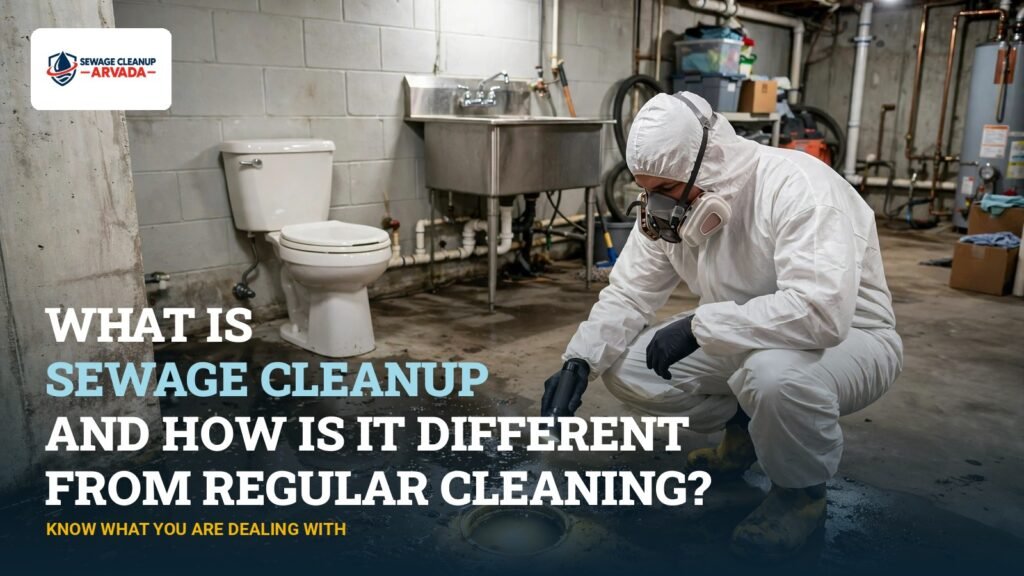
A mop, a bucket, and a spray bottle handle most messes in a house. A sewage backup is not one of those messes. Sewage cleanup is a defined response to contaminated water: it removes the sewage itself, takes out the materials it has soaked into, disinfects what remains, and dries the structure with measurements to prove it. This article explains what sewage cleanup is, what sewage actually contains, and the specific points where regular cleaning stops being enough.
The Short Answer First: What Sewage Cleanup Is
Sewage cleanup is the work of making a space safe again after wastewater has entered it.
That word, safe, is the heart of the definition. A regular cleaning job is finished when a room looks and smells clean. A sewage cleanup in Arvada, Colorado is finished when the contamination is gone, the materials that held it are out, and the structure is measurably dry.
The two jobs share a few tools and almost nothing else.
A Working Definition of Sewage Cleanup
Here is the definition in plain terms.
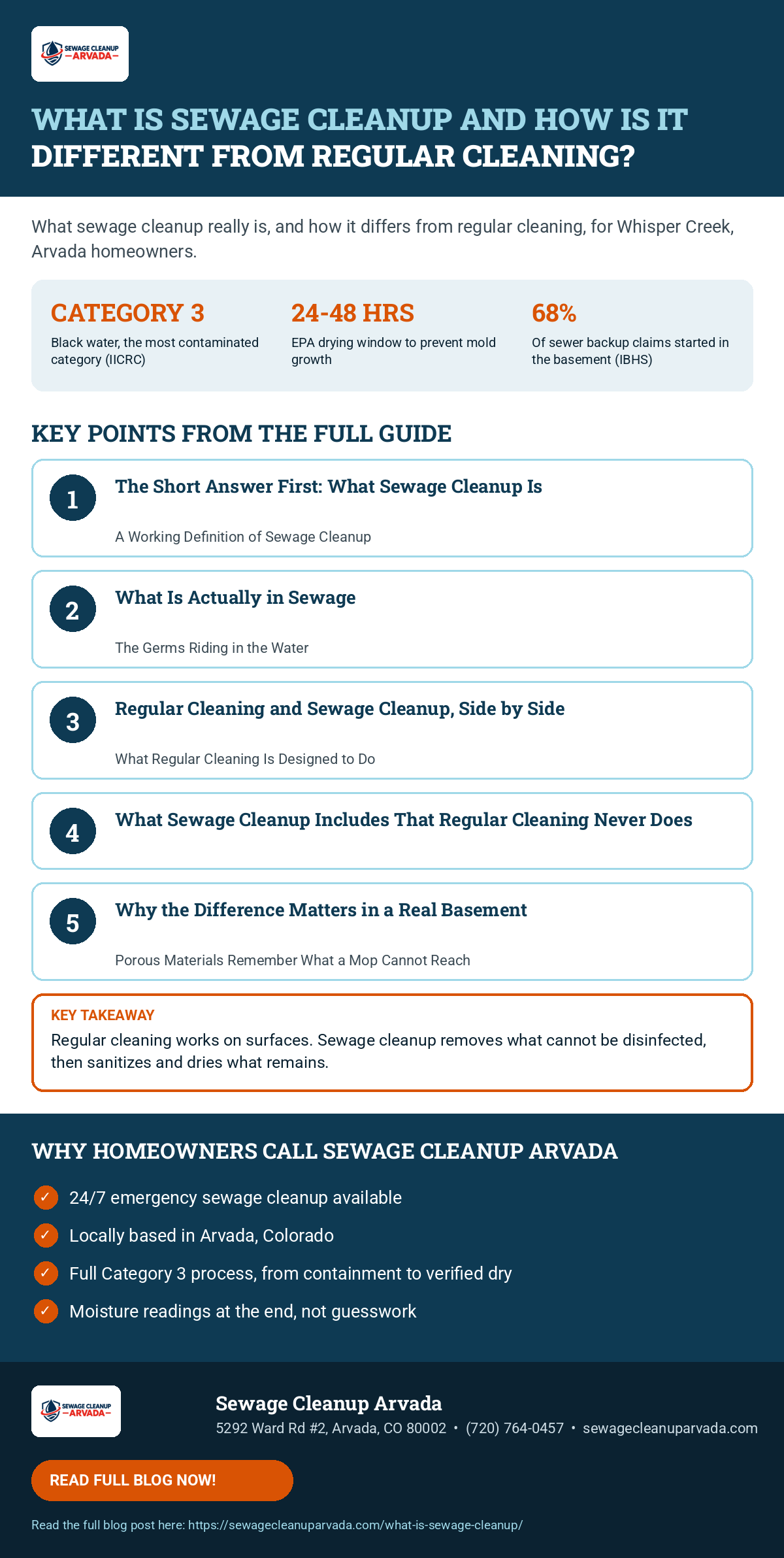
Sewage cleanup is the controlled removal of sewage and contaminated water from a building, the removal of porous materials that sewage has soaked into and cannot be disinfected, the cleaning and disinfecting of the surfaces that remain, and the drying of the structure until moisture readings return to normal levels.
Every part of that sentence earns its place. Controlled means the affected area is sealed off so contamination does not travel. Removal means some things leave the house instead of being wiped down. Drying with readings means the end of the job is verified, not guessed.
When a homeowner in Whisper Creek or anywhere else in Arvada, Colorado searches for sewage cleanup, this is the service the words point to.
Where Sewage in a Home Usually Comes From
Sewage enters a home through the lowest openings first.
A blocked main sewer line pushes wastewater back toward the house, and it surfaces at floor drains, basement toilets, and shower drains. A toilet overflow can send contaminated water across a bathroom floor. A septic system that is full or failing can push sewage back through the same openings.
The source matters less than what arrives. Whatever the path, the water that comes through a drain carries the contents of the sewer line with it, and it is handled as contaminated from the first minute.

What Is Actually in Sewage
The difference between sewage cleanup and regular cleaning starts with what is in the water.
Household dirt is mostly inert: dust, soil, grease, food residue. Unpleasant, but not a health hazard in normal contact.
Sewage is different in kind, not just in degree.
The Germs Riding in the Water
Raw sewage carries bacteria, viruses, and parasites from human waste.
It can carry E. coli and other bacteria that cause stomach and intestinal illness. It can carry viruses that survive in water and on surfaces. It can carry parasites that are built to pass from waste into a new host.
It also carries whatever else went down the drains of every home connected to the line: cleaning chemicals, oils, and residues that do not belong on a basement floor or in the air of a living space.
None of this is visible. Sewage that looks like plain dark water carries the same load as sewage that looks far worse, which is why appearance is never the test.
Why Category 3 Changes the Whole Job
The restoration industry sorts water damage into three categories, and sewage sits in the last one.
Category 1 is clean water from a supply line. Category 2 is used water with some contamination, such as water from an appliance. Category 3 is sewage.
Sewage is Category 3 black water, the most contaminated of the three water damage categories defined by the IICRC.
That classification is why sewage cleanup follows hazard rules instead of housekeeping rules. It decides the protective gear, the containment, the removal of porous materials, and the level of disinfection the job requires.
A Whisper Creek homeowner does not need to memorize the categories. Knowing that sewage sits at the top of the scale is enough to understand why the response looks the way it does.
Regular Cleaning and Sewage Cleanup, Side by Side
Put the two jobs next to each other and the differences line up clearly.
Regular cleaning works on surfaces, assumes the mess is safe to touch, and ends when things look clean. Sewage cleanup works on a contaminated area, assumes the mess is hazardous, and ends when measurements say the space is clean and dry.
Four differences carry most of the weight.
What Regular Cleaning Is Designed to Do
Regular cleaning is built for ordinary soil.
Soap and household cleaners lift dirt and grease from hard surfaces. A vacuum picks up dry debris. A mop spreads cleaner across a floor that is safe to stand on.
All of it assumes the person cleaning can touch the mess, breathe the air, and carry the bucket through the house without spreading anything dangerous. Those assumptions hold for a muddy footprint. They fail completely for sewage.
Difference One: The Goal Is Safety, Not Appearance
A cleaned kitchen floor is done when it shines. A sewage affected basement is not done when it shines, because the hazard was never the appearance.
The goal of sewage cleanup is a space where the contamination is actually gone: the sewage removed, the soaked materials out, the remaining surfaces disinfected, and the structure dry. Appearance is a byproduct. Safety is the deliverable.
This is also why a room can look perfectly fine after a wipe down and still fail every part of the real test.
Difference Two: The Gear and the Boundary
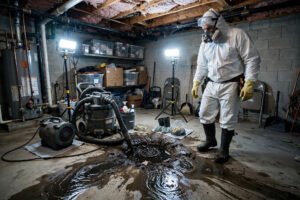
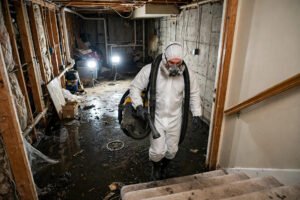
Sewage cleanup begins with full protective gear: a protective suit, a respirator, gloves, and boots, worn by everyone who enters the area.
It also begins with a boundary. The affected area is sealed off from the rest of the home so that foot traffic, air movement, and equipment do not carry contamination into clean rooms.
Regular cleaning has no boundary, because it does not need one. Dirt on a mop is a nuisance. Sewage on a shoe, tracked across a hallway carpet, is a second contaminated area.
Difference Three: Some Things Are Removed, Not Wiped
Cleaning treats every surface as saveable. Sewage cleanup does not.
Porous materials hold contamination inside themselves. Carpet padding, drywall, insulation, and upholstered items that sewage has soaked into cannot be disinfected reliably, because no surface treatment reaches what is inside them. They are removed and disposed of as contaminated waste.
Hard surfaces are the other side of the line. Concrete, tile, sealed stone, metal, and glass can be cleaned and disinfected in place. The judgment between the two groups is a core part of what sewage cleanup is.
Difference Four: Clean Is Measured, Not Assumed
Regular cleaning ends on a judgment call. Sewage cleanup ends on readings.
After cleaning and disinfecting, the structure is dried with air movers and dehumidifiers, and moisture levels in walls and floors are checked with meters. The job closes when those readings match the dry parts of the home.
That short window is part of the definition too. A cleanup that leaves a structure damp for a week has traded contamination for mold, which is why drying is built into sewage cleanup rather than left as an afterthought.
Difference Five: What Happens to What Comes Out
Regular cleaning produces a bag of trash and a bucket of dirty water, both poured or thrown away without a second thought.
Sewage cleanup produces contaminated waste. The sewage itself, the removed padding and drywall, and the water used during the work are all handled as hazardous material, bagged and taken out through the sealed area rather than carried through clean rooms.
That difference sounds like paperwork. It is not. It is the step that decides whether the contamination leaves the house or simply relocates to a hallway, a garage, or a kitchen sink on its way out.

What Sewage Cleanup Includes That Regular Cleaning Never Does
With the differences clear, the contents of the job itself are easier to place.
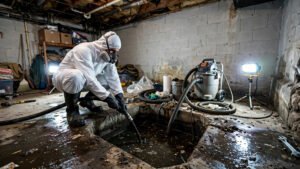
Sewage cleanup includes containment of the affected area. It includes extraction of standing sewage with industrial equipment, not buckets. It includes the removal and safe disposal of porous materials that cannot be disinfected. It includes cleaning first and disinfecting second, in that order, because disinfectant spent on surface soil does far less work on the germs beneath it. It includes odor treatment at the source, and structural drying that ends with moisture readings.
None of those elements appear in regular cleaning, because regular cleaning was never designed for a hazardous material.
For homes in Whisper Creek arranging sewage cleanup help, this list is the practical meaning of the term: not a deeper version of house cleaning, but a different job altogether.
Why the Difference Matters in a Real Basement
Definitions matter most where the water lands, and in homes it lands in the basement more than anywhere else.
According to the Insurance Institute for Business and Home Safety, 68 percent of all drain system sewer backup claims started in the basement.
Basements hold the lowest drains in the house, and many Arvada, Colorado basements are finished living space: carpet, drywall, insulation, furniture, and stored belongings, all of them porous, all of them at floor level where sewage arrives first.
That combination is exactly where the gap between cleaning and cleanup does its damage.
Porous Materials Remember What a Mop Cannot Reach
A mop moves across the surface of a floor. Sewage moves into the floor, under it, and up the base of the wall behind it.
Carpet padding holds contaminated water against the slab. Drywall wicks moisture upward past the visible line. Insulation inside the wall stays wet long after the room feels dry.
Treating those materials as a cleaning problem leaves the contamination in place, sealed inside the structure of the home. Treating them as a cleanup problem takes them out, which is the entire point of the distinction.
Finished Rooms Versus Bare Concrete
The size of this gap depends on the room the sewage reaches.
A backup across a bare concrete floor in an unfinished utility area is the simplest version of the job: extraction, cleaning, disinfection, and drying, with little or nothing porous to remove.
The same backup in a finished basement is a larger event by far. Carpet, padding, drywall, insulation, and furniture are all in the water at once, and each one has to be judged, and most of them have to come out.
Both events carry the same Category 3 label. The definition of the response stays the same. Only the amount of material inside the boundary changes.
The Smell Is a Symptom, Not the Problem
Homeowners often judge a backup by the smell, and the smell is real. Sewage odor is strong, and it lingers.
But odor is a sign of a source, not the source itself. When the smell survives a wipe down, it usually means contamination remains: residue in a drain, moisture inside a wall base, or a porous item that should have come out.
Sewage cleanup removes the source. Regular cleaning, at its best, perfumes it for a few days.

Sewage Cleanup in Whisper Creek, Arvada, Colorado
Whisper Creek sits in northwest Arvada, Colorado, near Whisper Creek Park, with many homes reached from Indiana St and W 86th Pkwy.
The neighborhood mix includes newer homes with finished basements, the exact layout where a backup does the most quiet damage. A finished basement hides the travel paths of water behind drywall and under carpet, so the visible puddle is often the smallest part of the event.
Knowing what sewage cleanup is, before one is needed, changes the first hour. The safe steps are simple: stop using water and drains, keep people and pets away from the affected area, treat electricity as a hard boundary, and take photos and notes from dry ground.
Homeowners who have read through how to prepare your home before the sewage cleanup crew arrives tend to have a calmer first hour, because the preparation is mostly about protecting the clean parts of the home and leaving the contaminated parts alone.
Who This Matters For in Arvada, Colorado
Homeowners come first, because they live with both the health question and every decision that follows a backup.
Rentals, condos, and HOA-managed properties come next. A tenant usually finds the water, while an owner or manager arranges the response, and a shared definition of sewage cleanup keeps that conversation clear: what will be removed, what will be disinfected, and how dryness will be proven.
Commercial properties follow, and they are never left out. Restaurants, retail spaces, offices, and multifamily buildings across Arvada, Colorado deal with the same Category 3 water, and the same definition applies at a larger scale.
The full range of sewage cleanup services is built on this definition, scaled to the space involved.
Sewage Cleanup Arvada Serving the Whisper Creek Community and Beyond in Arvada
Sewage Cleanup Arvada serves the Whisper Creek community in Arvada, Colorado, near local landmarks like Whisper Creek Park, for homes close to the crossing of Indiana St and W 86th Pkwy, at coordinates 39.85678, -105.15807.
Get Sewage Cleanup Whisper Creek Service Now
Navigate from Whisper Creek to Sewage Cleanup Arvada Now
Frequently Asked Questions About Sewage Cleanup in Arvada, Colorado
What is sewage cleanup in simple terms?
It is the process of making a space safe after sewage has entered it: removing the sewage and contaminated water, taking out porous materials that cannot be disinfected, cleaning and disinfecting the surfaces that remain, and drying the structure until moisture readings are normal.
Is sewage cleanup the same as deep cleaning?
No. Deep cleaning is still regular cleaning, aimed at dirt and surface germs in a space that is safe to be in. Sewage cleanup is a response to Category 3 black water, with protective gear, containment, removal of contaminated materials, and verified drying. The goal is safety, not appearance.
Why is sewage called black water?
Black water is the industry term for Category 3 water, the most contaminated category in the IICRC classification. The name marks it as water that carries sewage and a heavy load of bacteria, viruses, and parasites, as opposed to clean water or lightly contaminated gray water.
Can household cleaners make a room safe after a sewage backup?
Household cleaners are made for surface soil on hard surfaces, in spaces that are safe to touch. Sewage soaks into porous materials where surface products cannot reach, and it exposes anyone cleaning to Category 3 contamination. That is why the work is done with protective gear, containment, and removal of the materials that hold the contamination inside them.
What should I do first if sewage backs up into my home?
Stop using water and drains, keep children and pets away from the affected area, and stay out of standing water, especially near outlets or appliances. Take photos and notes from a dry, safe spot, and call for professional sewage cleanup help. Do not try to mop, vacuum, or disinfect the sewage yourself.
Sewage Cleanup Arvada, 5292 Ward Rd #2, Arvada, CO 80002. (720) 764-0457
Hours: Open 24 hours, 7 days a week for emergency service