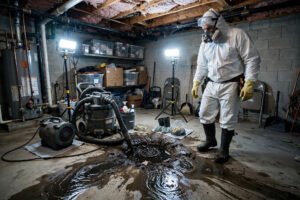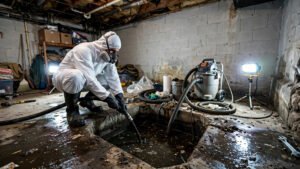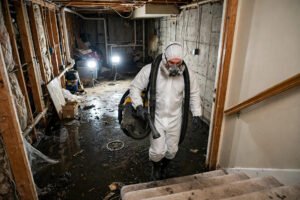

A sewage cleanup is not complete when the room looks clean. It is complete when the tests say so. Professionals verify a finished job three ways: moisture readings compared against a dry standard, a slow visual inspection of every surface and hidden space the sewage reached, and an odor check that treats any returning sewer smell as evidence something was missed. When all three pass, the space is safe to use and safe to rebuild.
Looks Clean Is Not the Same as Proven Clean
The eye is a poor judge of a finished sewage job.
A basement floor can look spotless an hour after cleaning while the base of the wall behind it is still soaked. Paint hides moisture. Concrete hides contamination in its pores. A room can even smell neutral while damp material sits inside a wall cavity, quietly feeding mold.
That gap between looks and reality is exactly why testing exists.
When a crew finishes a sewage cleanup in Arvada, Colorado, the visible work is only half the job. The other half is proving, with instruments and methodical checks, that the contamination is gone and the structure is dry. A homeowner who understands the tests can tell the difference between a crew that cleaned and a crew that verified.
None of the tests are exotic. What makes them professional is that they are done in order, at every point the water reached, and written down. Skip any one of them and a specific doubt stays behind: skip the meter and the doubt is moisture, skip the inspection and the doubt is residue, skip the odor check and the doubt is a source nobody found.
Why Sewage Raises the Bar for Sign-Off
Not all water damage is judged by the same standard.
The IICRC (Institute of Inspection, Cleaning and Restoration Certification) sorts water into three categories, and sewage sits in the most serious one.
Sewage is Category 3 black water, the most contaminated of the three water damage categories defined by the IICRC.
Category 3 water carries bacteria, viruses, and parasites. So the sign-off for a sewage job has to answer two questions, not one. Are the surfaces actually clean? And is the structure actually dry?
A clean water leak only has to pass the second test. A sewage cleanup in Arvada, Colorado has to pass both, everywhere the water went.
The Dry Standard: The Number Every Reading Is Compared Against
Moisture testing starts with a step most homeowners never see.
Before judging any wet material, the technician measures the same material somewhere it never got wet: the same drywall upstairs, the same framing in an unaffected room. That reading becomes the dry standard for the house.
Every later reading is compared against it.
This matters because there is no single magic number that means dry. Wood, drywall, and concrete each hold different normal moisture levels, and those levels shift with the season and the home. A wall is dry when it reads like the dry walls in the same house, not when it hits a number from a chart.
Pin Meters, Pinless Meters, and What Each One Finds
Two meter types do most of the work.
Pin meters push two small probes into wood or drywall and measure moisture at that exact depth. They answer a precise question about a precise spot.
Pinless meters scan a wider area without leaving holes. They are the search tool, sweeping walls and floors to find the wet pockets the pin meter then confirms.
Crews also track the air itself with a hygrometer, because drying is finished only when the room air and the materials agree. A wall can read dry at the surface while humid air keeps the cavity damp, and the combination of readings catches that.
Where the Readings Are Taken
Readings follow the water, not the room layout.
Wall bases get checked along their full length, because sewage wicks sideways as well as up. Corners and the lowest points of a slab get extra attention, since water settles there. Readings are taken below and beside any wall section that was opened, and around floor drains, pipe penetrations, and the base of built-in cabinets.
In an Olde Town Arvada home with a finished basement, that grid can run to dozens of points. Each one gets recorded, not just glanced at.
The points are marked as they are taken, usually on a simple sketch of the room or noted along the wall base. That map is what makes the final visit meaningful: the crew returns to the same points, in the same spots, so the last set of readings can be compared line by line with the first.
Moisture Readings Over Time, Not One Quick Check
A single dry reading proves very little.
Drying is verified as a trend. Readings are taken when drying equipment is placed, again during the drying period, and again at the end. The numbers should fall steadily and then level out at the dry standard.
That is why the first readings happen fast, on the first visit. The drying clock and the testing clock start together.
If a reading stalls while the others fall, the crew treats it as a clue, not an inconvenience. A stubborn number usually means a hidden wet pocket, and the response is to open, redirect airflow, or extend drying until that point joins the trend.

The Visual Inspection: Slow, Close, and Under Strong Light
Meters find moisture. Eyes find what meters cannot.
The visual pass is deliberately slow. The technician works around the room at close range with a strong light held at a low angle, because raking light reveals what flat overhead light hides: thin residue films, faint tide lines where the water level sat, and splatter marks above the line that extraction never touched.
Any mark like that sends the area back for another cleaning pass. It is not debated.
Seams, Baseboards, and the Floor Edge
Residue survives in the same places every time.
It collects where the floor meets the wall, inside the seams of sheet flooring, around the base of fixtures, and behind baseboards that were left in place. These edges are checked one by one, because a clean open floor means nothing if the perimeter still carries contamination.
Baseboards that trapped moisture behind them are checked at the wall base with the meter as well as the eye, so the two tests back each other up.
Opened Cavities Get Inspected Too
Where drywall or flooring was removed, the inspection goes inside the structure.
Framing, sill plates, and the inside faces of remaining material are examined for residue and read with the meter. A cavity does not get closed up on trust. It gets closed when the inside passes the same checks as the visible room.

The Smell Test: Odor Is Treated as Evidence
It sounds informal. It is anything but.
After cleaning and drying, the crew checks the air in the space at normal standing distance, doors closed, equipment off. A finished sewage job should smell like nothing in particular.
A returning sewer odor is never treated as a nuisance to be masked. It is treated as a test result that failed, and it points somewhere: a drain trap that dried out, residue inside a wall base, or a porous item that should have been removed and was not.
The crew traces it to the source and deals with the source. Fragrance is not a fix, and a professional sign-off never relies on one. If the smell comes back a day after the crew leaves, that is the same failed test arriving late, and it is worth a call.
Surface Checks After Sanitizing
Clean surfaces get one more layer of verification.
The crew re-walks the sanitized area looking for missed spots, streaking, or residue that only shows once the surface dries. Drains and fixtures the sewage passed through get checked again as well, since residue there can keep feeding odor into an otherwise clean room.
Some crews add ATP swab testing at this stage. A swab of the surface is read by a handheld device that detects organic residue, giving a pass or fail number for cleanliness rather than an opinion. It is not required on every job, but where it is used, it turns “looks clean” into a measured result, the same way the moisture meter does for dryness.
Fixtures get the same treatment. Toilets, tubs, sinks, and floor drains in the affected area are checked for residue around their bases and inside their rims, because sewage that passed through a fixture leaves contamination in places a quick wipe never reaches. A job is not signed off while a fixture inside the work area still fails that check.
Basements Get the Closest Look of All
There is a reason the densest testing happens below grade.
According to the Insurance Institute for Business and Home Safety, 68 percent of all drain system sewer backup claims started in the basement.
The basement is where sewage enters first and where it hides best: behind finished walls, under flooring, inside the floor drain, and along the cold joint where the slab meets the foundation.
So basement sign-off includes the slab itself, the floor drain, and the lowest run of every wall, read point by point. In Arvada, Colorado, where so many homes have finished basements, that thoroughness is what separates a verified job from a hopeful one.
What Passing Looks Like: The Sign-Off Itself
When every check passes, the results come together into a simple picture.
Moisture readings sit at the dry standard at every recorded point. The visual pass finds no residue, no tide lines, no missed edges. The air smells neutral with the equipment off and the doors closed.
Only then is the space cleared for normal use, and only then does rebuilding make sense. Drywall closed over a wall that never passed its readings just hides the problem at the exact moment it becomes expensive to reach.
If you want the full picture of the work these tests are checking, this walkthrough of what professional sewage cleanup involves lays out each stage that leads up to the sign-off.
The Paper Trail Behind the Word “Done”
A verified job leaves documents, not just a verbal assurance.
Expect a record of the readings taken, notes on which materials were removed and which areas were checked, and photos from before, during, and after the work. That record protects the homeowner in every later conversation about the property, and it is the crew’s own proof that the tests in this guide actually happened.
If a crew cannot show you any of it, the sign-off was a sentence, not a process.

What a Homeowner Can Safely Check from the Doorway
You do not need instruments to take part in the sign-off, and you should never enter the work area or touch surfaces to test them yourself.
From the doorway, look. There should be no visible residue, no staining lines on walls, and no belongings left sitting in the affected area.
Smell, from the same spot, after the room has been closed for a while. Neutral is the pass mark.
Then ask questions. Ask to see the final readings and what they were compared against. Ask which materials were removed and which cavities were opened and checked. A crew that tested properly answers all of it without hesitation, because the answers are already written down.
What not to do: do not run taps or flush toilets repeatedly to test the line, do not peel back materials to check behind them, and do not move drying equipment before the final readings are taken. Each of those can restart the problem or ruin the measurements.
Red Flags That a Cleanup Is Not Finished
A few signs mean the job ended before the tests did.
The sewer smell returns within a day or two of the crew leaving. Paint starts to bubble or a baseboard swells along a wall that was wet. A musty odor settles into a room that was supposed to be dry.
Or the quieter flags: no readings were ever shared, no one can say what the dry standard was, and the equipment left while walls were still being described as damp.
Any of these is a reason to call the crew back and ask for the verification to be completed properly. With sewage cleanup work, done is a measured state, not a schedule.
Who This Matters For in Arvada, Colorado
Homeowners come first, because they live with the result. A verified cleanup means the family can use the basement again without wondering what is inside the walls.
Rentals, condos, and HOA-managed properties come next. Tenants, owners, and managers all rely on the same sign-off record to show a unit is safe to occupy again, and the documentation settles questions before they become disputes.
Commercial properties follow, and they are never left out. A restaurant, office, or retail space in Arvada, Colorado reopens on the strength of the same tests, with the readings and inspection notes as the evidence.
The full range of sewage cleanup services ends with this same verification approach, scaled to the space involved.
Sewage Cleanup Arvada Serving the Olde Town Arvada Community and Beyond in Arvada
Sewage Cleanup Arvada serves the Olde Town Arvada community in Arvada, Colorado, near local landmarks like Olde Town Square, for homes close to the crossing of Grandview Ave and Wadsworth Blvd, at coordinates 39.79915, -105.08147.
Get Sewage Cleanup Olde Town Arvada Service Now
Navigate from Olde Town Arvada to Sewage Cleanup Arvada Now

Frequently Asked Questions About Sewage Cleanup in Arvada, Colorado
How do professionals know when a sewage cleanup is really complete?
They measure it. Moisture readings across the affected materials match the dry standard taken from an unaffected part of the same home, the visual inspection finds no residue or tide lines, and the air smells neutral with the equipment off. All three checks have to pass.
What moisture level means a wall is dry enough after a sewage cleanup?
There is no single number that fits every home. Professionals compare readings in the affected wall against the same material in a dry part of the house. When the two match, the wall is dry, whatever the actual figure is.
Can a room smell fine and still fail the completion tests?
Yes. Odor is only one of the three checks. Moisture can sit inside a wall cavity or under flooring without producing any smell at first, which is exactly why meter readings and the cavity inspection exist alongside the smell test.
When do the final completion tests happen?
At the end of drying, once readings have leveled out at the dry standard. Drying usually runs for several days with check visits along the way, and the final verification happens before equipment is removed and before any rebuilding starts.
What should I ask for when the crew says the job is done?
Ask for the final moisture readings and the dry standard they were compared against, notes on which materials were removed, and photos of the work. A crew that verified the job properly will already have all of it recorded.
Sewage Cleanup Arvada, 5292 Ward Rd #2, Arvada, CO 80002. (720) 764-0457
Hours: Open 24 hours, 7 days a week for emergency service