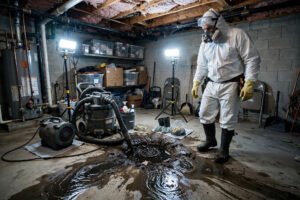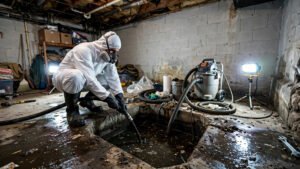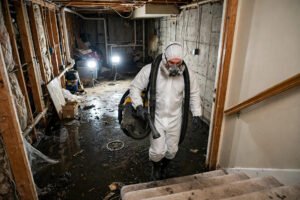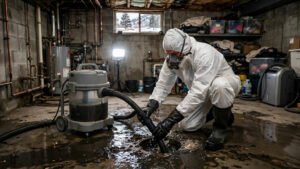

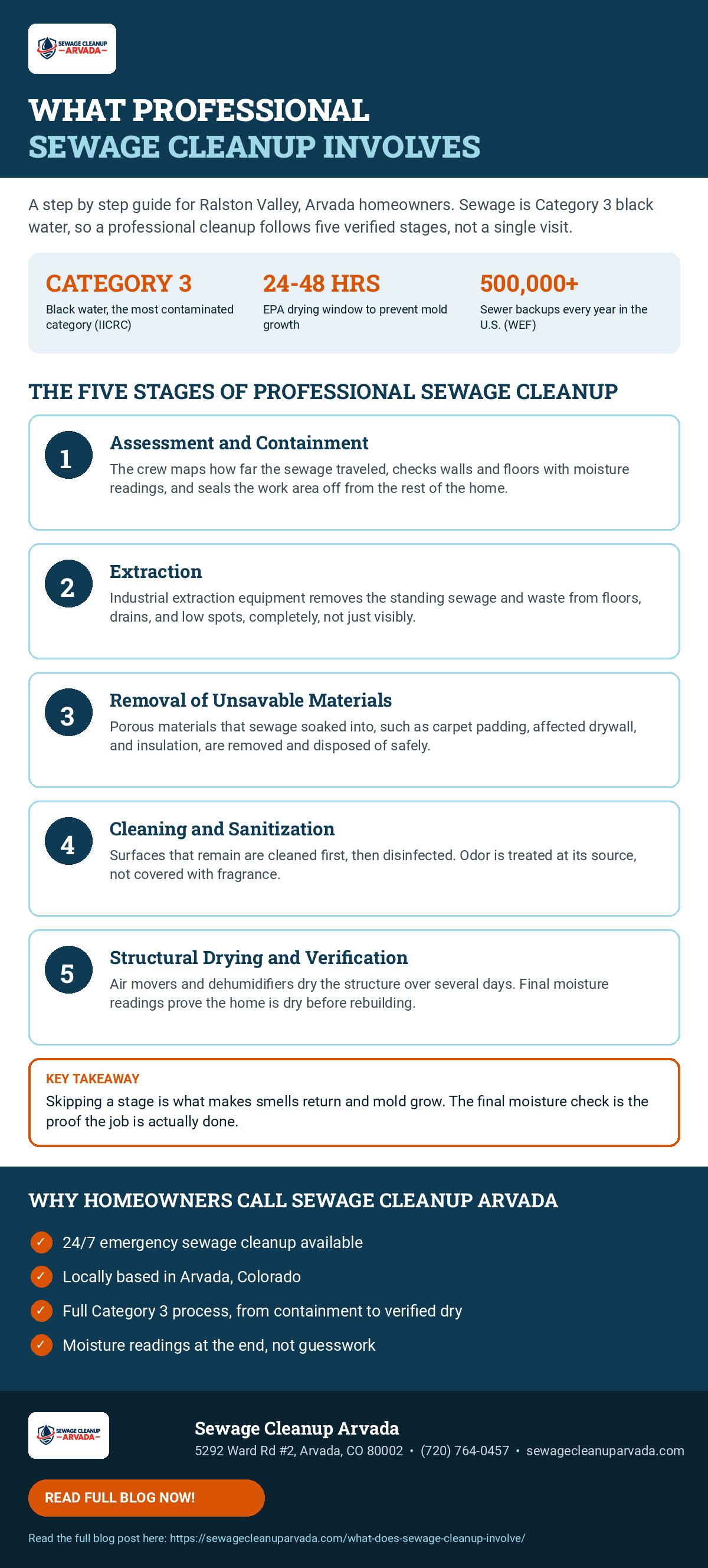
Professional sewage cleanup is a staged process, not a single cleaning visit. It starts with assessment and containment, moves through extraction, removal of contaminated materials, cleaning and sanitization, and ends with structural drying that is verified with moisture readings. Each stage exists because sewage is Category 3 black water, and each stage has to finish before the next one can work.
What Sewage Cleanup Actually Means
The phrase gets used loosely, so it helps to pin it down.
Sewage cleanup means removing contaminated water and waste from a home, removing the materials that sewage has soaked into and cannot be disinfected, cleaning and disinfecting what remains, and drying the structure until measured moisture levels are back to normal.
That is a longer list than most people expect when they picture the job.
It is also why a sewage cleanup in Arvada, Colorado looks nothing like a normal house cleaning, even when the affected area is one basement room.
Cleanup, Removal, and Remediation: Words That Get Mixed Up
Three words appear in almost every search on this topic, and they are not quite the same thing.
Cleanup is the whole job, start to finish. Removal is one part of it: taking out standing sewage and the porous materials it has ruined. Remediation is the broader fix, which includes dealing with the effects of the event, such as contaminated materials, odors, and moisture inside walls.
When a homeowner in Arvada, Colorado searches for sewage cleanup, they usually mean all three, whether or not they know the separate words.
The stages below cover all of them, in the order a professional crew works through them.
Why Sewage Is Not a Normal Cleaning Job
Clean water and sewage sit at opposite ends of the water damage scale.
The IICRC (Institute of Inspection, Cleaning and Restoration Certification) sorts water into three categories. Category 1 is clean water from a supply line. Category 2 is used water with some contamination. Category 3 is sewage.
Sewage is Category 3 black water, the most contaminated of the three water damage categories defined by the IICRC.
That single classification drives the entire process. It is why the crew wears full protective gear, why porous materials come out instead of being wiped down, and why the area is sealed off before work starts.
Sewage can carry bacteria, viruses, and parasites. Anything it soaks into has to be judged against that fact, not against how dirty it looks.
Before the Crew Arrives: What Has Already Happened
A professional job starts before anyone reaches your door.
It starts with the call, the questions, and the equipment decisions that follow from your answers. By the time the crew arrives at a home in Ralston Valley or anywhere else in Arvada, Colorado, the first stage is already planned.
More than 500,000 sewer backups occur each year in the United States, according to the Water Environment Federation.
Backups are common enough that crews follow a set routine for them. What changes from home to home is the size of the affected area, the materials involved, and how far the water traveled.
The Call and the Questions That Matter
On the call, expect to describe what happened in plain terms.
Which drain or fixture backed up first. When you noticed it. Whether the water is still rising or has stopped. Which rooms are affected, and whether the area is a finished space or bare concrete.
Expect questions about safety too. Whether the water reached outlets or appliances. Whether anyone in the home is ill, elderly, or has a weakened immune system. Whether pets are in the house.
Those answers decide what the crew loads onto the truck, so a clear description saves real time later.
What the Crew Brings and Why
The equipment list follows from the stages.
Extraction pumps and hoses for the standing sewage. Containment sheeting and tape to seal the work area. Protective suits, respirators, gloves, and boots for every person who will enter it.
Then the second wave: cleaning and disinfecting agents made for contaminated water, air movers and dehumidifiers for drying, and moisture meters for the checks that close the job.
None of it is decorative. Each item maps to a stage below.
Stage 1: Assessment and Containment
The crew does not start by removing water. It starts by understanding the job.
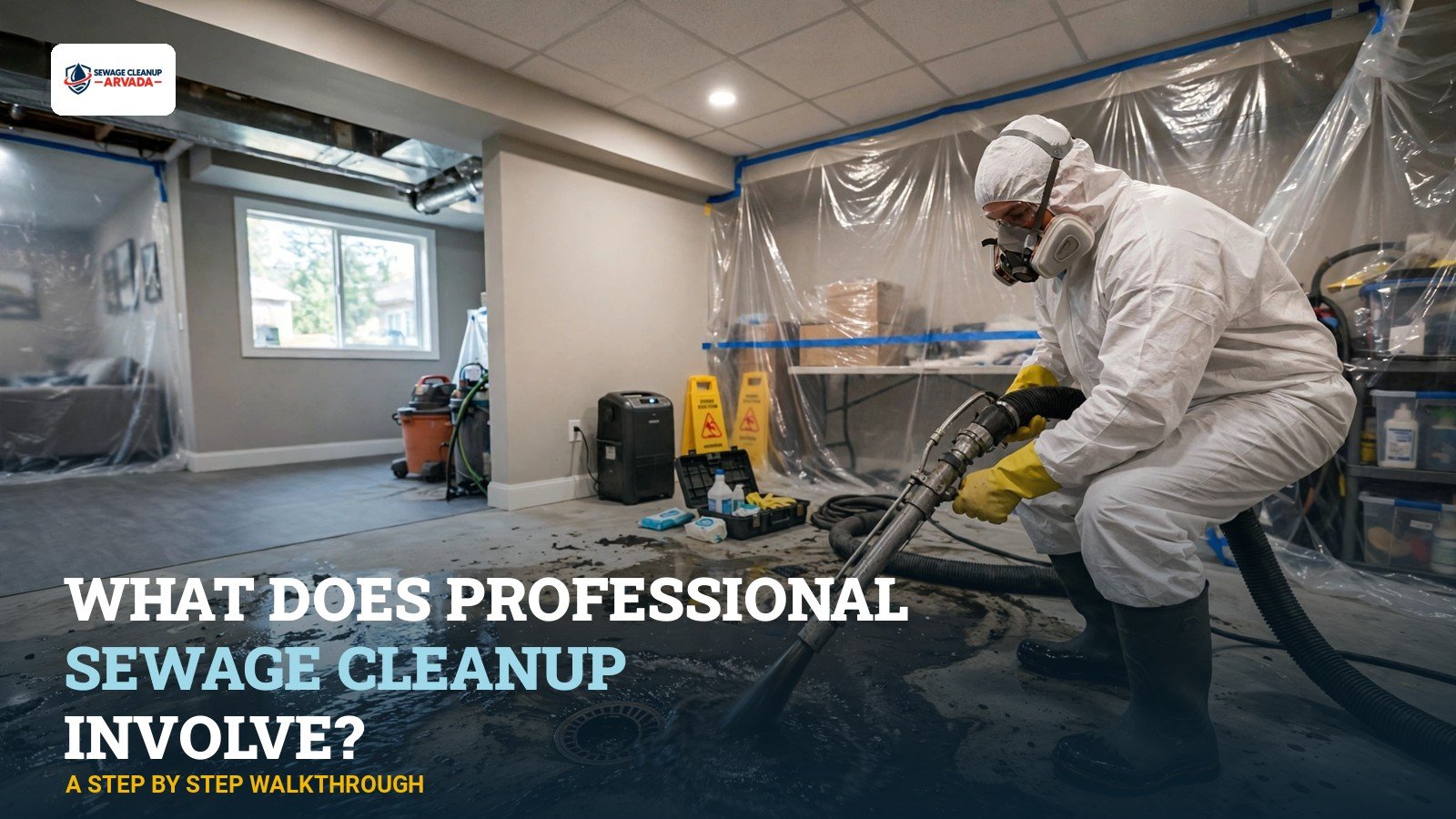
A technician walks the affected area and the rooms around it, looking at where the sewage entered, how far it spread on the surface, and which materials it touched. Floors, baseboards, drywall, insulation, carpet, and stored belongings all get noted.
Then the area is sealed. Plastic containment sheeting closes off the work zone from the clean parts of the home, so that everything that happens next stays inside it.
Finding How Far the Sewage Traveled
The visible puddle is only part of the map.
Sewage wicks upward into drywall and insulation, runs under flooring, and follows the slope of a slab into rooms that look untouched. A floor can look dry two rooms away while the base of the wall between them is soaked.
Assessment means checking those hidden paths, including moisture readings in walls and floors at the edges of the visible damage. The line the crew draws at this stage decides what gets cleaned, what gets removed, and what gets left alone.
In a Ralston Valley basement, that check often reaches further than the homeowner expected, because finished basements hide the travel paths behind drywall and under carpet.
Sealing the Area Off From the Rest of the Home
Containment is the least visible stage and one of the most important.
Without it, every later step risks spreading contamination. Foot traffic carries residue. Air movement carries particles. Hoses and equipment move in and out through doorways.
The sealed zone gives the crew a clean boundary: contaminated items stay in, clean rooms stay clean, and people and pets in the home can use the rest of the house safely while work goes on.
This is also the stage where the crew confirms the source has stopped. Cleaning an area that is still receiving sewage is wasted work, so the line problem behind the backup is confirmed addressed, or at least no longer flowing, before extraction begins.
Stage 2: Extraction of Standing Sewage
With the area assessed and sealed, the standing sewage comes out.
Industrial extraction equipment removes the water and waste far faster and far more completely than any household tool. The goal is not a floor that looks dry. The goal is removing the contaminated liquid itself, including what has pooled in low spots, along wall bases, and inside the floor drain area.
Speed matters here, but completeness matters more. Every hour sewage sits, it soaks deeper into porous materials and the removal list grows.
Why Extraction Comes Before Everything Else
Homeowners sometimes ask why the crew does not scrub first and extract later.
The answer is simple. You cannot disinfect a puddle. Cleaning agents do their work on surfaces, and a surface covered in standing sewage is not reachable.
Extraction also protects the rest of the structure. Liquid sewage keeps spreading and wicking for as long as it sits. Removing it stops the clock on new damage and lets the crew see the true edges of the affected area, often for the first time.
Only after extraction does the real condition of floors, walls, and belongings become clear.
Stage 3: Removal of Materials That Cannot Be Saved
This is the stage homeowners find hardest, and it is the stage that defines professional work.
Porous materials that sewage has soaked into cannot be disinfected reliably. The contamination is inside the material, not on its surface, and no surface treatment reaches it. Those materials are removed and disposed of as contaminated waste.
The removal is surgical, not sweeping. Crews cut and take out only what the assessment and the water line show was reached, and they re-check as they open walls, because the inside of a wall sometimes tells a different story from its surface.
What Usually Has to Come Out
Carpet and carpet padding are at the top of the list. Padding in particular holds contaminated water like a sponge and sits at the top of the removal list on almost every job.
Affected drywall and insulation come out up to above the water line, because both wick moisture upward beyond what the eye can see. Baseboards usually follow, since water collects behind them.
Upholstered furniture, mattresses, and soft stored items that sewage reached are generally removed as well. So are cardboard boxes and paper goods stored on a basement floor, which absorb contamination instantly.
What Can Usually Stay
Hard, non-porous surfaces are the other side of the line.
Concrete floors, tile, sealed stone, metal, and glass can be cleaned and disinfected in place. Structural framing, once exposed, cleaned, and dried, normally stays. Appliances need individual judgment, depending on whether water reached motors, insulation, or controls.
This split is why two homes with the same sized backup can have very different jobs. A backup across a bare concrete floor in an unfinished Arvada, Colorado basement is mostly extraction, cleaning, and drying. The same backup in a finished basement adds a removal stage, because the room itself is built from porous materials.

Stage 4: Cleaning and Sanitization
Once contaminated materials are out, the surfaces that remain get cleaned, then disinfected. The order is deliberate, and reversing it is a common misunderstanding about how this stage works.
Cleaning removes the soil and residue. Disinfecting then treats the cleaned surface. A disinfectant sprayed onto a dirty surface spends itself on the dirt and does far less work on the germs beneath it.
Crews work through the zone methodically: floors, wall bases, exposed framing, fixtures, and any salvageable hard surfaces, with dwell time allowed for the products to do what they are rated to do.
Cleaning First, Disinfecting Second
Think of it as washing before treating, the same logic as washing a cut before dressing it.
This stage also covers the drain area and any fixtures the sewage passed through, since residue there can keep producing odor and contamination long after the floor looks clean.
For homes arranging sewage cleanup help, this is the stage that turns a room from emptied to genuinely clean, and it cannot be rushed without undoing its purpose.
Odor Removal Is Part of This Stage, Not an Extra
A sewage smell that lingers after a backup almost always means a source remains: residue in a drain, contamination inside a wall base, or a porous item that should have come out.
That is why odor work belongs inside the cleaning stage rather than after it. Proper sanitization of every reached surface, plus removal of the materials that hold odor, is what ends the smell. Covering it with fragrance does not, and the smell returns within days when the source is still present.
Homes that still smell a week after a cleanup usually skipped something in this stage or in the removal stage before it.
Stage 5: Structural Drying and Moisture Verification
The room now looks clean. It is not finished.
Walls, framing, subfloor, and concrete hold moisture that the eye cannot see, and damp building materials are an open invitation to mold. The drying stage runs air movers and dehumidifiers in a planned layout, moving air across wet surfaces and pulling the moisture out of the air as it evaporates.
Drying is measured in days, not hours, and it ends with readings, not opinions.
That window is the reason cleanup and drying are treated as one continuous job. A perfectly cleaned basement that stays damp inside its walls has traded one problem for another.
Why Fans Alone Are Not Drying
A household fan moves air. It does not remove moisture from the room, and on a contaminated or just-cleaned surface, uncontrolled airflow can push particles where they do not belong.
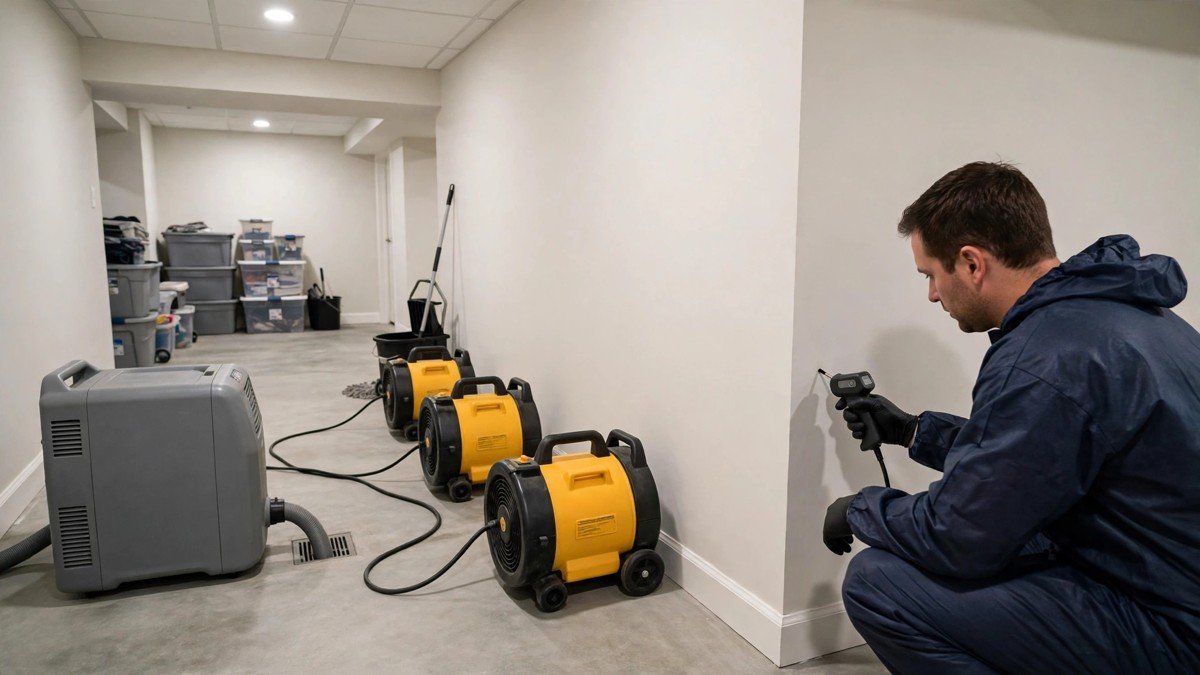
Professional drying pairs air movement with dehumidification and containment, so moisture leaves the structure and then leaves the air, instead of relocating into the next room. Equipment placement follows the moisture map from the assessment, and readings are taken again as drying progresses to confirm the plan is working.
If readings stall, the layout changes or a hidden wet pocket gets opened. The numbers lead.
The Final Moisture Check
The job closes with verification.
The crew takes moisture readings across the previously wet materials and compares them with readings from unaffected parts of the home. When the numbers match normal levels, the structure is dry, and the family can use the space again with the problem actually behind them.
This final check is the difference between a cleanup that was performed and a cleanup that was proven. It is worth asking any crew how they verify dryness, because “it feels dry” is not a measurement.
How Long the Whole Process Usually Takes
Homeowners ask this on almost every call, and the honest answer is that the stages have different clocks.
Assessment, containment, and extraction usually happen on the first visit. Removal and sanitization follow in the same visit or the next, depending on how much material is involved.
Drying is the long stage. Several days of equipment running is normal, with short check visits for readings. Rebuilding what was removed, such as drywall and flooring, is a separate step that starts only after the final moisture check passes.
What stretches a timeline is rarely the cleaning. It is how far the sewage traveled before the first call, which is why the warning signs you need professional sewage cleanup are worth knowing before a small problem becomes a five-stage job.
What a Homeowner Should and Should Not Do During the Process
Your part of this process is small, and it is mostly about not adding to the problem.
Do keep people and pets out of the sealed area. Do keep water use paused or limited as the crew advises, since every flush still travels through the same line. Do ask questions at each stage; a good crew explains what is happening and why.
Do not enter the work zone to retrieve belongings. Do not move drying equipment, switch it off, or open the containment to peek. Do not pour bleach or chemicals into drains or onto floors in the work area; it interferes with the crew’s products and does not disinfect a structure.
And do not throw away damaged items before they are documented. Photographs and a simple list protect you in every conversation that follows a backup.
Who This Matters For in Arvada, Colorado
Homeowners come first, because they carry the health risk and every decision the process involves.
Rentals, condos, and HOA-managed properties come next. A tenant usually finds the backup, while an owner or manager arranges the response, and a clear description of the stages helps everyone understand what will happen inside the property and how long it will take.
Commercial properties follow, and they are never left out. Restaurants, retail spaces, offices, and multifamily buildings across Arvada, Colorado run through the same five stages, with containment mattering even more when part of a building stays open during the work.
The full range of sewage cleanup services follows this same staged approach, scaled to the space involved.
Sewage Cleanup Arvada Serving the Ralston Valley Community and Beyond in Arvada
Sewage Cleanup Arvada serves the Ralston Valley community in Arvada, Colorado, near local landmarks like Ralston Central Park, for homes close to the crossing of W 64th Ave and Simms St, at coordinates 39.8127, -105.12844.
Get Sewage Cleanup Ralston Valley Service Now
Navigate from Ralston Valley to Sewage Cleanup Arvada Now
Frequently Asked Questions About Sewage Cleanup in Arvada, Colorado
What does professional sewage cleanup involve, in short?
Five stages: assessment and containment, extraction of the standing sewage, removal of porous materials that cannot be disinfected, cleaning and sanitization of what remains, and structural drying that ends with moisture readings. Each stage prepares the next, and skipping one weakens the rest.
How long does sewage cleanup take from start to finish?
The first stages usually happen on the first visit: assessment, containment, extraction, and most removal. Drying is the long part and normally runs for several days with check visits, and rebuilding starts only after the final moisture check passes.
Can I stay in my home during a sewage cleanup?
Usually yes, outside the sealed work area. Containment exists so the rest of the home stays usable. If the backup is extensive, or if water reached electrical systems, the crew may advise staying elsewhere until those risks are cleared.
Why does some of my flooring or drywall have to be removed?
Because sewage soaks into porous materials, and contamination inside carpet padding, drywall, or insulation cannot be disinfected reliably from the surface. Hard surfaces such as concrete and tile are cleaned and disinfected in place instead.
What should I do while waiting for the crew to arrive?
Stop using water and drains, keep people and pets away from the affected area, and take photos and notes from a dry, safe spot. Do not try to mop, vacuum, or disinfect the sewage yourself, and do not discard damaged items before they are documented.
Sewage Cleanup Arvada, 5292 Ward Rd #2, Arvada, CO 80002. (720) 764-0457
Hours: Open 24 hours, 7 days a week for emergency service