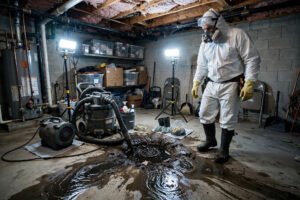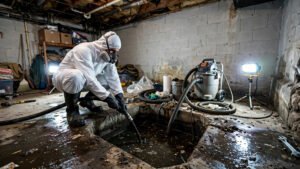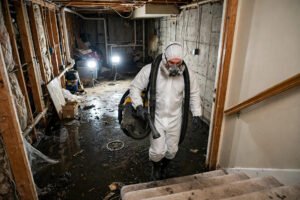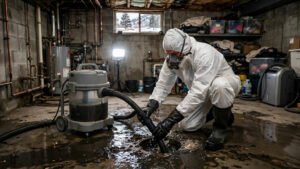

A toilet overflow looks like a one room problem. It rarely is. Sewage that comes up through a toilet follows gravity, flooring seams, and time, and it can end up under tile, inside the subfloor, down a wall cavity, and in the room below while the bathroom floor is the only place that looks wet. This guide explains how far contamination from a toilet overflow actually spreads in a Denver, Colorado home, what decides the distance, and how professionals find the true edge of it.
The Short Answer First
Most of the spread happens out of sight.
The water you see on the bathroom floor is the smallest part of the map. The larger part is the moisture and contamination that moved under the flooring, wicked into the base of the walls, and drained down to whatever sits below that bathroom.
Two overflows that look identical on the surface can have very different footprints underneath. A ten minute overflow onto old grout lines is not the same event as an overflow that ran while nobody was home.
That is why any honest answer to “how far does it spread” starts with the same sentence: it depends on the floor, the walls, and the clock, and it has to be measured, not guessed.
It also depends on the building. A ground floor bathroom over a concrete slab spreads differently from a second floor bathroom over a finished living room. Denver, Colorado homes include both, plus everything between, which is why this guide walks through each path the water takes instead of offering one tidy number.
What Spread Really Means: Surface, Soak, and Seep
Spread happens in three ways at once.
Surface spread is the puddle itself, the part anyone can see. It moves across the floor toward the lowest point, which is often the door, a floor vent, or the gap around the toilet base.
Soak is what porous materials pull in. Grout, wood, drywall, and insulation absorb contaminated water and hold it, and the contamination goes wherever the water goes.
Seep is the slow travel through seams and openings: grout lines, the joint between the tub and the floor, the hole cut for the toilet flange, and the penetrations where pipes pass through the floor.
A cleanup that only addresses the surface layer leaves the soak and the seep behind. That is the whole reason this topic deserves a full explanation.
Why Water From an Overflowed Toilet Counts as Sewage
It is tempting to treat a toilet overflow as dirty water. It is not dirty water. It is sewage that came back up the drain line instead of going down it.
Whatever was in that line came with it: waste, paper, and the bacteria and viruses that live in a sewer system. The origin of the water does not change because it arrived through a clean looking porcelain fixture.
Sewage is Category 3 black water, the most contaminated of the three water damage categories defined by the IICRC.
That category is the lens for everything below. It is why the spread distance matters so much, and why the area a crew treats is always larger than the area that looked wet.
What Is Actually in That Water
Sewage carries bacteria, viruses, and parasites. Contact with it can make people sick, and the risk is higher for children, older adults, and anyone with a weakened immune system.
This is also why the safe response to an overflow is distance, not a mop. Keep people and pets out of the room, stop using water elsewhere in the home so the line is not loaded further, and treat any outlet or appliance the water reached as a hard electrical boundary.
Document the scene with photos from the doorway, standing on dry ground. Then let professionals measure the rest.
Where the Water Goes in the First Minutes
The first minutes set the shape of the whole problem.
Water leaving a toilet bowl takes the fastest paths available. It sheets across hard flooring, pools against the tub and vanity, and starts working into every seam it crosses.
Across the Floor and Straight for the Seams
Tile feels waterproof. A tile floor is not a sealed surface. The grout lines between tiles are porous, they crack with age, and each one is a doorway into the layers below.
Vinyl and laminate behave differently but fail in their own way. Water finds the seams between planks and the edge where the flooring meets the wall, then travels underneath across a wide area while the top still looks mostly dry.
Even the toilet itself is an entry point. The wax ring that seals the toilet to the flange can let overflow water slip beneath the base, where it soaks the subfloor around the flange in a ring nobody can see from above.
Under the Vanity, the Tub, and the Door
Bathroom fixtures hide spread.
Water runs under a vanity cabinet and sits against its base for hours. It slips under the tub apron. It crosses the threshold into the hallway because doorways are rarely sealed, and the flooring on the other side often drinks it in faster than tile does.
By the time a homeowner in Denver, Colorado has stopped the water, the footprint under the floor is usually wider than the wet patch on top of it. The visible room is the start of the map, not the whole map.

Inside the Floor: The Spread Nobody Sees
Once water gets under a finished floor, it keeps moving.
It spreads through the underlayment, along the subfloor, and into the joist bays below. Wood subfloor swells as it absorbs contaminated water, and that absorption carries the contamination with it, inch by inch, away from the bathroom.
How Far Under Tile, Vinyl, and Wood
There is no fixed number of feet, and anyone who gives one without measuring is guessing.
What is known is the pattern. Water travels until it runs out, hits a barrier, or soaks in fully. On a flat subfloor it can travel well past the bathroom walls, following the slope of the building and the seams of the subfloor panels.
Finished flooring slows the discovery, not the travel. A floor can feel solid and dry underfoot while the layer beneath it is saturated.
Down Is the Other Direction: The Room Below
Gravity always collects its share.
Water that reaches a pipe penetration or a seam in the subfloor drips into the ceiling of the room below. From there it spreads across the top of that ceiling, stains it, and soaks the drywall from behind.
This is why a bathroom overflow on an upper floor so often becomes a two story problem. The ceiling stain downstairs is frequently the first visible sign that the spread went further than the bathroom.
According to the Insurance Institute for Business and Home Safety, 68 percent of all drain system sewer backup claims started in the basement.
Water that starts at a toilet and water that ends in a basement are the same story told at two heights: sewage and the moisture it carries always finish at the lowest point they can reach.
Into the Walls: Wicking Raises the Line
Walls spread contamination upward.
Drywall and insulation wick moisture the way a paper towel wicks a spill. Contaminated water at the base of a wall climbs into the drywall above the visible line, and it carries contamination into material that never touched the puddle directly.
Baseboards hide this completely. The wall can be wet several inches up behind a baseboard that looks clean and dry, which is why professionals check behind them instead of trusting the surface.
In a Denver, Colorado home with a finished bathroom, the wall check often extends the treated area further than the floor check does. The two maps rarely match, and the wall map usually wins.
Room to Room: How Clean Areas Get Involved
Contamination also travels on feet, paws, and objects.
Someone walks from the bathroom to the kitchen for towels, and the hallway and kitchen now carry residue. A bath mat gets carried to a laundry basket in another room. A pet crosses the wet floor and then crosses the house.
This tracked spread is smaller than the hidden spread, but it is real, and it is the reason crews seal the work area and ask that the bathroom stay empty until they arrive.
Odor travels too, and it confuses people. A sewer smell in a room does not prove contamination is in that room, because odor moves with air. A room can also be contaminated with little smell at all. Smell is a clue to investigate, never a measurement of the boundary.
Bath Mats, Towels, and the Small Carriers
The most ordinary objects do the carrying.
A bath mat soaked at one corner gets hung over the tub, then moved to a laundry room. Towels used in the first confused minutes end up in a hamper in a bedroom. A mop gets rinsed in a kitchen or laundry sink, moving contamination to a second fixture and a second drain.
None of this is carelessness. It is what people do in the first five minutes of a disgusting surprise. It is also why crews ask what was used, what was moved, and where those items are now, and why the safest first move is to touch as little as possible and leave the room as it is.
Anything that touched the water, including shoes worn into the room, stays at the boundary until the crew can judge it. That one habit limits tracked spread more than any other.

Time Is the Multiplier
Every factor above gets worse with one ingredient: time.
In the first hour, most of the damage is still near the surface. Given a day, soak and seep have done their work in the subfloor and the walls. Given several days, the moisture problem has opened the door to mold on top of the contamination problem.
This is the practical meaning of spread. The distance contamination travels is not fixed at the moment of the overflow. It keeps growing until the water is extracted and the structure is dried, which is why the response window matters more than the size of the first puddle.
What a Weekend Away Can Do
The extreme case makes the rule plain.
An overflow that starts on a Friday in an empty house runs its full course: the bowl empties and refills issues aside, the water spreads across the bathroom, under the flooring, down the wall bases, and into the room below, and then it sits. By Monday, the map is the whole lower structure of that bathroom, and the mold clock has been running for days.
Compare that with the same overflow caught in ten minutes by someone at home. The water barely leaves the tile. Same toilet, same line, completely different cleanup, and the only variable was time.
Nobody plans an overflow, of course. The practical takeaway is smaller: when one happens, the hours before the call matter as much as anything the crew does after it.
How Professionals Find the True Edge
A professional sewage cleanup visit after a toilet overflow is built around one question: where did it actually go?
The crew starts with the visible area, then works outward with moisture meters, checking the floor at intervals, the base of every wall the water could have reached, and the ceiling and walls of the room below.
Readings, not appearances, draw the line. Dry looking material that reads wet joins the treated area. Material beyond the line that reads dry is left alone.
The toilet is usually lifted as part of this work, because the flange and the subfloor beneath the base are prime hidden spread points that cannot be checked any other way.
What gets removed follows the same map. Porous material the sewage soaked into, such as affected drywall, insulation, and flooring layers that cannot be disinfected, comes out. Hard surfaces that can be cleaned and disinfected stay, and everything is dried and re-read before the job closes.
What To Do While the Water Is Still There
Your role is short and specific.
Stop using water in the home so nothing more travels through the line. Do not flush the toilet again to test it; a test flush is how a small overflow becomes a large one.
Keep children and pets completely out of the bathroom and the hallway it touched. If the water reached an outlet, a cord, or an appliance, stay clear of that spot and treat it as an electrical boundary, not a cleaning task.
Take photos from the doorway for your records. Note when the overflow started and whether the toilet has overflowed before, because a repeat overflow points at the line, not the fixture.
The fuller checklist of how to prepare your home before the sewage cleanup crew arrives covers the rest of the waiting period, step by step.

Who This Matters For in Denver, Colorado
Homeowners face this first, because an overflow in their bathroom is their floor, their walls, and their call to make.
Rentals, condos, and HOA-managed properties come next. The person who finds the overflow is often a tenant, while the decision and the access belong to an owner or a manager, and shared walls and floors mean one unit’s overflow can become the unit below’s ceiling problem.
Commercial properties follow, and they are never left out. A restroom overflow in a Denver, Colorado restaurant, office, or retail space carries the same spread pattern with far more foot traffic tracking it, which is why those spaces close the area first and ask questions later.
In every case the logic is identical. The visible puddle is the beginning of the question, and the measured map is the answer. The full range of sewage cleanup services follows that measured approach, from the first reading to the final dry check.
Sewage Cleanup Arvada Serving the Denver Community and Beyond
Sewage Cleanup Arvada serves the Denver community in Denver, Colorado, near local landmarks like Union Station, for homes close to the crossing of E Colfax Ave and Broadway, at coordinates 39.74002, -104.98743.
Get Sewage Cleanup Denver Service Now
Navigate from Denver to Sewage Cleanup Arvada Now

Frequently Asked Questions About Sewage Cleanup in Denver, Colorado
How far can sewage spread from a toilet overflow?
There is no fixed distance. On the surface it may stay inside the bathroom, while underneath it can travel under flooring into adjoining rooms, up into the base of walls, and down into the ceiling of the room below. Only moisture readings draw the real boundary.
Is a toilet overflow really sewage, or just dirty water?
It is sewage. Water that comes back up through a toilet has traveled through the drain line and carries the bacteria, viruses, and waste of that system. It is treated as Category 3 black water, the most contaminated category.
Can I just dry the bathroom with fans and skip the cleanup?
No. Fans move air; they do not remove contamination, and blowing air across a contaminated area before it is cleaned can spread particles into other rooms. The water has to be extracted, contaminated porous material dealt with, surfaces disinfected, and the structure dried and verified.
The water only touched the tile. Why would walls or flooring need to come out?
Because tile floors leak through grout lines and seams, and drywall wicks contaminated water upward behind the baseboard. If readings show sewage soaked into porous material, that material cannot be disinfected reliably and is removed, while hard surfaces are cleaned in place.
What should I do first when a toilet overflows with sewage?
Stop using water in the home, do not flush again to test it, and keep people and pets out of the area. Photograph the scene from dry ground, note when it started, and call for emergency sewage cleanup. Help is available around the clock: Call (720) 764-0457.
Sewage Cleanup Arvada, 5292 Ward Rd #2, Arvada, CO 80002. (720) 764-0457
Hours: Open 24 hours, 7 days a week for emergency service