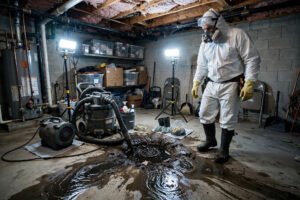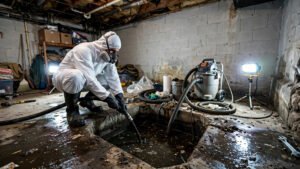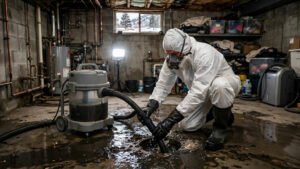

A sewage backup after heavy rain is a capacity event. The storm pushes rainwater into sewer lines that are already carrying everything the neighborhood sends them, and older lines with cracks, offset joints, and roots have no spare room when the load spikes. When the line cannot move the volume forward, it moves it backward, into the lowest drains of the homes connected to it. The sewage cleanup that follows starts with the same rules as any backup: stop using water, keep everyone away from the affected area, and treat every drop as Category 3 black water.
Start Here: Safe Steps While the Rain Is Still Falling
A storm backup has one feature other backups do not: the cause is still arriving.
While rain is falling and the line is surcharged, the situation can worsen on its own. The steps below are about holding the line, literally, until the storm passes and help can work.
Pause Water Use Until the Storm Passes
Every flush and shower adds your home water on top of the storm load the line is already failing to carry.
Pause it all. Tell everyone in the house, out loud, because one unaware laundry load during a surcharge is how a slow floor drain becomes a flooded basement.
Water use can resume once the drains are running clear and the backup has been assessed, not before.
Keep Everyone Away From Affected Drains and Floors
Sewage that arrives with stormwater looks diluted. It is not safer.
It carries the same bacteria, viruses, and parasites as any other sewage, now spread wider by the extra water. Keep children and pets out of affected rooms entirely, and do not walk through standing water to rescue belongings. Items in the affected area can wait for the crew, who cross it in protective gear.
If water has reached outlets, a power strip, or anything plugged in, treat electricity as a hard boundary: stay out of the water and say so when you call.
Document from dry ground. A photo from the doorway records the water line, the affected drains, and the time, which helps the crew judge how the event unfolded.
Watch the Street Before You Decide Who to Call
A storm backup has two possible owners, and the street tells you which one you are dealing with.
If sewage is bubbling from a manhole, standing in the street, or your neighbors on the same line have the same problem at the same time, the city main is surcharging. Call the city utility as well as a cleanup crew, because the main is theirs to relieve.
If the street is quiet and the problem is only inside your home, the cause sits in your line or at your connection, and the cleanup crew is the first call. Either way, the contamination already inside your home is yours to have cleaned, and it needs professionals.

How a Storm Overloads a Sewer Line
Sewer lines are sized for sewage, not for storms. Heavy rain attacks that sizing from two directions at once.
More than 500,000 sewer backups occur each year in the United States, according to the Water Environment Federation.
Storm days account for a heavy share of those events, and the mechanics are simple once they are laid out.
Inflow: Rainwater Finding Its Way Into Sewage Lines
Rainwater is not supposed to enter a sanitary sewer at all. In a hard Front Range storm, it finds the openings anyway.
Cracked cleanout caps, damaged manhole covers, and illegal or aging connections all let stormwater pour in. Groundwater adds a second route, seeping through cracked pipe walls and loose joints along the whole length of a line, a process engineers call infiltration.
Each route is small on its own. Multiplied across every street in a neighborhood during an hour of heavy rain, the extra volume is enormous, and it arrives all at once.
Surcharge: When the Line Carries More Than It Can Move
A surcharge is what happens when the incoming volume passes what the pipe can carry.
The line fills completely, then pressurizes. Flow that should move downhill toward the treatment plant stalls, and pressure looks for relief at the lowest connected points. Those points are the floor drains, tubs, and showers of the homes along the line.
That is why several homes can back up in the same storm while a house one street over, on a different line, stays dry. It is also why a rain backup often eases as the storm ends: the surcharge drains down, even though the contamination it left behind does not.
Snowmelt and Saturated Ground Play the Same Role
Rain is not the only weather that loads a sewer line in Arvada, Colorado.
Spring snowmelt and long soaking rains saturate the ground for days, and saturated soil feeds groundwater into every crack and loose joint along a buried line, hour after hour. The volume arrives more slowly than a storm surge, but it can last far longer, and a marginal line that survives a cloudburst may give up on the third day of melt.
The signs are the same: slow drains, gurgling, and finally sewage at the lowest opening. The calendar changes, the mechanics do not, and neither does the response.
Why Older Lines Fail First
A new, sound line rides out a storm with capacity to spare. An older line starts the storm already compromised, and the rain simply collects the debt.
Cracks, Offset Joints, and Roots Leave No Spare Capacity
Age works on a sewer line from inside and outside at once.
Soil shifts and settles over decades, opening joints and dropping sections out of alignment. Pipe walls crack and corrode. Every opening is both a leak on dry days and an entry point for groundwater and roots on wet ones.
Research published through the U.S. Forest Service links tree roots to more than 50 percent of sewer blockages.
Roots thicken inside the line year after year, narrowing the passage and catching solids. On a dry day the line still copes, barely. In a storm, the narrowed section becomes the choke point where the surcharge turns around and heads back into the house.
Newer Homes Are Not Immune
Neighborhoods like Leyden Rock in Arvada, Colorado are newer, and their household lines are modern. That helps, and it does not settle the question.
A newer home still connects to shared lines that carry the whole street, and those lines collect inflow from every crack and connection along their length. When the shared line surcharges, the pressure does not ask how old the house is. It asks which drains sit lowest, and it finds them.
This is why a Leyden Rock homeowner can do everything right and still meet sewage at the basement floor drain during an exceptional storm. The failure is a system event, and the response has to match that scale.
Storm Sewage Is Still Category 3
Rain dilutes the look of sewage, not its contents.
What comes up through a floor drain during a storm is wastewater mixed with storm inflow, and it carries the same bacteria, viruses, and parasites as a dry weather backup. It is handled as Category 3 black water from the first minute, by a crew in full protective gear, with the same removal and sanitizing standards.
The storm setting adds two complications rather than removing risk. The extra water spreads contamination across a wider area than a fixture backup would, and it pushes moisture into wall bases, flooring edges, and stored items that a smaller event would never reach.
Speed matters for a second reason as well.
The U.S. EPA advises drying water-damaged areas and materials within 24 to 48 hours to prevent mold growth.
That is the practical meaning of U.S. EPA guidance on drying wet materials: after a storm, the drying clock is already running while the rain is still falling.
What a Professional Sewage Cleanup Involves After a Storm
A professional sewage cleanup after a storm follows the same staged process as any other backup: stop and assess, extract, remove and sanitize, then dry and verify.
The storm changes the timing and the footprint, not the standards. For spaces where the water travels under floors and into walls, how sewage cleanup in a crawl space is different shows how much of the work happens in places the homeowner never sees.
Stop and Assess Once the Source Settles
Storm work starts when the surcharge settles. Extracting water while the line is still pressurized means cleaning a room that is still receiving sewage, so the crew confirms the inflow has stopped and water use stays paused until it has.
Then the assessment maps the full footprint: every room the water reached, the materials it soaked, and the path it took through floor drains, tubs, and low openings. Storm events spread wide, and the map has to be wider than the visible puddles.
Extract and Remove What the Water Carried In
Standing water is extracted first, across the whole affected area.
Then the removal stage takes out what the water ruined or contaminated beyond cleaning: soaked carpet and pad, swollen baseboards, saturated soft goods, and debris the storm carried in. Hard surfaces that can be cleaned and disinfected in place are separated from porous materials that cannot, item by item and room by room.

Sanitize, Dry, and Verify With Moisture Readings
Cleaned surfaces are disinfected, and drying equipment goes to work on the structure: floors, wall bases, and any cavities the water entered.
The job closes with moisture readings across the affected area. Storm water travels further than it shows, and a room that looks dry can hold wet material behind a baseboard or under a floor edge. Readings, not appearances, decide when the space returns to normal use, because what happens when sewage cleanup is delayed is mostly a story about moisture left behind.

What Never to Do During a Rain Backup
Do not keep flushing or running water to see whether the line has cleared. While a surcharge lasts, added water joins the backup.
Do not open the cleanout or a drain cover to let the water out into the yard. That moves contamination onto soil and toward storm drains, and it puts you in direct contact with sewage.
Do not pour bleach or chemicals into standing water, and do not mix cleaning products in it. Chemicals do not sanitize sewage, and they add risk for everyone who handles the water afterward.
Do not run fans across a contaminated area to start drying early. Air moving over sewage before cleaning spreads contamination onto clean surfaces.
Do not assume the event is over because the water went down when the rain stopped. The surcharge draining away is the line recovering, not the room. The contamination it left is unchanged.
Lowering the Risk Before the Next Storm
Some storm risk lives in the shared system and cannot be removed from one house. The part that belongs to your line can be looked after.
Keep the cleanout cap secure and intact, because a cracked cap is a direct door for stormwater. Know where your cleanout and floor drains are before you need them in the dark. Take slow drains, gurgling, and sewer odors seriously in dry weather, because those are the warnings a narrowing line gives while there is still time to act on them, and a line inspection in a calm season is a quieter job than a cleanup in a wet one.
After any backup, ask what the crew found about the cause. A storm explains the timing, but roots, cracks, and offsets explain why your house was the one that reported it, and those causes can be addressed before the next storm tests them again.
The full range of sewage cleanup services covers storm backups with the same staged approach, and sewage cleanup in Arvada, Colorado explains how the pieces fit together.
Who This Matters For in Arvada, Colorado
Homeowners come first. A storm backup arrives at their drains, on their floors, and the safe first steps and the cleanup decision start with them.
Rentals and HOA-managed properties come next. Tenants spot the water first, owners carry the responsibility for the response, and in shared buildings one surcharged line can report itself in several homes at once, which makes fast, clear reporting worth a great deal.
Commercial properties follow, and they are never left out. Restaurants, retail sites, and offices in Arvada, Colorado face the same storm mechanics at their floor drains and restrooms, with staff and customers to keep clear of affected areas until the space is cleaned and verified.
Sewage Cleanup Arvada Serving the Leyden Rock Community and Beyond in Arvada
Sewage Cleanup Arvada serves the Leyden Rock community in Arvada, Colorado, near local landmarks like Leyden Rock, the sandstone formation the community is named for, for homes close to the crossing of W 82nd Ave & Quaker St, at coordinates 39.84472, -105.18411.
Get Sewage Cleanup Leyden Rock Service Now
For a sewage cleanup for Leyden Rock homes after a storm, call (720) 764-0457.
Navigate from Leyden Rock to Sewage Cleanup Arvada Now
Frequently Asked Questions About Sewage Cleanup in Arvada, Colorado
Why did my sewer back up in the rain when it worked fine yesterday?
Because a storm changes the load, not just the weather. Rainwater enters sewer lines through cracks, joints, and damaged caps, the shared line surcharges, and a line that copes on a dry day has no spare capacity left. The backup is the moment the extra volume meets a narrowing or a full line.
Is a rain backup the city problem or mine?
It depends on where the failure sits. Sewage in the street, a bubbling manhole, or several neighbors backing up at once points to the city main, which is the utility responsibility. A quiet street with sewage only in your home points to your line or your connection. The contamination inside your home needs a professional cleanup either way.
Should I run the washing machine during a storm if the drains seem slow?
No. Slow drains during a storm are the line asking for relief, and a laundry load adds a large volume of water at exactly the wrong moment. Pause all water use until the storm passes and the drains run clear.
Does a backup after rain mean my sewer line is broken?
Not always. Some storm backups are pure capacity events in a sound line. Others expose cracks, offset joints, or root growth that dry weather hides. A camera inspection after the cleanup separates the two, which is why the cause matters as much as the cleanup.
What can I do before the next storm to lower the risk?
Keep the cleanout cap secure and intact, know where your cleanout and floor drains are, and act on dry weather warnings like slow drains, gurgling, and sewer odors instead of waiting. If a previous backup pointed to roots or damage in your line, having that addressed in a calm season is the strongest step available.
Sewage Cleanup Arvada, 5292 Ward Rd #2, Arvada, CO 80002. (720) 764-0457
Hours: Open 24 hours, 7 days a week for emergency service