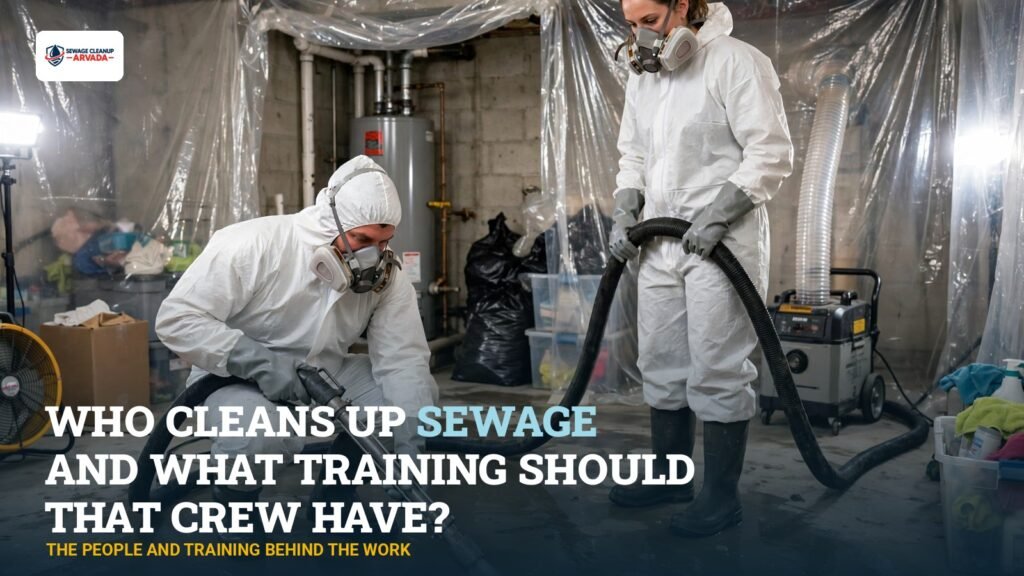
When sewage backs up into a home, the person who cleans it up is not a general cleaner and not a plumber. It is a dedicated cleanup crew: technicians whose training is built around contaminated water, protective equipment, and a methodical process that ends with measured proof the structure is dry. This guide explains who these crews are in Arvada, Colorado, what their training actually covers, and how a homeowner can tell a trained crew from an untrained one before work starts.
The Short Answer: A Cleanup Crew, Trained for Contaminated Water
Three different trades touch a sewage problem, and they do three different jobs.
A plumber fixes the line: the blockage, the break, the failed fitting. A general cleaner cleans normal dirt from normal surfaces. A sewage cleanup crew does the part in between and after: removing contaminated water and waste, taking out materials that cannot be disinfected, sanitizing what remains, and drying the structure.
The cleanup crew is the one trained for the hazard itself. Sewage is not a mess to be wiped up. It is a contaminated material to be handled under rules, and the training exists because those rules are not obvious.
More than 500,000 sewer backups occur each year in the United States, according to the Water Environment Federation.
At that volume, sewage cleanup is a specialty with its own methods, its own equipment, and its own training path. Homeowners in Arvada, Colorado are not hiring a pair of hands. They are hiring that training.
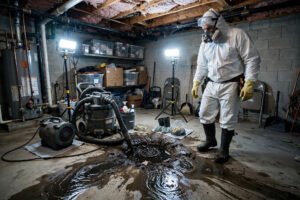
It helps to picture the difference at the door. An untrained worker arrives with a mop, a bucket, and good intentions. A trained crew arrives with containment sheeting, extraction equipment, protective gear for every person, and a sequence they have worked many times before. The homeowner’s problem is identical. Everything about the next four hours is not.
What “Trained” Means When the Water Is Sewage
Training for this work starts from one fact and builds everything on top of it.
Category 3 means the water can carry bacteria, viruses, and parasites. Every habit a trained technician has, from how gear goes on to how waste is bagged, exists to keep that contamination away from skin, lungs, and the clean parts of the home.
An untrained person sees a dirty floor. A trained person sees an exposure problem with a floor underneath it. That difference is the training.
Safety Training Comes Before Cleaning Training
The first subject is not cleaning. It is exposure.
Crews are trained in bloodborne pathogen awareness in the OSHA (Occupational Safety and Health Administration) sense: sewage is treated as potentially infectious material, and the rules cover how to avoid contact, how to handle contaminated items, and what to do after any accidental exposure.
Hygiene rules are part of the same block. No eating, drinking, or touching the face in the work zone. Hand washing and gear removal follow a set order when leaving the area, so contamination stays in the zone instead of traveling to the truck, the door handle, and the kitchen.
This sounds basic. It is also where untrained cleanups fail first, quietly, in ways a homeowner never sees.
Health Knowledge: What Sewage Can Do to People
A trained crew can explain, in plain words, why the area is sealed and why children and pets stay out.
Sewage exposure can cause stomach and intestinal illness, skin infections through cuts, and respiratory irritation. The risk is higher for young children, older adults, and anyone with a weakened immune system.
That knowledge shapes decisions on the job: which rooms get closed, how waste is handled, and why a technician will stop and re-seal an area rather than push through quickly. Speed is never the first value on a sewage job. Containment is.

The Protective Gear Is Part of the Training
The suit is not a uniform. It is equipment, and using it correctly is a trained skill.
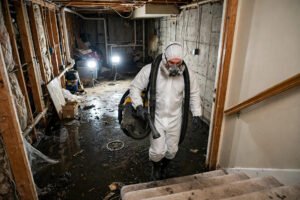
A full set for sewage work means a protective suit, a respirator, heavy gloves, and rubber boots, worn by every person who enters the contaminated area, every time, for the whole time they are in it.
What Each Piece Is Actually For
The suit keeps contaminated water and residue off skin and clothing, and it is treated as contaminated itself when the work is done.
The respirator protects the lungs from the particles and aerosols that extraction and demolition stir up. The gloves protect hands, which do most of the touching. The boots protect feet in standing water and are cleaned or contained before they cross into a clean area.
None of this is improvised on site. Crews are trained on which gear a Category 3 job requires before anyone opens a door.
Putting Gear On and Taking It Off Is a Procedure
The risky moment is not the work. It is the exit.
Trained crews follow a set order for removing gear, working from the most contaminated items inward, so that bare hands never touch an outer surface. Suits and gloves from a sewage job are bagged as contaminated waste, not tossed in a household bin or worn back through the home.
A homeowner watching a crew suit up and, later, watching how they come out of the work area, is watching the training in its most visible form.

Methods Training: The Work Itself, Done in Order
Safety training keeps the crew safe. Methods training is what makes the cleanup complete.
Professional methods, of the kind set out in IICRC (Institute of Inspection, Cleaning and Restoration Certification) standards for water damage work, give crews a shared sequence: assess, contain, extract, remove what cannot be disinfected, clean and sanitize, dry, and verify.
Each stage has a reason, and the order is the point. Sanitizing before extraction wastes the product on standing water. Drying before removal traps moisture inside contaminated material. A trained crew can tell you why the stage they are on comes where it does.
Judging Materials: What Can Be Cleaned and What Cannot
The hardest judgment on a sewage job is material judgment.
Porous materials that sewage soaked into, such as carpet padding, affected drywall, and insulation, cannot be disinfected reliably, because the contamination sits inside them. Hard, non-porous surfaces such as concrete, tile, and metal can be cleaned and sanitized in place.
Crews are trained to make that call material by material and to explain it. A crew that wants to throw out everything, or save everything, is telling you something about its training.
Equipment Training: Extraction, Drying, and Measurement
The tools are professional grade, and each one has a technique.
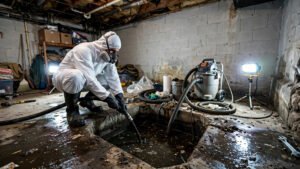
Extraction equipment removes contaminated water completely, including from low spots and drain areas. Air movers and dehumidifiers are placed from a moisture map, not scattered. Moisture meters, in the wall and floor models crews carry, turn “it feels dry” into a number that can be compared against unaffected parts of the home.
That last skill closes the job. The final readings are how a trained crew proves the structure is dry instead of asking the homeowner to take it on faith. Anyone can read what does professional sewage cleanup involve in that verification step: it is where training becomes evidence.
How a Crew Works as a Team on Site
Training also shows in how the work is divided.
On a typical job, one technician leads the assessment and the readings, while the others run extraction, manage hoses and equipment, and watch the boundary of the work zone. Someone is always responsible for the clean side: the path in and out, the staging area where gear goes on, and the point where bagged waste leaves the zone.
That division is not ceremony. It prevents the classic untrained error, where the person who has been standing in contaminated water walks through the home to fetch a forgotten tool, carrying the problem with them.
It also gives the homeowner one clear point of contact who can explain what stage the job is in and what happens next. Calm, explained work is a training outcome too.
Training Is Ongoing, Not a One Time Event
Nobody is trained once and finished.
Methods get refreshed as standards and products change. New technicians start supervised, working the simpler stages alongside experienced crew members before they lead an assessment or make material calls on their own. Experienced technicians review finished jobs: what the readings showed, what was removed, and what they would check earlier next time.
Refreshers, Practice, and Supervised First Jobs
The pattern mirrors other skilled trades. Classroom style learning covers the categories, the exposure rules, and the reasons behind the sequence. Practice covers the gear and the equipment, where putting a respirator on correctly is rehearsed in a clean room rather than learned in a contaminated one.
Then come supervised jobs, where a new technician extracts, bags, and sanitizes under an experienced eye. Judgment, like deciding whether a section of drywall can be cleaned or has to come out, is the last skill handed over, because it is the one that depends on everything else.
For a homeowner, none of this structure is visible directly. What is visible is its result: a crew where every member, not just the leader, works the same way and gives the same answers.
What Crews Are Trained to Expect Behind the Backup
A backup has a cause, and trained crews read the signs of the common ones because the cause changes what they check.
Blockages from grease and wipes are household causes. Structural causes, like a shifted or cracked line, show themselves in repeat backups at the same fixture. Outdoor causes arrive through the line as well.
Research published through the U.S. Forest Service links tree roots to more than 50 percent of sewer blockages.
A cleanup crew does not repair the line; that is the plumber’s trade. But a trained crew will say plainly when the pattern points to a line problem, because cleaning a room while the cause is still active is work done twice. In West Woods and across Arvada, Colorado, that honest handoff is part of the job.

Questions Worth Asking Any Crew Before Work Starts
A homeowner does not need to inspect credentials paperwork to learn a lot. A few plain questions, and the quality of the answers, reveal the training.
Ask what protective gear the crew will wear, and listen for the full set without hesitation. Ask how they will keep the rest of the home separated from the work area, and listen for containment described as a first step, not an afterthought.
Ask which materials they expect to remove and which they expect to clean, and listen for the porous versus non-porous logic. Ask how they will know the home is dry at the end, and listen for moisture readings, not opinions.
Ask what happens to the waste. Contaminated material and used protective gear leave as bagged waste, handled under the same exposure rules as the work itself.
A trained crew answers these questions easily, because the answers are its daily routine. Vague answers are information too.
One more question belongs on the list, and it is about the homeowner rather than the crew: ask what you should do, and what you should stay away from, while the work runs. A trained crew gives clear boundaries without being asked twice: which rooms to avoid, whether water use is paused, and how the drying equipment should be left alone once it is running. That guidance is part of the training as well. The crew is responsible not only for the contaminated area, but for making sure nobody in the home wanders into it by accident, including children, guests, and pets who do not know the rules yet.
Who This Matters For in Arvada, Colorado
Homeowners carry this decision most directly, because they choose who enters a contaminated home and whose process they trust.
Rentals, condos, and HOA-managed properties come next. A tenant or a unit owner usually reports the backup, while an owner or manager hires the crew, and the training questions above give that decision maker a shared checklist even when they are not on site.
Commercial properties follow, and they are never left out. A backup in an Arvada, Colorado restaurant, office, or retail space adds staff and customers to the exposure picture, which makes a trained, containment-first crew a requirement rather than a preference.
Whichever the property, the standard is the same one this guide describes, and the full range of sewage cleanup services is delivered by crews who work to it, in West Woods and every Arvada neighborhood the service covers. When a backup cannot wait, that help runs around the clock: Call (720) 764-0457 for emergency sewage cleanup.
Sewage Cleanup Arvada Serving the West Woods Community and Beyond in Arvada
Sewage Cleanup Arvada serves the West Woods community in Arvada, Colorado, near local landmarks like West Woods Golf Club, for homes close to the crossing of W 64th Ave and Quaker St, at coordinates 39.81271, -105.18384.
Get Sewage Cleanup West Woods Service Now
Navigate from West Woods to Sewage Cleanup Arvada Now

Frequently Asked Questions About Sewage Cleanup in Arvada, Colorado
Who do I call to clean up sewage in my home?
Call a sewage cleanup crew, the specialists trained for contaminated water. A plumber repairs the line itself, and a general cleaner handles ordinary dirt; the cleanup crew removes the sewage, sanitizes the space, and dries the structure. For Sewage Cleanup Arvada, that call is (720) 764-0457, with 24/7 emergency sewage cleanup available.
What training should a sewage cleanup crew have?
Training in contaminated water safety: bloodborne pathogen awareness, hygiene and exposure rules, correct use of full protective gear, and professional cleanup methods in the IICRC style, meaning assessment, containment, extraction, removal of unsavable materials, sanitization, drying, and final moisture verification.
Why does the crew wear full protective gear for a small backup?
Because the hazard is the water, not the size of the puddle. Even a small amount of sewage is Category 3 black water and can carry bacteria, viruses, and parasites. The suit, respirator, gloves, and boots protect the crew and keep contamination from being tracked into clean rooms.
How can I tell if a crew is properly trained before they start?
Ask plain questions: what gear they will wear, how they will contain the area, which materials they expect to remove versus clean, how the waste is handled, and how they will prove the home is dry. Trained crews answer with a clear routine. Vague answers are a warning sign.
Does the cleanup crew also fix the sewer line?
No. Line repair is a plumber’s work. The cleanup crew handles everything the sewage touched inside the home, and a trained crew will tell you plainly when the backup pattern points to a line problem that needs a plumber, so the cleanup is not done twice.
Sewage Cleanup Arvada, 5292 Ward Rd #2, Arvada, CO 80002. (720) 764-0457
Hours: Open 24 hours, 7 days a week for emergency service