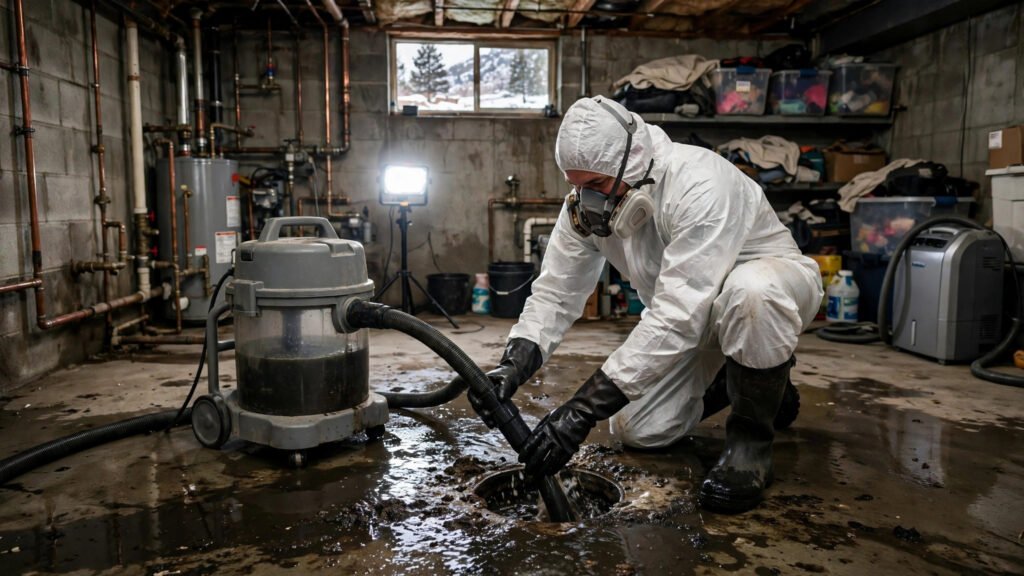
A main sewer line clog turns an ordinary drain problem into a house-wide event. One blockage in the line that carries everything away from your home can push sewage back through the lowest drains, and the cleanup that follows has a clear order to it. First the source is stopped and the spread is mapped, then the standing sewage is extracted, the clog is found and cleared, contaminated materials are removed, surfaces are sanitized, and the structure is dried and checked. Knowing those stages before the crew arrives takes the mystery out of a stressful day.
Start Here: Safe Steps Before the Crew Arrives
The minutes after you find sewage in your home matter, and the right moves are simple ones.
Stop Water Use Right Away
A main line clog means nothing leaving your home can get past the blockage.
Every flush, shower, and laundry load adds water behind the clog, and that water has only one place to go: back through the lowest drains in the house. Stop all water use at once, and tell everyone in the house out loud, because one unaware flush during a clog is how a small backup becomes a flooded room.
Water use stays paused until the crew confirms the line is clear.
Keep People and Pets Away From the Water
Sewage from a main line clog is Category 3 black water.
It carries bacteria, viruses, and parasites, and it soaks into everything it touches. Keep children and pets out of affected rooms entirely, and do not walk through standing sewage to rescue belongings. Items in the affected area can wait for the crew, who cross it in protective gear.
If sewage has reached a rug or a piece of furniture, leave it where it is.
Treat Electricity as a Hard Boundary
Water and electricity do not mix, and sewage water is no exception.
If sewage has reached outlets, a power strip, a furnace, a water heater, or anything plugged in, stay out of the water and do not touch switches or appliances in the affected area. Say so clearly when you call, so the crew knows the electrical situation before they step in.
Document from dry ground. A photo from the doorway records the water line, the affected drains, and the time, which helps the crew judge how the event unfolded and how far the sewage traveled.

What a Main Sewer Line Clog Actually Is
The phrase gets used for a lot of different problems, so it helps to pin down what it means.
A main sewer line clog is a blockage in the single pipe that carries all of a home’s wastewater away to the city sewer. It is the shared exit for every fixture in the house, and when it closes, every fixture feels it.
Your Home Line, the Lateral, and the City Main
Three pieces of pipe connect your home to the city system, and each one has its own job.
Inside the house, branch lines from each fixture join into the main house drain. That drain leaves the house and becomes the lateral, the buried pipe that runs from your home to the street. The lateral meets the city main under the street, and the city main carries everything onward.
A clog can sit in any of those three places. A blockage in the lateral is the homeowner side of the problem in most cases, while a blockage in the city main belongs to the utility, so the crew works out which one it is early.
What Clogs the Main Line
Main line clogs build slowly, then announce themselves all at once.
Tree roots are the most common cause in older neighborhoods. A root finds a hairline crack or a loose joint, slips inside for the moisture, and grows into a thick mat that catches everything passing by. Grease is the second regular offender: poured down a kitchen drain, it cools and hardens on the pipe wall, layer after layer, until the opening narrows.
Research published through the U.S. Forest Service links tree roots to more than 50 percent of sewer blockages.
Other causes fill out the list. Wipes and hygiene products that do not break down catch on rough pipe walls and build into a mass. Older clay and cast iron lines corrode and scale inside, narrowing the passage year by year, and soil shifts can drop a section of pipe out of alignment so solids collect at the offset joint.
In Allendale and across Arvada, Colorado, homes of different ages carry different versions of this list, which is why the crew inspects before they assume.
Why One Clog Backs Up Several Fixtures at Once
This is the detail that confuses most homeowners, and it is also the clearest sign of a main line clog.
When a single fixture clogs, only that fixture misbehaves. When the main line clogs, the whole system backs up together, because every fixture shares the same exit. Water from an upstairs shower has nowhere to go, so it looks for the lowest opening in the house, and that is usually a basement floor drain, a basement shower, or a ground floor tub.
That is why a main line clog often shows up in a room nobody was using: the water traveled there, pushed by everything the house sent down the drains after the blockage formed.
The First Signs the Main Line Is Blocked
A main line clog rarely arrives without warning. The signs show up days or weeks before the backup.
Several Drains Slow Down Together
One slow drain is a local problem. Several slow drains at once is a main line problem.
Watch for the pattern: the kitchen sink drains slowly, the upstairs shower pools at your feet, and the basement toilet flushes weakly, all in the same week. Together, they describe a single narrowing point downstream of all of them.
Gurgling, Bubbling, and Odors
A gurgling drain is air trapped behind a blockage, looking for a way out.
You hear it when a toilet flushes and the tub gurgles in reply, or when the washing machine drains and a nearby sink bubbles. Sewer odors that come and go are the same story from a different sense: gas from the blocked line finding its way back through a dry trap or a low drain.
Both together mean the line is asking to be looked at before it closes completely.
Water Appearing in the Lowest Fixture
This is the sign that turns a warning into an event.
Run the washing machine and watch the basement shower, or flush an upstairs toilet and watch the floor drain. If water rises in a fixture nobody used, the main line is blocked and the house is already sending water back to its lowest point.
Stop using water the moment you see this. Every additional gallon joins the backup, and the cleanup grows with it.
More than 500,000 sewer backups occur each year in the United States, according to the Water Environment Federation.
What Happens Step by Step During Sewage Cleanup
A professional sewage cleanup after a main sewer line clog follows the same staged process as any other backup: stop and assess, extract, remove and sanitize, then dry and verify.
The clog adds one stage in the middle, finding and clearing the blockage, and the order matters: the clog is dealt with before the deep cleaning begins.
Step 1: Stop and Assess
The crew starts by confirming the source is stopped.
Water use stays paused while they walk the home and map the footprint: every room the sewage reached, the materials it soaked, and the path it took through floor drains, tubs, and low openings. They check which fixtures backed up and which stayed clear, because that pattern points to where the clog sits.
The assessment also sets the safety picture, since sewage near outlets or appliances changes how the crew moves through the room.
Step 2: Find the Clog
Guessing at a clog wastes time and risks the wrong fix, so the crew locates it before they clear it.
The cleanout is the usual starting point: a capped pipe, often outside the home or in the basement, that gives direct access to the main line. From there, a sewer camera travels down the line and shows the blockage on a screen, along with its distance from the house and what it is made of: roots look like a tangled mat, grease like a smooth narrowing, and a collapsed section like a wall where the pipe should continue.
The camera also records the condition of the rest of the line, which matters after the cleanup: one root intrusion and joints failing along the whole length are different problems.

Step 3: Extract the Standing Sewage
With the source stopped and the clog located, the standing sewage comes out.
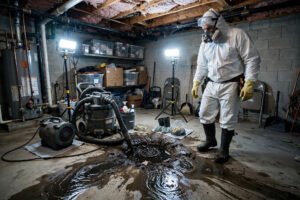
Professional extraction equipment removes the water across the whole affected area, not just the deepest puddle. The crew works from the lowest point outward, because sewage that sits in a room keeps soaking into floors and wall bases while it waits.
Extraction is the stage homeowners notice most, because the room visibly changes. It is only the beginning: the water is gone, but everything it touched is still contaminated.
Step 4: Clear the Main Line
Clearing the clog is what keeps the backup from returning the moment water use resumes.
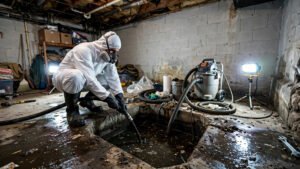
The method depends on what the camera found. A cable machine with a cutting head breaks up roots and clears soft blockages from the cleanout, and a hydro jet uses pressurized water to scour grease and scale from the pipe walls. A collapsed or badly offset section cannot be cleared this way, and that finding changes the conversation toward repair.
Once the line runs clear, the crew confirms it with flow and, where it fits, a second camera pass. Water use resumes only after that confirmation.
Step 5: Remove What Cannot Be Cleaned
Sewage soaks into porous materials, and some of those materials cannot be cleaned back to safe use.
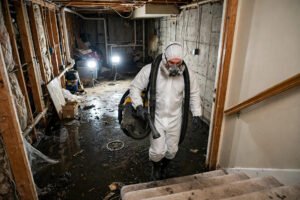
Soaked carpet and pad, swollen baseboards, saturated drywall at the water line, and soft goods that sat in the water are removed and bagged for disposal. Hard surfaces that can be cleaned and disinfected in place are separated from porous materials that cannot, item by item and room by room.
This stage feels wasteful, and it is the stage most worth trusting: a rug that looks fine after a rinse still holds contamination in its fibers.
Step 6: Sanitize Every Surface the Sewage Touched
Once the unsalvageable material is out, the remaining surfaces are cleaned and disinfected.
The crew works across every surface the sewage reached, including floors, wall bases, and the sides of fixtures, using disinfectants suited to Category 3 contamination. The goal is not a fresh smell. The goal is surfaces that no longer carry the bacteria, viruses, and parasites the sewage brought in.
Sanitizing comes after removal for a reason: disinfectant over soaked carpet treats the surface and leaves the contamination underneath untouched.
Step 7: Dry and Verify With Moisture Readings
Drying equipment goes to work on the floors, wall bases, and any cavities the sewage entered.
The U.S. EPA advises drying water-damaged areas and materials within 24 to 48 hours to prevent mold growth.
That is the practical meaning of U.S. EPA guidance on drying wet materials: after a main line clog, the drying clock is already running while the line is being cleared.
The job closes with moisture readings across the affected area. Sewage water travels further than it shows, and a room that looks dry can hold wet material behind a baseboard. Readings, not appearances, decide when the space returns to normal use, because what happens when sewage cleanup is delayed is mostly a story about moisture left behind.

What Decides How Long the Cleanup Takes
How long the work takes depends on what the crew finds.
The spread of the sewage is the first factor. One room with a shallow backup is a different job from a finished basement where water reached several rooms and the wall bases. The materials are the second factor: hard floors and tile clean faster than carpet and drywall, which hold water and often have to come out. The clog itself is the third factor: a soft grease blockage clears quickly, while a root mat or a damaged section takes longer to find and deal with.
Drying sets the pace at the end, and moisture readings decide when the structure is dry. For a fuller picture of the timing factors, how long sewage cleanup takes walks through the same stages from the clock side.
What Never to Do After a Main Line Clog
Do not keep flushing or running water to see whether the line has cleared. While a clog lasts, added water joins the backup.
Do not open the cleanout or a drain cover to let the sewage out into the yard. That moves contamination onto soil and toward storm drains, and it puts you in direct contact with sewage.
Do not pour bleach or chemicals into standing sewage, and do not mix cleaning products in it. Chemicals do not sanitize sewage, and they add risk for everyone who handles the water afterward.
Do not run fans across a contaminated area to start drying early. Air moving over sewage before cleaning spreads contamination onto clean surfaces.
Do not snake the main line yourself with a rented machine. A cable in a damaged line can break or get stuck, and it puts you in direct contact with Category 3 water.
What the Crew Finds Tells You About the Next Clog
The cleanup ends the event. What the crew found in the line decides whether it happens again.
Roots in the line mean the trees near the lateral are feeding on it, and the intrusion grows back unless the entry point is addressed. Grease buildup means the kitchen drain needs a change in habit, because grease poured down the drain hardens on the pipe wall and the next layer starts forming at once. Scale and corrosion in an older line mean the pipe itself is narrowing, and no amount of clearing restores its original diameter.
Ask what the camera showed. The answer turns a stressful day into a plan: what to watch for, what to change, and what to have looked at before the line closes again.
The full range of sewage cleanup services covers main line clogs with the same staged approach, and sewage cleanup in Arvada, Colorado explains how the pieces fit together.
Who This Matters For in Arvada, Colorado
Homeowners come first. A main line clog arrives at their drains, on their floors, and the safe first steps and the cleanup decision start with them.
Rentals and HOA-managed properties come next. Tenants spot the water first, owners carry the responsibility for the response, and in shared buildings one blocked lateral can report itself in several homes at once, which makes fast, clear reporting worth a great deal.
Commercial properties follow, and they are never left out. Restaurants, retail sites, and offices in Arvada, Colorado face the same main line mechanics at their floor drains and restrooms.
Sewage Cleanup Arvada Serving the Allendale Community and Beyond in Arvada
Sewage Cleanup Arvada serves the Allendale community in Arvada, Colorado, near local landmarks like Arvada West High School, 11595 Allendale Dr, for homes close to the crossing of W 64th Ave & Allendale Dr, at coordinates 39.81049, -105.12708.
Get Sewage Cleanup Allendale Service Now
For a sewage cleanup for Allendale homes after a main sewer line clog, call (720) 764-0457.
Navigate from Allendale to Sewage Cleanup Arvada Now
Frequently Asked Questions About Sewage Cleanup in Arvada, Colorado
How do I know the clog is in the main sewer line and not one drain?
When several fixtures misbehave at once, the main line is the suspect. A single slow sink points to that sink, but a slow kitchen sink, a pooling shower, and a weak toilet in the same week point downstream of all of them. Water rising in a fixture nobody used, like a basement shower filling while the washing machine runs, confirms it.
Can I still use water while the main line is clogged?
No. With the main line blocked, every gallon you send down a drain has nowhere to go except back through the lowest drains. Pause all water use, including toilets, showers, laundry, and dishwashers, until the crew confirms the line is clear.
Does the clog have to be cleared before the cleanup starts?
The standing sewage is extracted first so the rooms stop soaking, but the deep cleaning waits until the line is clear, because cleaning a room that is still receiving sewage solves nothing. Finding and clearing the clog sits between extraction and sanitizing for exactly that reason.
Will the crew have to dig up my yard to clear a main line clog?
Usually not. Most clogs are cleared from the cleanout with a cable machine or a hydro jet, and the sewer camera locates the blockage without digging. Digging only enters the picture when the camera shows a collapsed or badly offset section that clearing cannot fix, and that is a repair decision, not a cleanup step.
What should I do after the cleanup so the clog does not come back?
Ask what the camera found, because the cause decides the next step. Roots call for the entry point to be addressed, grease calls for keeping it out of the kitchen drain, and scale or corrosion in an older line calls for a plan before the pipe narrows further. Watch for the early signs too: several drains slowing together, gurgling, and odors.
Sewage Cleanup Arvada, 5292 Ward Rd #2, Arvada, CO 80002. (720) 764-0457
Hours: Open 24 hours, 7 days a week for emergency service