
One week sounds like a short delay. Life is busy, the water went down, the room looks almost normal again, and the call can wait until the weekend.
A sewage backup does not wait with you.
Under the surface, that week is a working week for moisture, bacteria, and mold. This guide walks through what changes day by day when cleanup is delayed in an Arvada, Colorado home, and what still helps if some of those days have already passed.
Nothing below is guesswork about attitude. It is simply what water, time, and building materials do when they are left together, and it is why professionals talk about sewage in terms of hours instead of weekends.
The First 24 Hours: The Window That Matters Most
In the first day, almost everything about the job is still at its smallest.
The sewage is mostly liquid. It sits on surfaces more than it soaks into them, and extraction at this point removes the bulk of it before drywall, flooring, and framing have had time to drink deeply.
That window is the whole ballgame. Inside it, a cleanup is mostly extraction, targeted removal, sanitizing, and a short drying run. Outside it, each of those stages grows.
This is also the day when arranging sewage cleanup help changes the most about what follows, because nothing has had time to become permanent yet.
Think of what extraction on day one actually meets: standing water that lifts out cleanly, baseboards that have barely begun to swell, a floor that releases its moisture willingly once air and dehumidification start. The crew is working with materials that still behave the way they did before the backup.
That cooperation disappears fast. It is the first thing the delay spends.
Days Two and Three: Moisture Starts Moving
By the second and third day, the visible water may be gone. The moisture is not.
It has been pulled into every porous material it touched, and it keeps traveling after the surface dries. This is the stage where a room can look recovered while the structure inside it is getting wetter, not drier.
Drywall, Baseboards, and Flooring Drink It In
Drywall wicks moisture upward well above the line the water reached. A wall that took sewage to the baseboard can be damp a foot higher by day three, inside the cavity where nobody can see it.
Baseboards swell and separate. Laminate and engineered flooring take moisture into their seams and begin to cup and lift. Carpet padding, if it was left in place, holds contaminated water against the subfloor like a sponge that never gets wrung out.
None of this is visible from the doorway. It is measurable, which is why crews trust moisture readings over appearances from this stage onward.
The Smell Stops Being Just a Smell
The odor changes character around day two.
Fresh sewage smells foul. Sewage that has sat for two or three days smells different: heavier, sourer, present in rooms the water never reached. That change is the smell of bacterial growth doing its work in warm, wet material.
Porous items drink that odor in too. Upholstery, cardboard, paper, and fabric stored near the affected area begin to hold the smell themselves, which is why items that might have been cleaned on day one often cannot be saved by day four.
Warmth and Still Air Speed Everything Up
A closed basement room in a heated house is close to a perfect growth chamber.
Warmth accelerates bacterial activity. Still air lets moisture sit on surfaces instead of evaporating. The dark inside of a wall cavity protects colonies from light and disturbance while they establish.
Colorado weather adds its own twist. A warm spell after a backup, or a furnace running through a cold week in Arvada, Colorado, keeps the affected materials in exactly the temperature range where growth moves fastest.
None of these factors need to be extreme. Ordinary indoor conditions are enough, which is why the timeline below is the normal case and not a worst case.

Days Four and Five: The Problem Starts Growing
Around day four, the delay stops being about water at all. It becomes about growth.
Sewage is Category 3 black water, the most contaminated of the three water damage categories defined by the IICRC.
Category 3 water brings its own biology with it. Given moisture, warmth, and four or five days, mold colonies establish on the same surfaces the sewage soaked: drywall paper, wood, insulation, and the dust inside wall cavities.
Mold Growth You Can See, and Growth You Cannot
The growth you can see shows up as dark or fuzzy patches on the lower wall, along baseboards, and on the backs of furniture that sat against a wet wall.
The growth you cannot see matters more. Inside a closed wall cavity, colonies spread across the back of the drywall and the face of the insulation, fed by moisture that never dried because nobody opened the wall.
Air movement spreads the effect. Heating and cooling systems move air from the affected area through the house, and everyday foot traffic and fans can carry spores with it, which is one reason running a fan on a contaminated room before it is cleaned does real harm.
By day five, what began as a water problem usually has to be handled as a water problem and a mold problem at the same time.
Paper-faced materials suffer first and worst. The paper on drywall is food for mold, which is why walls show growth days before solid wood does. Cardboard storage boxes in the affected area are usually a total loss by this stage, and their contents have spent days sitting in contaminated humidity even if the water never touched them directly.
By Day Seven: A Bigger Job in Every Direction
At the one week mark, the comparison with day one is not subtle.
According to the Insurance Institute for Business and Home Safety, 68 percent of all drain system sewer backup claims started in the basement.
The basement is where backups begin, and it is where a week of waiting concentrates. The room that needed extraction and cleaning on day one now needs extraction, wider removal, mold aware handling, sanitizing, and a longer monitored drying run before anyone can talk about rebuilding.
The finish line moves too. Rebuilding cannot start until moisture readings pass, and a structure that absorbed seven days of moisture takes longer to release it. So the delay echoes past the cleanup itself: the room stays out of service longer, the stored belongings stay displaced longer, and the household keeps living around a sealed or stripped space well into the second week. A one week delay rarely costs one week. It usually costs the week, plus interest, paid in days at every stage that follows.
More Materials Cross the Line From Save to Remove
Every material has a point where cleaning stops being enough, and time moves materials across that line.
Drywall that could have been cut at a low flood line on day one may need to come out higher on day seven, because the moisture climbed. Flooring that might have dried in place early on has spent a week swelling and delaminating. Insulation inside wet walls, questionable on day two, is simply removed on day seven.
The pattern is consistent: the delay does not add a new kind of work so much as it adds more of every kind.
Contamination Reaches Places It Never Touched on Day One
A week of living in the house spreads the footprint.
Shoes cross the affected floor and carry residue to stairs and hallways. Pets wander in and out. Laundry and stored items get moved from the wet area to dry rooms, taking contamination with them in small amounts.
None of this is carelessness. It is normal life in a house with a room nobody fully sealed off, and it is why a delayed job often includes areas that were never wet at all.

The Health Side of a Week of Waiting
The damage timeline gets most of the attention. The exposure timeline runs alongside it.
Sewage carries bacteria, viruses, and parasites from the first hour. What a week changes is the dose and the audience: more days of contact with contaminated surfaces, more airborne particles as growth establishes, and more chances for children, older adults, and anyone with a weakened immune system to be exposed.
Sewer gas builds in a closed, wet space too, adding headaches and nausea to the picture for people living above it.
This is the part of the delay that cannot be undone with extra work later. Materials can be replaced on day seven. A week of breathing a contaminated room cannot be taken back, which is why keeping people and pets out of the area matters from the first day, not from the day the crew is called.
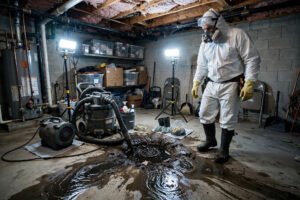
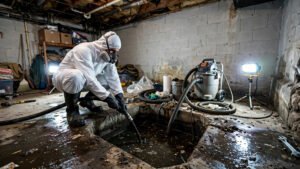
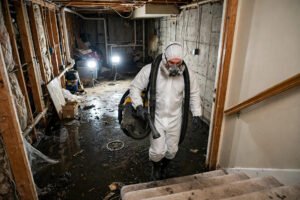
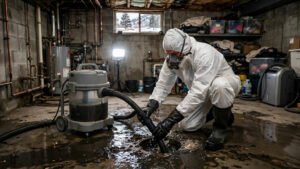
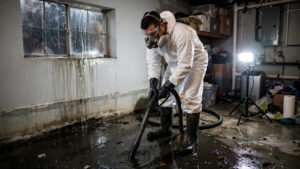
There is a useful comparison in how the two groups dress. A cleanup technician enters that room in a sealed suit, a respirator, gloves, and boots, and treats every surface as a hazard. A family living with a delayed backup walks through the same space in socks and pajamas, breathing the same air for hours at a time, including overnight in bedrooms above it.
The hazard is identical. Only the protection is different, and a week of delay widens that gap every single day.
Why Waiting Rarely Makes the Job Smaller
Homeowners usually delay for understandable reasons: hope that it dried on its own, a busy week, uncertainty about whether the problem is serious.
The outcome is predictable, though. Waiting trades a shorter list of tasks for a longer one: more material removed, more surfaces treated, more rooms included, more days of drying equipment, and more verification before the space can be rebuilt.
Drying on its own is not cleanup, either. A room that air dried over a week is a dry contaminated room. The germs and the odor sources remain in the materials, waiting for the next humid week to announce themselves again.
There is one more way the week can grow: the line is still blocked. A backup that was never cleared can repeat with the next heavy rain or the next week of normal water use, adding fresh sewage on top of the old. Homes in the Harvest Lane area and across the city see this when a partial blockage is mistaken for a finished problem because the first backup drained away on its own.
What Still Helps If a Few Days Have Already Passed
If you are reading this on day three or day six, the useful move is not to catch up on your own. It is to stop the clock.
Stop using water and drains in the affected part of the home. Keep people and pets out of the area, and close the door to it. Take photographs and notes from dry ground, including when the backup happened and what has changed since.
Do not try to make up lost time with household cleaners, mixed chemicals, or a rented fan. Those steps spread contamination and can make the professional stages slower, not faster.
Dry belongings in rooms next to the affected area can still be moved to a clean part of the home, and doing so protects them from the spread described above. Wet or contaminated items should stay where they are until the crew can judge them. Tell the crew about anything that was already moved, and mention whether the heating or cooling system serves the affected area, since shared air changes how containment gets set up.
If you want the full picture of what professional sewage cleanup involves, that walkthrough lays out the stages a crew will work through when they arrive, including how dryness gets verified at the end. A late job follows the same stages. It just has more to work through.

Who This Matters For in Arvada, Colorado
Homeowners come first, because they live with both sides of the delay: the growing damage and the daily exposure.
Rentals, condos, and HOA-managed properties come next. A tenant may spot the backup on day one while the decision to call sits with an owner or a manager, and days lost in that handoff are exactly the days this timeline describes.
Commercial properties follow, and they are never left out. A restaurant, shop, or office in Arvada, Colorado that waits a week faces the same growth curve, with more people moving through the space in the meantime.
The same staged sewage cleanup services apply whether the call comes on day one or day seven. The earlier call simply gives those stages less to undo.
Sewage Cleanup Arvada Serving the Harvest Lane Community and Beyond in Arvada
Sewage Cleanup Arvada serves the Harvest Lane community in Arvada, Colorado, near local landmarks like Two Ponds National Wildlife Refuge, for homes close to the crossing of W 72nd Ave and Beech St, at coordinates 39.82708, -105.14948.
Get Sewage Cleanup Harvest Lane Service Now
Navigate from Harvest Lane to Sewage Cleanup Arvada Now

Frequently Asked Questions About Sewage Cleanup in Arvada, Colorado
How long can sewage sit before it becomes a serious problem?
It is a health hazard from the first hour, because sewage is Category 3 black water. What changes with time is the scale: moisture spreads, mold begins growing within days, and more materials pass the point where they can be cleaned instead of removed.
Can mold really grow within a week after a sewage backup?
Yes. On wet materials, mold growth can begin within 24 to 48 hours, and by the end of a week colonies are often established on drywall, insulation, and wood, including inside wall cavities where they cannot be seen.
If the sewage water dried on its own, is cleanup still needed?
Yes. Drying removes moisture, not contamination. Bacteria, residue, and odor sources stay in the materials after the water leaves, and the area still needs extraction of residues, removal of unsavable materials, sanitizing, and verified drying.
What should I do if I could not call for cleanup right away?
Stop using water and drains, keep people and pets away from the affected area, and document the damage with photos and notes from a dry, safe spot. Then call. Do not try to catch up with household cleaners or fans, since both can spread contamination.
Does a delayed cleanup take longer than a prompt one?
Usually, yes. A week of waiting normally means more material has to be removed, more surfaces have to be treated, and drying runs longer with more check visits before the final moisture readings pass. The stages themselves stay the same. There is simply more inside each one.
Sewage Cleanup Arvada, 5292 Ward Rd #2, Arvada, CO 80002. (720) 764-0457
Hours: Open 24 hours, 7 days a week for emergency service