Local Arvada teamServing neighborhoods across Arvada
Sewage backup cleanup in Arvada, Colorado
Serving Arvada
Sewer Line Backup Cleanup in Arvada, CO
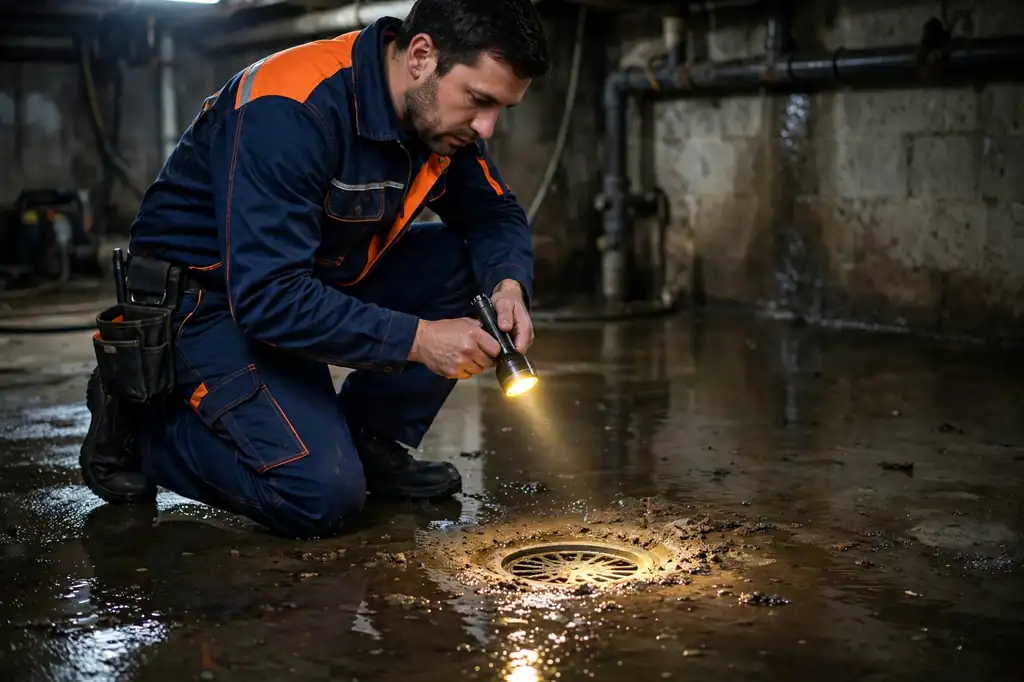
When the main sewer line blocks, sewage has nowhere to go but back into your house — through the lowest drains first. We clean up after sewer line backups: extracting the sewage, removing what it contaminated, and sanitizing the space so it is safe again.

Sewer Line Backup Cleanup in Arvada, CO
Every drain in your home — toilets, tubs, sinks, the washing machine, the basement floor drain — flows into one main sewer line that carries wastewater out to the city main. When that line blocks or fails, the flow reverses. Sewage and wastewater come back up through the lowest openings in the house, and they keep coming for as long as anyone upstairs keeps using water.
A sewer line backup is the most damaging kind of residential sewage event because it rarely affects one fixture: it spreads through basements, bathrooms and laundry rooms, and the water is Category 3 black water. This page explains how to recognize a line backup, why Arvada lines back up, what to do in the first hour, and how the cleanup works. If sewage is coming up in your home now, stop using all water in the house and call (720) 764-0457.
Signs of a sewer line backup
Caught at the gurgling stage, a backup may not have spilled yet — that is the moment to stop using water and get the line problem addressed, before the cleanup becomes a full extraction job.

Why sewer lines back up in Arvada homes
The leading cause in established Arvada neighborhoods. Cottonwood, elm and maple roots enter older lines through joints and hairline cracks, then trap paper and waste until the line closes. Neighborhoods with mature trees — Olde Town, Allendale, Ralston Valley — see this pattern most.
Many Arvada homes built before 1980 still have original clay tile or cast-iron sewer laterals. Clay joints separate and offset; cast iron scales, corrodes and eventually collapses. An offset joint catches solids the same way a root mass does.
Heavy rain can overload the shared system; water and sewage push back toward the lowest drains in the house, especially where no backwater valve is fitted.
Grease buildup, flushed wipes and hygiene products, and debris accumulate into a plug over time. "Flushable" wipes do not break down like toilet paper and are a recurring cause.
A sagging section of pipe (a belly) collects water and solids permanently, so the line backs up again and again until the section is dealt with.
Cleanup and repair are two different jobs: we clean and sanitize what the backup contaminated; the line itself — clearing it, camera inspection, repair or replacement — is a plumber's work. Both are usually needed. Cleanup should not wait for the repair debate, because contaminated material gets worse by the day, but no cleanup can hold if the line is still pushing sewage back in.

How cleanup works after a sewer line backup
The affected area is isolated so contaminated material and air stay out of clean rooms; HEPA air scrubbing is used where needed.
Standing sewage is pumped out and extracted from floors and subflooring — the full step-by-step is on the Raw Sewage Removal page.
Carpet and pad, wicked drywall and insulation, and swollen baseboards that absorbed sewage are removed and disposed of as contaminated waste. Sewage cannot be disinfected through the depth of porous material.
Concrete, tile, framing and subfloor are cleaned and washed with antimicrobial solutions, then rinsed and extracted again.
Air movers and dehumidifiers bring the structure to measured moisture targets, confirmed with meter readings — not guesswork — before the space is handed back.
A final sanitizing pass is applied. Odor is handled at its source: it lives in the contaminated material, and that material is gone. What remains is a cleaned structure, ready for whatever repair or rebuild the line and the rooms need.
A single overflowing toilet is a smaller version of the same event — see Toilet Overflow Cleanup. For the full restoration picture, our Water Damage Restoration hub shows how cleanup, drying and restoration fit together.


Further than the visible water. Sewage wicks up drywall roughly an inch or more beyond the waterline, travels under flooring along the subfloor, and follows the slope of a basement slab into rooms that look dry. Moisture readings, not eyesight, set the boundary of the cleanup — that is why a backup that "only got the laundry room" sometimes needs the adjoining finished room opened up as well. It is also why partial DIY cleanups fail: the visible area gets clean while the hidden spread keeps the odor and the contamination.
Questions before we arrive

Still unsure? A dispatcher can help identify the safest immediate step and the right appointment type.
Ask dispatch nowOn a tiny spill on a hard, non-porous surface, careful cleaning can be reasonable. A line backup is usually beyond that: the sewage is Category 3, it has typically reached carpet pad, drywall or subfloor where bleach cannot penetrate, and household equipment spreads contaminated aerosols. The porous material has to come out, which is the part most DIY attempts skip — and the part that keeps the odor and risk in the house.
Usually both, for different jobs. A plumber clears, inspects and repairs the line itself. A cleanup crew extracts the sewage, removes contaminated material, sanitizes and dries the structure. We do the cleanup side; we do not repair sewer lines, and we will tell you plainly when the line problem has to be solved before cleanup can hold.
Often, if the policy includes a Water Backup endorsement for sewer and drain backups — coverage and limits vary, and the insurer makes the final call. We document the damage, readings and removed materials so your claim file is complete.
Carpet and pad that sewage reached are removed — they cannot be disinfected through their depth. Hard surfaces and framing are cleaned and kept. Upholstered items in contact with the water are normally removed; solid pieces are judged case by case.
Extraction is the fast stage. Removal, washing, sanitization and verified drying take longer and depend on the spread. Drying is finished when moisture readings reach target, and we walk you through the expected sequence for your home before work begins.
Stop using all water in the house, keep people and pets out of the affected area, photograph the damage from a dry spot, and call (720) 764-0457. Do not flush anything "to test it" — each flush adds sewage at the lowest drain.
By removing what causes them. Sewage odor lives in contaminated porous material and sludge; once those are out and the structure is washed and sanitized, the source is gone. Deodorizing without removal only masks the smell for a few days.
Call for sewer line backup cleanup in Arvada
A sewer line backup keeps doing damage for as long as water is used in the house. Stop the water, keep everyone clear of the affected area, and call Sewage Cleanup Arvada at (720) 764-0457 for the cleanup.
Sewage Cleanup Arvada · 5292 Ward Rd #2, Arvada, CO 80002 · (720) 764-0457
