Sewage backup cleanup in Arvada, Colorado
Serving Arvada
When sewage backs up into a home, the person who cleans it up is not a general cleaner and not a plumber. It is a dedicated cleanup crew: technicians whose training is built around contaminated water, protective equipment, and a methodical process that ends with measured proof the structure is dry. This guide explains who these crews are in Arvada, Colorado, what their training actually covers, and how a homeowner can tell a trained crew from an untrained one before work starts.
Three different trades touch a sewage problem, and they do three different jobs.
A plumber fixes the line: the blockage, the break, the failed fitting. A general cleaner cleans normal dirt from normal surfaces. A sewage cleanup crew does the part in between and after: removing contaminated water and waste, taking out materials that cannot be disinfected, sanitizing what remains, and drying the structure.
The cleanup crew is the one trained for the hazard itself. Sewage is not a mess to be wiped up. It is a contaminated material to be handled under rules, and the training exists because those rules are not obvious.
More than 500,000 sewer backups occur each year in the United States, according to the Water Environment Federation.
At that volume, sewage cleanup is a specialty with its own methods, its own equipment, and its own training path. Homeowners in Arvada, Colorado are not hiring a pair of hands. They are hiring that training.
It helps to picture the difference at the door. An untrained worker arrives with a mop, a bucket, and good intentions. A trained crew arrives with containment sheeting, extraction equipment, protective gear for every person, and a sequence they have worked many times before. The homeowner’s problem is identical. Everything about the next four hours is not.
Training for this work starts from one fact and builds everything on top of it.
Category 3 means the water can carry bacteria, viruses, and parasites. Every habit a trained technician has, from how gear goes on to how waste is bagged, exists to keep that contamination away from skin, lungs, and the clean parts of the home.
An untrained person sees a dirty floor. A trained person sees an exposure problem with a floor underneath it. That difference is the training.
The first subject is not cleaning. It is exposure.
Crews are trained in bloodborne pathogen awareness in the OSHA (Occupational Safety and Health Administration) sense: sewage is treated as potentially infectious material, and the rules cover how to avoid contact, how to handle contaminated items, and what to do after any accidental exposure.
Hygiene rules are part of the same block. No eating, drinking, or touching the face in the work zone. Hand washing and gear removal follow a set order when leaving the area, so contamination stays in the zone instead of traveling to the truck, the door handle, and the kitchen.
This sounds basic. It is also where untrained cleanups fail first, quietly, in ways a homeowner never sees.
A trained crew can explain, in plain words, why the area is sealed and why children and pets stay out.
Sewage exposure can cause stomach and intestinal illness, skin infections through cuts, and respiratory irritation. The risk is higher for young children, older adults, and anyone with a weakened immune system.
That knowledge shapes decisions on the job: which rooms get closed, how waste is handled, and why a technician will stop and re-seal an area rather than push through quickly. Speed is never the first value on a sewage job. Containment is.

The suit is not a uniform. It is equipment, and using it correctly is a trained skill.
A full set for sewage work means a protective suit, a respirator, heavy gloves, and rubber boots, worn by every person who enters the contaminated area, every time, for the whole time they are in it.
The suit keeps contaminated water and residue off skin and clothing, and it is treated as contaminated itself when the work is done.
The respirator protects the lungs from the particles and aerosols that extraction and demolition stir up. The gloves protect hands, which do most of the touching. The boots protect feet in standing water and are cleaned or contained before they cross into a clean area.
None of this is improvised on site. Crews are trained on which gear a Category 3 job requires before anyone opens a door.
The risky moment is not the work. It is the exit.
Trained crews follow a set order for removing gear, working from the most contaminated items inward, so that bare hands never touch an outer surface. Suits and gloves from a sewage job are bagged as contaminated waste, not tossed in a household bin or worn back through the home.
A homeowner watching a crew suit up and, later, watching how they come out of the work area, is watching the training in its most visible form.

Safety training keeps the crew safe. Methods training is what makes the cleanup complete.
Professional methods, of the kind set out in IICRC (Institute of Inspection, Cleaning and Restoration Certification) standards for water damage work, give crews a shared sequence: assess, contain, extract, remove what cannot be disinfected, clean and sanitize, dry, and verify.
Each stage has a reason, and the order is the point. Sanitizing before extraction wastes the product on standing water. Drying before removal traps moisture inside contaminated material. A trained crew can tell you why the stage they are on comes where it does.
The hardest judgment on a sewage job is material judgment.
Porous materials that sewage soaked into, such as carpet padding, affected drywall, and insulation, cannot be disinfected reliably, because the contamination sits inside them. Hard, non-porous surfaces such as concrete, tile, and metal can be cleaned and sanitized in place.
Crews are trained to make that call material by material and to explain it. A crew that wants to throw out everything, or save everything, is telling you something about its training.
The tools are professional grade, and each one has a technique.
Extraction equipment removes contaminated water completely, including from low spots and drain areas. Air movers and dehumidifiers are placed from a moisture map, not scattered. Moisture meters, in the wall and floor models crews carry, turn “it feels dry” into a number that can be compared against unaffected parts of the home.
That last skill closes the job. The final readings are how a trained crew proves the structure is dry instead of asking the homeowner to take it on faith. Anyone can read what does professional sewage cleanup involve in that verification step: it is where training becomes evidence.
Training also shows in how the work is divided.
On a typical job, one technician leads the assessment and the readings, while the others run extraction, manage hoses and equipment, and watch the boundary of the work zone. Someone is always responsible for the clean side: the path in and out, the staging area where gear goes on, and the point where bagged waste leaves the zone.
That division is not ceremony. It prevents the classic untrained error, where the person who has been standing in contaminated water walks through the home to fetch a forgotten tool, carrying the problem with them.
It also gives the homeowner one clear point of contact who can explain what stage the job is in and what happens next. Calm, explained work is a training outcome too.
Nobody is trained once and finished.
Methods get refreshed as standards and products change. New technicians start supervised, working the simpler stages alongside experienced crew members before they lead an assessment or make material calls on their own. Experienced technicians review finished jobs: what the readings showed, what was removed, and what they would check earlier next time.
The pattern mirrors other skilled trades. Classroom style learning covers the categories, the exposure rules, and the reasons behind the sequence. Practice covers the gear and the equipment, where putting a respirator on correctly is rehearsed in a clean room rather than learned in a contaminated one.
Then come supervised jobs, where a new technician extracts, bags, and sanitizes under an experienced eye. Judgment, like deciding whether a section of drywall can be cleaned or has to come out, is the last skill handed over, because it is the one that depends on everything else.
For a homeowner, none of this structure is visible directly. What is visible is its result: a crew where every member, not just the leader, works the same way and gives the same answers.
A backup has a cause, and trained crews read the signs of the common ones because the cause changes what they check.
Blockages from grease and wipes are household causes. Structural causes, like a shifted or cracked line, show themselves in repeat backups at the same fixture. Outdoor causes arrive through the line as well.
Research published through the U.S. Forest Service links tree roots to more than 50 percent of sewer blockages.
A cleanup crew does not repair the line; that is the plumber’s trade. But a trained crew will say plainly when the pattern points to a line problem, because cleaning a room while the cause is still active is work done twice. In West Woods and across Arvada, Colorado, that honest handoff is part of the job.

A homeowner does not need to inspect credentials paperwork to learn a lot. A few plain questions, and the quality of the answers, reveal the training.
Ask what protective gear the crew will wear, and listen for the full set without hesitation. Ask how they will keep the rest of the home separated from the work area, and listen for containment described as a first step, not an afterthought.
Ask which materials they expect to remove and which they expect to clean, and listen for the porous versus non-porous logic. Ask how they will know the home is dry at the end, and listen for moisture readings, not opinions.
Ask what happens to the waste. Contaminated material and used protective gear leave as bagged waste, handled under the same exposure rules as the work itself.
A trained crew answers these questions easily, because the answers are its daily routine. Vague answers are information too.
One more question belongs on the list, and it is about the homeowner rather than the crew: ask what you should do, and what you should stay away from, while the work runs. A trained crew gives clear boundaries without being asked twice: which rooms to avoid, whether water use is paused, and how the drying equipment should be left alone once it is running. That guidance is part of the training as well. The crew is responsible not only for the contaminated area, but for making sure nobody in the home wanders into it by accident, including children, guests, and pets who do not know the rules yet.
Homeowners carry this decision most directly, because they choose who enters a contaminated home and whose process they trust.
Rentals, condos, and HOA-managed properties come next. A tenant or a unit owner usually reports the backup, while an owner or manager hires the crew, and the training questions above give that decision maker a shared checklist even when they are not on site.
Commercial properties follow, and they are never left out. A backup in an Arvada, Colorado restaurant, office, or retail space adds staff and customers to the exposure picture, which makes a trained, containment-first crew a requirement rather than a preference.
Whichever the property, the standard is the same one this guide describes, and the full range of sewage cleanup services is delivered by crews who work to it, in West Woods and every Arvada neighborhood the service covers. When a backup cannot wait, that help runs around the clock: Call (720) 764-0457 for emergency sewage cleanup.
Sewage Cleanup Arvada serves the West Woods community in Arvada, Colorado, near local landmarks like West Woods Golf Club, for homes close to the crossing of W 64th Ave and Quaker St, at coordinates 39.81271, -105.18384.
Get Sewage Cleanup West Woods Service Now

Who do I call to clean up sewage in my home?
Call a sewage cleanup crew, the specialists trained for contaminated water. A plumber repairs the line itself, and a general cleaner handles ordinary dirt; the cleanup crew removes the sewage, sanitizes the space, and dries the structure. For Sewage Cleanup Arvada, that call is (720) 764-0457, with 24/7 emergency sewage cleanup available.
What training should a sewage cleanup crew have?
Training in contaminated water safety: bloodborne pathogen awareness, hygiene and exposure rules, correct use of full protective gear, and professional cleanup methods in the IICRC style, meaning assessment, containment, extraction, removal of unsavable materials, sanitization, drying, and final moisture verification.
Why does the crew wear full protective gear for a small backup?
Because the hazard is the water, not the size of the puddle. Even a small amount of sewage is Category 3 black water and can carry bacteria, viruses, and parasites. The suit, respirator, gloves, and boots protect the crew and keep contamination from being tracked into clean rooms.
How can I tell if a crew is properly trained before they start?
Ask plain questions: what gear they will wear, how they will contain the area, which materials they expect to remove versus clean, how the waste is handled, and how they will prove the home is dry. Trained crews answer with a clear routine. Vague answers are a warning sign.
Does the cleanup crew also fix the sewer line?
No. Line repair is a plumber’s work. The cleanup crew handles everything the sewage touched inside the home, and a trained crew will tell you plainly when the backup pattern points to a line problem that needs a plumber, so the cleanup is not done twice.
Sewage Cleanup Arvada, 5292 Ward Rd #2, Arvada, CO 80002. (720) 764-0457
Hours: Open 24 hours, 7 days a week for emergency service
A toilet overflow looks like a one room problem. It rarely is. Sewage that comes up through a toilet follows gravity, flooring seams, and time, and it can end up under tile, inside the subfloor, down a wall cavity, and in the room below while the bathroom floor is the only place that looks wet. This guide explains how far contamination from a toilet overflow actually spreads in a Denver, Colorado home, what decides the distance, and how professionals find the true edge of it.
Most of the spread happens out of sight.
The water you see on the bathroom floor is the smallest part of the map. The larger part is the moisture and contamination that moved under the flooring, wicked into the base of the walls, and drained down to whatever sits below that bathroom.
Two overflows that look identical on the surface can have very different footprints underneath. A ten minute overflow onto old grout lines is not the same event as an overflow that ran while nobody was home.
That is why any honest answer to “how far does it spread” starts with the same sentence: it depends on the floor, the walls, and the clock, and it has to be measured, not guessed.
It also depends on the building. A ground floor bathroom over a concrete slab spreads differently from a second floor bathroom over a finished living room. Denver, Colorado homes include both, plus everything between, which is why this guide walks through each path the water takes instead of offering one tidy number.
Spread happens in three ways at once.
Surface spread is the puddle itself, the part anyone can see. It moves across the floor toward the lowest point, which is often the door, a floor vent, or the gap around the toilet base.
Soak is what porous materials pull in. Grout, wood, drywall, and insulation absorb contaminated water and hold it, and the contamination goes wherever the water goes.
Seep is the slow travel through seams and openings: grout lines, the joint between the tub and the floor, the hole cut for the toilet flange, and the penetrations where pipes pass through the floor.
A cleanup that only addresses the surface layer leaves the soak and the seep behind. That is the whole reason this topic deserves a full explanation.
It is tempting to treat a toilet overflow as dirty water. It is not dirty water. It is sewage that came back up the drain line instead of going down it.
Whatever was in that line came with it: waste, paper, and the bacteria and viruses that live in a sewer system. The origin of the water does not change because it arrived through a clean looking porcelain fixture.
Sewage is Category 3 black water, the most contaminated of the three water damage categories defined by the IICRC.
That category is the lens for everything below. It is why the spread distance matters so much, and why the area a crew treats is always larger than the area that looked wet.
Sewage carries bacteria, viruses, and parasites. Contact with it can make people sick, and the risk is higher for children, older adults, and anyone with a weakened immune system.
This is also why the safe response to an overflow is distance, not a mop. Keep people and pets out of the room, stop using water elsewhere in the home so the line is not loaded further, and treat any outlet or appliance the water reached as a hard electrical boundary.
Document the scene with photos from the doorway, standing on dry ground. Then let professionals measure the rest.
The first minutes set the shape of the whole problem.
Water leaving a toilet bowl takes the fastest paths available. It sheets across hard flooring, pools against the tub and vanity, and starts working into every seam it crosses.
Tile feels waterproof. A tile floor is not a sealed surface. The grout lines between tiles are porous, they crack with age, and each one is a doorway into the layers below.
Vinyl and laminate behave differently but fail in their own way. Water finds the seams between planks and the edge where the flooring meets the wall, then travels underneath across a wide area while the top still looks mostly dry.
Even the toilet itself is an entry point. The wax ring that seals the toilet to the flange can let overflow water slip beneath the base, where it soaks the subfloor around the flange in a ring nobody can see from above.
Bathroom fixtures hide spread.
Water runs under a vanity cabinet and sits against its base for hours. It slips under the tub apron. It crosses the threshold into the hallway because doorways are rarely sealed, and the flooring on the other side often drinks it in faster than tile does.
By the time a homeowner in Denver, Colorado has stopped the water, the footprint under the floor is usually wider than the wet patch on top of it. The visible room is the start of the map, not the whole map.

Once water gets under a finished floor, it keeps moving.
It spreads through the underlayment, along the subfloor, and into the joist bays below. Wood subfloor swells as it absorbs contaminated water, and that absorption carries the contamination with it, inch by inch, away from the bathroom.
There is no fixed number of feet, and anyone who gives one without measuring is guessing.
What is known is the pattern. Water travels until it runs out, hits a barrier, or soaks in fully. On a flat subfloor it can travel well past the bathroom walls, following the slope of the building and the seams of the subfloor panels.
Finished flooring slows the discovery, not the travel. A floor can feel solid and dry underfoot while the layer beneath it is saturated.
Gravity always collects its share.
Water that reaches a pipe penetration or a seam in the subfloor drips into the ceiling of the room below. From there it spreads across the top of that ceiling, stains it, and soaks the drywall from behind.
This is why a bathroom overflow on an upper floor so often becomes a two story problem. The ceiling stain downstairs is frequently the first visible sign that the spread went further than the bathroom.
According to the Insurance Institute for Business and Home Safety, 68 percent of all drain system sewer backup claims started in the basement.
Water that starts at a toilet and water that ends in a basement are the same story told at two heights: sewage and the moisture it carries always finish at the lowest point they can reach.
Walls spread contamination upward.
Drywall and insulation wick moisture the way a paper towel wicks a spill. Contaminated water at the base of a wall climbs into the drywall above the visible line, and it carries contamination into material that never touched the puddle directly.
Baseboards hide this completely. The wall can be wet several inches up behind a baseboard that looks clean and dry, which is why professionals check behind them instead of trusting the surface.
In a Denver, Colorado home with a finished bathroom, the wall check often extends the treated area further than the floor check does. The two maps rarely match, and the wall map usually wins.
Contamination also travels on feet, paws, and objects.
Someone walks from the bathroom to the kitchen for towels, and the hallway and kitchen now carry residue. A bath mat gets carried to a laundry basket in another room. A pet crosses the wet floor and then crosses the house.
This tracked spread is smaller than the hidden spread, but it is real, and it is the reason crews seal the work area and ask that the bathroom stay empty until they arrive.
Odor travels too, and it confuses people. A sewer smell in a room does not prove contamination is in that room, because odor moves with air. A room can also be contaminated with little smell at all. Smell is a clue to investigate, never a measurement of the boundary.
The most ordinary objects do the carrying.
A bath mat soaked at one corner gets hung over the tub, then moved to a laundry room. Towels used in the first confused minutes end up in a hamper in a bedroom. A mop gets rinsed in a kitchen or laundry sink, moving contamination to a second fixture and a second drain.
None of this is carelessness. It is what people do in the first five minutes of a disgusting surprise. It is also why crews ask what was used, what was moved, and where those items are now, and why the safest first move is to touch as little as possible and leave the room as it is.
Anything that touched the water, including shoes worn into the room, stays at the boundary until the crew can judge it. That one habit limits tracked spread more than any other.

Every factor above gets worse with one ingredient: time.
In the first hour, most of the damage is still near the surface. Given a day, soak and seep have done their work in the subfloor and the walls. Given several days, the moisture problem has opened the door to mold on top of the contamination problem.
This is the practical meaning of spread. The distance contamination travels is not fixed at the moment of the overflow. It keeps growing until the water is extracted and the structure is dried, which is why the response window matters more than the size of the first puddle.
The extreme case makes the rule plain.
An overflow that starts on a Friday in an empty house runs its full course: the bowl empties and refills issues aside, the water spreads across the bathroom, under the flooring, down the wall bases, and into the room below, and then it sits. By Monday, the map is the whole lower structure of that bathroom, and the mold clock has been running for days.
Compare that with the same overflow caught in ten minutes by someone at home. The water barely leaves the tile. Same toilet, same line, completely different cleanup, and the only variable was time.
Nobody plans an overflow, of course. The practical takeaway is smaller: when one happens, the hours before the call matter as much as anything the crew does after it.
A professional sewage cleanup visit after a toilet overflow is built around one question: where did it actually go?
The crew starts with the visible area, then works outward with moisture meters, checking the floor at intervals, the base of every wall the water could have reached, and the ceiling and walls of the room below.
Readings, not appearances, draw the line. Dry looking material that reads wet joins the treated area. Material beyond the line that reads dry is left alone.
The toilet is usually lifted as part of this work, because the flange and the subfloor beneath the base are prime hidden spread points that cannot be checked any other way.
What gets removed follows the same map. Porous material the sewage soaked into, such as affected drywall, insulation, and flooring layers that cannot be disinfected, comes out. Hard surfaces that can be cleaned and disinfected stay, and everything is dried and re-read before the job closes.
Your role is short and specific.
Stop using water in the home so nothing more travels through the line. Do not flush the toilet again to test it; a test flush is how a small overflow becomes a large one.
Keep children and pets completely out of the bathroom and the hallway it touched. If the water reached an outlet, a cord, or an appliance, stay clear of that spot and treat it as an electrical boundary, not a cleaning task.
Take photos from the doorway for your records. Note when the overflow started and whether the toilet has overflowed before, because a repeat overflow points at the line, not the fixture.
The fuller checklist of how to prepare your home before the sewage cleanup crew arrives covers the rest of the waiting period, step by step.

Homeowners face this first, because an overflow in their bathroom is their floor, their walls, and their call to make.
Rentals, condos, and HOA-managed properties come next. The person who finds the overflow is often a tenant, while the decision and the access belong to an owner or a manager, and shared walls and floors mean one unit’s overflow can become the unit below’s ceiling problem.
Commercial properties follow, and they are never left out. A restroom overflow in a Denver, Colorado restaurant, office, or retail space carries the same spread pattern with far more foot traffic tracking it, which is why those spaces close the area first and ask questions later.
In every case the logic is identical. The visible puddle is the beginning of the question, and the measured map is the answer. The full range of sewage cleanup services follows that measured approach, from the first reading to the final dry check.
Sewage Cleanup Arvada serves the Denver community in Denver, Colorado, near local landmarks like Union Station, for homes close to the crossing of E Colfax Ave and Broadway, at coordinates 39.74002, -104.98743.
Get Sewage Cleanup Denver Service Now

How far can sewage spread from a toilet overflow?
There is no fixed distance. On the surface it may stay inside the bathroom, while underneath it can travel under flooring into adjoining rooms, up into the base of walls, and down into the ceiling of the room below. Only moisture readings draw the real boundary.
Is a toilet overflow really sewage, or just dirty water?
It is sewage. Water that comes back up through a toilet has traveled through the drain line and carries the bacteria, viruses, and waste of that system. It is treated as Category 3 black water, the most contaminated category.
Can I just dry the bathroom with fans and skip the cleanup?
No. Fans move air; they do not remove contamination, and blowing air across a contaminated area before it is cleaned can spread particles into other rooms. The water has to be extracted, contaminated porous material dealt with, surfaces disinfected, and the structure dried and verified.
The water only touched the tile. Why would walls or flooring need to come out?
Because tile floors leak through grout lines and seams, and drywall wicks contaminated water upward behind the baseboard. If readings show sewage soaked into porous material, that material cannot be disinfected reliably and is removed, while hard surfaces are cleaned in place.
What should I do first when a toilet overflows with sewage?
Stop using water in the home, do not flush again to test it, and keep people and pets out of the area. Photograph the scene from dry ground, note when it started, and call for emergency sewage cleanup. Help is available around the clock: Call (720) 764-0457.
Sewage Cleanup Arvada, 5292 Ward Rd #2, Arvada, CO 80002. (720) 764-0457
Hours: Open 24 hours, 7 days a week for emergency service
One week sounds like a short delay. Life is busy, the water went down, the room looks almost normal again, and the call can wait until the weekend.
A sewage backup does not wait with you.
Under the surface, that week is a working week for moisture, bacteria, and mold. This guide walks through what changes day by day when cleanup is delayed in an Arvada, Colorado home, and what still helps if some of those days have already passed.
Nothing below is guesswork about attitude. It is simply what water, time, and building materials do when they are left together, and it is why professionals talk about sewage in terms of hours instead of weekends.
In the first day, almost everything about the job is still at its smallest.
The sewage is mostly liquid. It sits on surfaces more than it soaks into them, and extraction at this point removes the bulk of it before drywall, flooring, and framing have had time to drink deeply.
That window is the whole ballgame. Inside it, a cleanup is mostly extraction, targeted removal, sanitizing, and a short drying run. Outside it, each of those stages grows.
This is also the day when arranging sewage cleanup help changes the most about what follows, because nothing has had time to become permanent yet.
Think of what extraction on day one actually meets: standing water that lifts out cleanly, baseboards that have barely begun to swell, a floor that releases its moisture willingly once air and dehumidification start. The crew is working with materials that still behave the way they did before the backup.
That cooperation disappears fast. It is the first thing the delay spends.
By the second and third day, the visible water may be gone. The moisture is not.
It has been pulled into every porous material it touched, and it keeps traveling after the surface dries. This is the stage where a room can look recovered while the structure inside it is getting wetter, not drier.
Drywall wicks moisture upward well above the line the water reached. A wall that took sewage to the baseboard can be damp a foot higher by day three, inside the cavity where nobody can see it.
Baseboards swell and separate. Laminate and engineered flooring take moisture into their seams and begin to cup and lift. Carpet padding, if it was left in place, holds contaminated water against the subfloor like a sponge that never gets wrung out.
None of this is visible from the doorway. It is measurable, which is why crews trust moisture readings over appearances from this stage onward.
The odor changes character around day two.
Fresh sewage smells foul. Sewage that has sat for two or three days smells different: heavier, sourer, present in rooms the water never reached. That change is the smell of bacterial growth doing its work in warm, wet material.
Porous items drink that odor in too. Upholstery, cardboard, paper, and fabric stored near the affected area begin to hold the smell themselves, which is why items that might have been cleaned on day one often cannot be saved by day four.
A closed basement room in a heated house is close to a perfect growth chamber.
Warmth accelerates bacterial activity. Still air lets moisture sit on surfaces instead of evaporating. The dark inside of a wall cavity protects colonies from light and disturbance while they establish.
Colorado weather adds its own twist. A warm spell after a backup, or a furnace running through a cold week in Arvada, Colorado, keeps the affected materials in exactly the temperature range where growth moves fastest.
None of these factors need to be extreme. Ordinary indoor conditions are enough, which is why the timeline below is the normal case and not a worst case.

Around day four, the delay stops being about water at all. It becomes about growth.
Sewage is Category 3 black water, the most contaminated of the three water damage categories defined by the IICRC.
Category 3 water brings its own biology with it. Given moisture, warmth, and four or five days, mold colonies establish on the same surfaces the sewage soaked: drywall paper, wood, insulation, and the dust inside wall cavities.
The growth you can see shows up as dark or fuzzy patches on the lower wall, along baseboards, and on the backs of furniture that sat against a wet wall.
The growth you cannot see matters more. Inside a closed wall cavity, colonies spread across the back of the drywall and the face of the insulation, fed by moisture that never dried because nobody opened the wall.
Air movement spreads the effect. Heating and cooling systems move air from the affected area through the house, and everyday foot traffic and fans can carry spores with it, which is one reason running a fan on a contaminated room before it is cleaned does real harm.
By day five, what began as a water problem usually has to be handled as a water problem and a mold problem at the same time.
Paper-faced materials suffer first and worst. The paper on drywall is food for mold, which is why walls show growth days before solid wood does. Cardboard storage boxes in the affected area are usually a total loss by this stage, and their contents have spent days sitting in contaminated humidity even if the water never touched them directly.
At the one week mark, the comparison with day one is not subtle.
According to the Insurance Institute for Business and Home Safety, 68 percent of all drain system sewer backup claims started in the basement.
The basement is where backups begin, and it is where a week of waiting concentrates. The room that needed extraction and cleaning on day one now needs extraction, wider removal, mold aware handling, sanitizing, and a longer monitored drying run before anyone can talk about rebuilding.
The finish line moves too. Rebuilding cannot start until moisture readings pass, and a structure that absorbed seven days of moisture takes longer to release it. So the delay echoes past the cleanup itself: the room stays out of service longer, the stored belongings stay displaced longer, and the household keeps living around a sealed or stripped space well into the second week. A one week delay rarely costs one week. It usually costs the week, plus interest, paid in days at every stage that follows.
Every material has a point where cleaning stops being enough, and time moves materials across that line.
Drywall that could have been cut at a low flood line on day one may need to come out higher on day seven, because the moisture climbed. Flooring that might have dried in place early on has spent a week swelling and delaminating. Insulation inside wet walls, questionable on day two, is simply removed on day seven.
The pattern is consistent: the delay does not add a new kind of work so much as it adds more of every kind.
A week of living in the house spreads the footprint.
Shoes cross the affected floor and carry residue to stairs and hallways. Pets wander in and out. Laundry and stored items get moved from the wet area to dry rooms, taking contamination with them in small amounts.
None of this is carelessness. It is normal life in a house with a room nobody fully sealed off, and it is why a delayed job often includes areas that were never wet at all.

The damage timeline gets most of the attention. The exposure timeline runs alongside it.
Sewage carries bacteria, viruses, and parasites from the first hour. What a week changes is the dose and the audience: more days of contact with contaminated surfaces, more airborne particles as growth establishes, and more chances for children, older adults, and anyone with a weakened immune system to be exposed.
Sewer gas builds in a closed, wet space too, adding headaches and nausea to the picture for people living above it.
This is the part of the delay that cannot be undone with extra work later. Materials can be replaced on day seven. A week of breathing a contaminated room cannot be taken back, which is why keeping people and pets out of the area matters from the first day, not from the day the crew is called.
There is a useful comparison in how the two groups dress. A cleanup technician enters that room in a sealed suit, a respirator, gloves, and boots, and treats every surface as a hazard. A family living with a delayed backup walks through the same space in socks and pajamas, breathing the same air for hours at a time, including overnight in bedrooms above it.
The hazard is identical. Only the protection is different, and a week of delay widens that gap every single day.
Homeowners usually delay for understandable reasons: hope that it dried on its own, a busy week, uncertainty about whether the problem is serious.
The outcome is predictable, though. Waiting trades a shorter list of tasks for a longer one: more material removed, more surfaces treated, more rooms included, more days of drying equipment, and more verification before the space can be rebuilt.
Drying on its own is not cleanup, either. A room that air dried over a week is a dry contaminated room. The germs and the odor sources remain in the materials, waiting for the next humid week to announce themselves again.
There is one more way the week can grow: the line is still blocked. A backup that was never cleared can repeat with the next heavy rain or the next week of normal water use, adding fresh sewage on top of the old. Homes in the Harvest Lane area and across the city see this when a partial blockage is mistaken for a finished problem because the first backup drained away on its own.
If you are reading this on day three or day six, the useful move is not to catch up on your own. It is to stop the clock.
Stop using water and drains in the affected part of the home. Keep people and pets out of the area, and close the door to it. Take photographs and notes from dry ground, including when the backup happened and what has changed since.
Do not try to make up lost time with household cleaners, mixed chemicals, or a rented fan. Those steps spread contamination and can make the professional stages slower, not faster.
Dry belongings in rooms next to the affected area can still be moved to a clean part of the home, and doing so protects them from the spread described above. Wet or contaminated items should stay where they are until the crew can judge them. Tell the crew about anything that was already moved, and mention whether the heating or cooling system serves the affected area, since shared air changes how containment gets set up.
If you want the full picture of what professional sewage cleanup involves, that walkthrough lays out the stages a crew will work through when they arrive, including how dryness gets verified at the end. A late job follows the same stages. It just has more to work through.

Homeowners come first, because they live with both sides of the delay: the growing damage and the daily exposure.
Rentals, condos, and HOA-managed properties come next. A tenant may spot the backup on day one while the decision to call sits with an owner or a manager, and days lost in that handoff are exactly the days this timeline describes.
Commercial properties follow, and they are never left out. A restaurant, shop, or office in Arvada, Colorado that waits a week faces the same growth curve, with more people moving through the space in the meantime.
The same staged sewage cleanup services apply whether the call comes on day one or day seven. The earlier call simply gives those stages less to undo.
Sewage Cleanup Arvada serves the Harvest Lane community in Arvada, Colorado, near local landmarks like Two Ponds National Wildlife Refuge, for homes close to the crossing of W 72nd Ave and Beech St, at coordinates 39.82708, -105.14948.
Get Sewage Cleanup Harvest Lane Service Now

How long can sewage sit before it becomes a serious problem?
It is a health hazard from the first hour, because sewage is Category 3 black water. What changes with time is the scale: moisture spreads, mold begins growing within days, and more materials pass the point where they can be cleaned instead of removed.
Can mold really grow within a week after a sewage backup?
Yes. On wet materials, mold growth can begin within 24 to 48 hours, and by the end of a week colonies are often established on drywall, insulation, and wood, including inside wall cavities where they cannot be seen.
If the sewage water dried on its own, is cleanup still needed?
Yes. Drying removes moisture, not contamination. Bacteria, residue, and odor sources stay in the materials after the water leaves, and the area still needs extraction of residues, removal of unsavable materials, sanitizing, and verified drying.
What should I do if I could not call for cleanup right away?
Stop using water and drains, keep people and pets away from the affected area, and document the damage with photos and notes from a dry, safe spot. Then call. Do not try to catch up with household cleaners or fans, since both can spread contamination.
Does a delayed cleanup take longer than a prompt one?
Usually, yes. A week of waiting normally means more material has to be removed, more surfaces have to be treated, and drying runs longer with more check visits before the final moisture readings pass. The stages themselves stay the same. There is simply more inside each one.
Sewage Cleanup Arvada, 5292 Ward Rd #2, Arvada, CO 80002. (720) 764-0457
Hours: Open 24 hours, 7 days a week for emergency service
Most sewage cleanups happen in rooms where a crew can stand up, walk around, and roll equipment through a door.
A crawl space cleanup in Arvada, Colorado starts with none of that.
The work happens flat on a worker’s stomach, in the dark, on bare soil, with the floor of the house sitting inches above his back. This guide walks through what changes when sewage ends up under the house instead of in it, and why the whole approach has to change with it.
A crawl space is the shallow area between the ground and the first floor of a home.
In many homes it is eighteen inches to three feet tall. Nobody stands in it. Most homeowners have never been inside theirs at all.
What is down there matters more than most people realize. The floor joists that hold up your rooms. The piers that support the beams. The ductwork that moves heated and cooled air. And nearly every drain line and water line the house owns.
Homes in the Hills at Standley Lake area and across Arvada, Colorado sit over crawl spaces like this, and when sewage appears under one of them, the job is different from the first minute.
Every tool, every hose, and every bag of removed material moves through the access hatch and across that low space by hand.
A technician works lying flat or on elbows and knees. Turning around can mean backing out and starting the approach again from a different angle.
That single fact changes the pace of everything. Work that takes minutes in an open basement takes far longer when each reach covers a few feet of ground and the ceiling is the underside of your floor.
A basement gives sewage a hard surface to sit on. A crawl space gives it dirt.
Soil and gravel absorb contaminated water instead of pooling it neatly. The liquid mixes into the top layer of ground, spreads sideways through it, and keeps moving long after the surface looks settled.
There is no floor drain to guide it and no slab edge to mark where it stopped. Reading the true edge of the affected area takes probing, moisture checks, and experience with how soil behaves.
In a basement, sewage mostly threatens what sits on the floor. In a crawl space, it threatens the structure itself.
The joists and beams are inches above the ground, not feet. The bottom of the ductwork hangs low. The insulation sits directly in the splash and soak zone, and the vapor barrier that was supposed to keep ground moisture down becomes the sheet that holds contaminated water against everything.
That is why a modest looking release under a house can touch more building material than a larger spill in an open room. The space compresses everything together, and the cleanup plan has to account for all of it at once.
Homeowners are often surprised that the house above can look almost normal while the crawl space below is in trouble.
The reason is plumbing geography. The drain lines and the main sewer line run under the floor, and a blockage or a break below the house releases sewage at the lowest and weakest point it can find.
That point is usually under the house, not in it.
When a main line blocks, wastewater looks for any opening: a loose joint, a cracked fitting, a cleanout cap that is not sealing.
Under a house, that release can run quietly for days. The rooms above may drain a little slowly and nothing more, while contaminated water spreads across the soil below.
Tree roots are a common reason the line blocks in the first place.
Tree roots cause more than 50 percent of sewer blockages, according to research published through the U.S. Forest Service.
Roots enter through tiny joints, grow into a mass inside the pipe, and catch everything that flows past. On a street with mature trees, the line under the house is exactly where that mass does its damage.
The first sign of a crawl space backup is usually a smell, not a puddle.
Sewer odor rises through floor registers, gaps around pipes, and the access hatch itself. Homeowners notice it in a hallway or a bathroom and cannot find a source anywhere in the living space.
That smell is information. It means something below the floor has been wet with sewage long enough to announce itself, and it is the reason this kind of backup is often older than it looks when a crew finally gets under the house.

Sewage is hazardous anywhere. In a low, enclosed, unventilated space, every part of that hazard concentrates.
Category 3 water can carry bacteria, viruses, and parasites. In a crawl space, a worker’s face is close to the surface the whole time, which is why full protective gear, including a respirator, suit, gloves, and boots, is not optional down there.
It is also why this space should never be entered by a homeowner to investigate. The look is not worth the exposure.
Standing at the hatch with a flashlight shows you the first few feet. It does not show you the far corners, the low spots behind piers, or how far the moisture traveled through the soil.
Sewage follows the slope of the ground and the path of the pipes. A dry looking patch near the hatch can sit ten feet from a soaked area under the back of the house.
Crews map the space properly by going in with lights and moisture readings, working pier to pier, until the wet edge is found in every direction.
Two parts of the crawl space connect directly to the rooms above.
Insulation tucked between the joists absorbs contaminated moisture and odor, and fallen or soaked sections have to come out. Ductwork runs through the same space, and its joints and insulation wrap sit right where the moisture and odor collect.
That is how a problem under the house becomes a smell in the living room. Treating the crawl space fully, including the materials hanging in it, is what stops the house above from keeping the odor.
Extraction equipment is built for rooms. In a crawl space, the machines stay outside and only the hoses and the technician go in.
The hose is fed through the hatch and worked across the soil by hand, one section at a time. Pools hiding behind piers get found by feel and by light, not by walking around them.
It is slow, physical, methodical work, and it is the stage that decides how much of the ground itself is contaminated.
A technician lying flat can reach a few feet in each direction. Then he backs up, repositions, and works the next patch.
Wet soil complicates the pass. Liquid sewage mixes into the top layer, so extraction takes the water and the worst of the slurry with it, and the crew judges as they go how much of the surface layer is too contaminated to stay.
Breaks are part of the method. Workers rotate out of the space regularly, because heat, posture, and air quality all limit how long anyone should work under a floor.
Everything removed leaves the same way the technician entered: through the hatch, in sealed bags, one load at a time.
That includes the torn or soaked vapor barrier lying on the soil. It includes fallen insulation and debris that sewage reached. In spots where contamination soaked deep, it can include the top layer of soil itself.
None of it can be disinfected reliably in place. Porous material that sewage soaked into is removed, the same rule that applies in a basement, only slower because of the door it all has to fit through.
Once the sewage and the ruined materials are out, the surfaces that remain get cleaned and then disinfected: joists, beams, piers, pipes, and the ground itself.
The order matters as much here as anywhere. Cleaning removes the soil load and residue first, so the disinfectant that follows can do its work on the surface instead of spending itself on the dirt.
For homes arranging sewage cleanup in a crawl space, this stage is worked joist by joist and pier by pier, at arm’s length, with the technician repositioning constantly to reach the next face of wood or concrete.
Wood framing is cleaned and treated, then checked again once dry, because grain holds moisture deep.
Concrete piers and block walls are hard surfaces, and they clean up well. The soil is the judgment call: surface contamination is treated, heavily soaked ground is removed, and a fresh vapor barrier goes down at the end to seal the clean surface.
Odor work lives in this stage too. A crawl space that still smells after cleaning is telling you a source remains, usually soaked insulation or a patch of ground that was missed behind a pier.

A cleaned crawl space is still a wet crawl space.
Joists, beams, and soil all hold moisture, and the low, still air under a house gives that moisture nowhere to go. Drying equipment has to be compact enough to fit the hatch and placed carefully, because a badly aimed air mover just stirs the far corner while the near corner stays wet.
The U.S. Environmental Protection Agency advises drying water-damaged areas and items within 24 to 48 hours to prevent mold growth.
That window is harder to honor under a house, which is exactly why crawl space drying is monitored instead of assumed. Readings are taken at the joists, at the piers, and at the soil surface, and equipment is adjusted until the numbers reach normal levels.
Soil is a moisture reservoir. Even after the surface looks dry, the ground below it keeps feeding damp air upward into the framing.
Ducts complicate the map further, blocking airflow to whole sections of the space. A corner behind a duct run can stay wet days after the open areas read dry.
The final check matters here more than anywhere in the house, because nobody will casually notice a still damp crawl space later. The readings are the only witness.

Your part in a crawl space backup is smaller than in a basement backup, and that is by design.
Stop using water and drains, since everything you run travels through the lines below the floor. Keep people and pets away from the access hatch area, and keep out of the crawl space entirely.
Document from dry ground: photographs from the hatch opening without entering, notes on when the smell started, and which drains have been slow. That record helps the crew and helps you later.
Do not crawl in to look, do not aim a household fan into the hatch, and do not pour anything into drains to try to clear the line. Moving contaminated air and adding chemicals both make the professional work harder.
Knowing the warning signs you need professional sewage cleanup helps here too, because a crawl space problem usually whispers before it shouts.
The honest answer is that the same stages take longer per square foot under a house.
Assessment and extraction usually happen on the first visit, but the extraction alone can take hours in a wide or low space. Removal and sanitization follow, worked section by section.
Drying runs for several days with check visits, since the soil and the still air slow everything down. The size of the hatch, the height of the space, and how far the sewage spread are the three facts that stretch or shorten the whole job.
One more factor surprises people: the weather above ground. Rain in the days after a backup raises the moisture under the house and can slow the drying readings, which is one more reason the crew verifies with measurements instead of calling the space dry on a schedule.
Homeowners with crawl space foundations come first, because the space under their floor is out of sight and easy to forget until it announces itself by smell.
Rentals, condos, and HOA-managed properties come next. A tenant may notice the odor while an owner or manager arranges the response, and a clear picture of what the crew will do under the building helps everyone plan.
Commercial properties follow, and they are never left out. Restaurants, retail spaces, offices, and light industrial buildings across Arvada, Colorado can sit over crawl spaces too, and the same careful, section by section approach applies at that scale.
The full range of sewage cleanup services includes crawl space work handled this same way, scaled to the building involved.
Sewage Cleanup Arvada serves the Hills at Standley Lake community in Arvada, Colorado, near local landmarks like Standley Lake, for homes close to the crossing of Simms St and W 86th Pkwy, at coordinates 39.85216, -105.13005.
Get Sewage Cleanup Hills at Standley Lake Service Now

Can sewage back up into a crawl space without flooding the house?
Yes. The drain lines and the main sewer line run under the floor, so a blockage or break below the house can release sewage under the home while the rooms above show nothing worse than slow drains and a sewer smell coming up through the floor.
Does the soil under the house have to be removed during cleanup?
Sometimes the top layer does. If sewage only wetted the surface, the ground can be treated and covered with a fresh vapor barrier. Where contamination soaked deep, crews remove the affected soil in sealed bags as part of the job.
Is it safe to crawl under the house and look for myself?
No. Sewage is Category 3 black water, and a crawl space adds low air, poor light, and close contact with contaminated soil. Look from the hatch opening if you need to, take photos from there, and leave entering the space to a crew in full protective gear.
How long does crawl space sewage cleanup take?
Assessment and extraction usually start on the first visit, with removal and sanitization worked section by section after that. Drying normally runs for several days with check visits, because soil and still air under a house hold moisture longer than an open basement does.
Will the smell inside the house go away once the crawl space is cleaned?
In most cases, yes. The odor inside the home is usually rising from the crawl space through registers and pipe gaps, so once the source below is removed, sanitized, and dried, the smell above clears with it.
Sewage Cleanup Arvada, 5292 Ward Rd #2, Arvada, CO 80002. (720) 764-0457
Hours: Open 24 hours, 7 days a week for emergency service
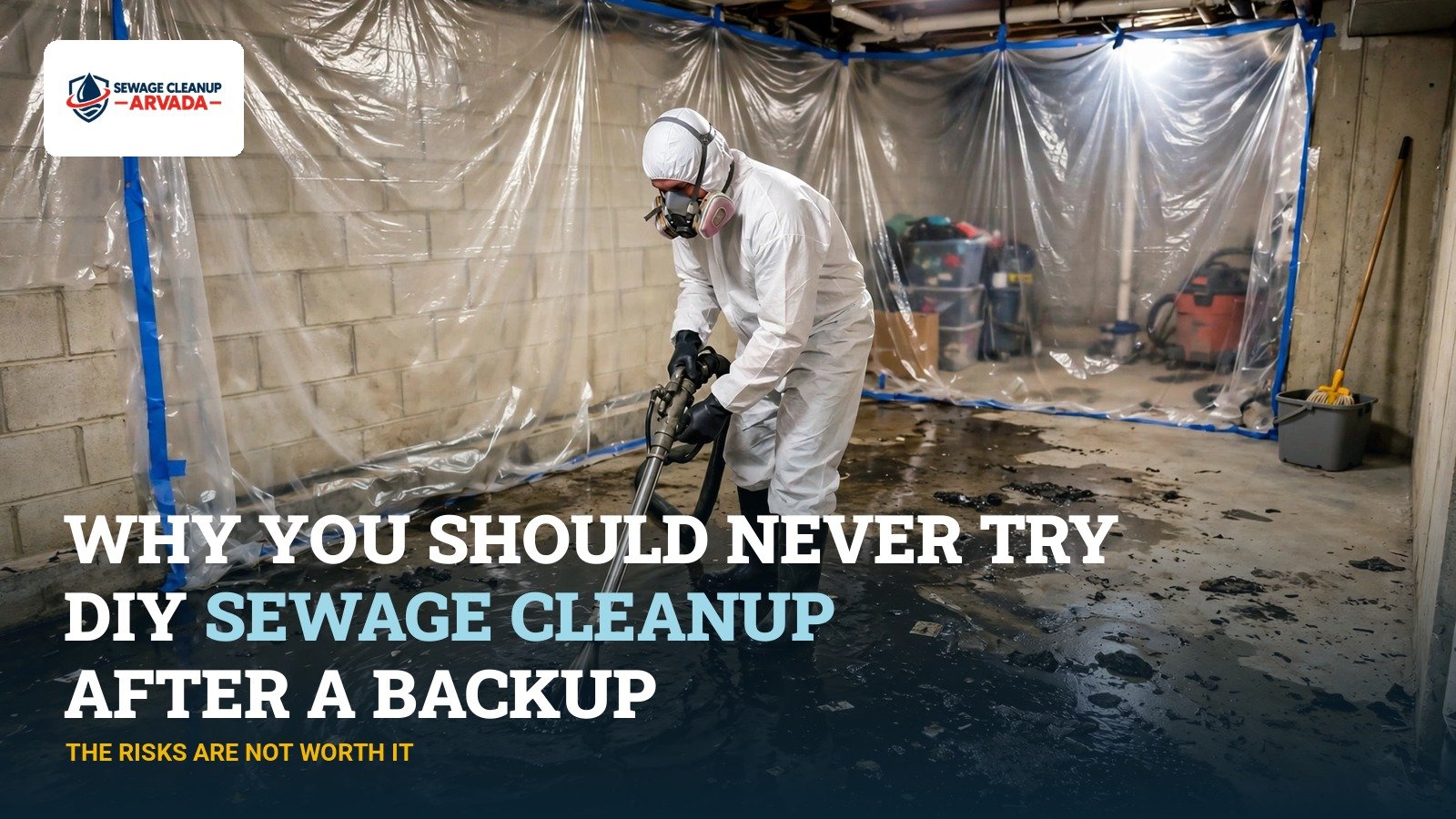
The water is on the floor, the smell is getting worse, and the mop is right there in the closet. That first impulse, to roll up your sleeves and handle it yourself, is understandable. It is also the most dangerous decision in the whole event. Sewage is Category 3 black water, and a backup is a contamination problem wearing the disguise of a cleaning problem. This article walks through the reasons DIY sewage cleanup puts your health, your home, and everyone in it at risk, and what to do instead.
Backups are not rare freak events. They are a routine failure of an aging, loaded system, and they happen in every kind of neighborhood.
More than 500,000 sewer backups occur each year in the United States, according to the Water Environment Federation.
Common, though, does not mean minor. Every one of those events puts contaminated water inside a home, and the water does not become safer because the situation is familiar.
In Allendale and across Arvada, Colorado, the pattern is the same: a line blocks or fails, wastewater looks for the lowest way out, and it finds a floor drain, a basement toilet, or a shower drain. What happens in the next hour decides how much of the home it touches.
The first reason is the water itself.
The restoration industry sorts water damage into categories. Category 1 is clean water. Category 2 is lightly contaminated water. Category 3 is sewage.
Sewage is Category 3 black water, the most contaminated of the three water damage categories defined by the IICRC.
That category exists because of what sewage carries: bacteria, viruses, and parasites from human waste, along with whatever chemicals and residues went down the drains connected to the line.
Contact with it is not a hygiene question. It is an exposure.
The smell is what pushes people to act fast, and it is the least of the problem.
Sewage exposure can cause stomach and intestinal illness, skin infections through cuts and broken skin, and respiratory irritation from the air in a contaminated room. The risk rises for anyone who spends real time in the water, which is exactly what a DIY cleanup asks for: kneeling in it, breathing over it, and carrying it through the house in buckets.
A professional crew treats that exposure as the central fact of the job. A homeowner with a mop treats it as a smell to get rid of. Only one of those starting points matches what is actually in the water.
The exposure math changes again with who is in the house.
Children put hands in mouths. Pets walk through a room and then groom themselves and climb on furniture. Older adults and anyone with a weakened immune system face a higher risk from the same contact.
Keeping them out of the affected area is not caution theater. It is the single most protective step in the first hour, and it is free.
Look at what a professional wears to enter a sewage affected room, and the DIY gap becomes physical.
A full protective suit that sewage cannot soak through. A respirator that filters the air, not a dust mask. Heavy gloves that resist tearing. Rubber boots that keep contaminated water off skin for hours.
Household gear fails at every point on that list. Kitchen gloves tear on debris. Cloth and paper masks do not seal. Sneakers and work boots soak through and then carry contamination onto every floor they touch afterward, including the clean ones.
The gear is not a uniform. It is the difference between working in Category 3 water and being exposed to it.
Protective gear has a second job that is easy to miss: it can be removed and bagged as contaminated waste when the work is done.
A homeowner’s clothes and shoes have no such exit. Whatever they picked up in the affected room travels with them: onto the stairs, the hallway carpet, the kitchen floor, and eventually into a washing machine shared with the rest of the household laundry.
Crews plan the way out of the room as carefully as the way in. DIY cleanup almost never does, because nobody warns the homeowner that they have become part of the contamination path.

Even a careful DIY effort moves contamination around. The tools themselves are the reason.
A mop does not lift sewage out of a room. It pushes contaminated water across the floor, into grout lines, under baseboards, and toward rooms that were clean. The rinse bucket then carries that water to a sink somewhere else in the house.
A household vacuum is worse. It is not built for contaminated water, and it can pull sewage into its motor and push contaminated air out the other side.
Fans pointed at a wet, contaminated room do something similar with air. Before an area is cleaned, moving air carries moisture and particles into clean rooms and into the heating and cooling system.
And the most common DIY test of all, flushing a toilet or running water to see whether the line has cleared, adds more water to a system that has already failed. The backup does not drain. It grows.
None of this is carelessness. It is what household tools do, used exactly as designed, on a problem they were never designed for.
There is also the question nobody asks at the start: where does the water go?
Every bucket of sewage carried out of a basement gets emptied somewhere, usually a sink or a laundry tub in a clean part of the house. Every mop gets rinsed somewhere. The tools themselves then need to be cleaned, which spreads the same problem to the tools, the sink, and the hands doing the rinsing.
Professional extraction removes the sewage from the home in one direction, out of the sealed work area. DIY cleanup moves it through the home in several directions, one bucket at a time.
A floor can be wiped. A wall cannot.
Sewage wicks upward into drywall and insulation, travels under flooring, and settles into carpet padding, all of it hidden within hours of the backup. The surface a homeowner can reach is the smallest part of the affected area.
That hidden moisture is the long-term problem. Materials that stay wet inside a wall grow mold, and porous materials that absorbed sewage keep the contamination and the odor locked inside them, no matter how the surface smells afterward.
This is why a room can look finished after a DIY effort and still be an active problem. The visible part was never the measure. The inside of the wall was, and it cannot be checked with eyes or a nose. It is checked with moisture readings, after the contaminated materials have been removed.
A backup is a symptom. Something upstream failed, and wiping the floor does nothing about it.
Tree roots cause more than 50 percent of sewer blockages, according to research published through the U.S. Forest Service.
Roots inside a line, a collapsed section of pipe, a grease blockage: each one stays exactly where it was while the floor gets mopped. The next heavy use of water, the next storm, the next load of laundry can push the same sewage back into the same room.
A homeowner who handles the cleanup alone also handles the second backup alone, usually in a room that was never fully dried from the first one.
One boundary in a backup is absolute, and it has nothing to do with cleaning.
Standing water and electricity are a dangerous combination. If sewage has reached outlets, cords, appliances, or the electrical panel, the affected area is not a cleaning problem at all until that risk is cleared.
Do not enter standing water to reach a switch, a plug, or a panel. Do not move appliances that are sitting in it. Treat the whole area as off limits and say so plainly when you call for help, and call an electrician or the utility where the situation calls for it.
Professional crews hold the same boundary. The difference is that they plan around it from the first phone call, instead of discovering it with wet feet.
The honest reason most people reach for the mop is simple: calling for help feels like the bigger step, and the DIY route feels like handling it yourself for nothing.
That math ignores what delay and partial work do to the damage itself. Sewage that sits while a homeowner works through it slowly soaks deeper into padding, drywall, and insulation, so more of the room ends up in the removal pile. A backup that returns because the cause was never addressed starts the whole event over in a room that was never fully dry. Contamination spread into clean rooms adds those rooms to the job.
The DIY route is not the same work done the easy way. It is a smaller, riskier piece of the work, and the rest of the damage arrives later, larger than it had to be. The homeowners who come out ahead after a backup are the ones whose first hour protected the rest of the house.
Set the two approaches side by side and the gap is not effort. It is equipment and method.
A professional response starts with containment, sealing the work area off from the rest of the home. It uses industrial extraction to remove the sewage itself, not spread it thinner. Contaminated porous materials are removed and leave the house as sealed waste. Surfaces that remain are cleaned, then disinfected, and the structure is dried until moisture readings prove it.
For a full walkthrough of what does sewage cleanup involve, stage by stage, that guide covers the process in order.
None of that lives on a garage shelf, and none of it can be improvised safely in an afternoon. That is the whole argument: DIY sewage cleanup is not a simpler version of the same job. It is a different, riskier activity with the same name.

Skipping the DIY route does not mean standing idle. The safe steps are few, and they matter.
Stop using water and drains throughout the home. Every flush and every load of laundry travels through the same line that just failed.
Keep people and pets out of the affected area, and keep the door closed where there is one.
Treat electricity as a hard boundary. If water has reached outlets or appliances, stay out of the area entirely.
Document from dry ground. Photos of the water level, the affected fixtures, and the rooms involved, plus a short note of when the backup was first noticed, help everyone who gets involved later.
Do not throw damaged items away before they are documented. A short list and a few photos protect you in every conversation that follows a backup, and items tossed in the first hour cannot be recorded afterward.
If you rent, call your landlord or property manager in the same first hour. A backup can involve shared lines and neighboring units, and early notice protects everyone in the building, not just your own rooms.
Then make the call for sewage cleanup help. Sewage Cleanup Arvada is locally based in Arvada, Colorado, with 24/7 emergency sewage cleanup available, so the first hour can end with a plan instead of a mop.
Homeowners come first, because the DIY impulse is strongest in the person who owns the home, pays for the damage, and wants the problem gone tonight.
Rentals, condos, and HOA-managed properties come next. A tenant facing a backup may feel pressure to handle it quietly, and a landlord may suggest it from a distance. The Category 3 risk is identical either way, and the safe answer is the same.
Commercial properties follow, and they are never left out. Restaurants, retail spaces, offices, and multifamily buildings across Arvada, Colorado cannot put staff or customers anywhere near a sewage affected area, and the no-DIY rule applies there with even less room for debate.
The full range of sewage cleanup services exists for exactly this situation, scaled to the space involved.
Sewage Cleanup Arvada serves the Allendale community in Arvada, Colorado, near local landmarks like the Arvada Center for the Arts and Humanities, for homes close to the crossing of Wadsworth Blvd and W 58th Ave, at coordinates 39.802, -105.08147.
Get Sewage Cleanup Allendale Service Now

Can I clean up a small sewage spill myself?
Size does not change the category. Even a small amount of sewage is Category 3 black water, and it soaks into porous materials the same way a larger backup does. Keep people and pets away from it, stop using water and drains, and have it handled with protective gear and proper removal rather than household tools.
What happens if sewage is just left to dry on its own?
Drying is not cleaning. Sewage left in place leaves its bacteria and residue in the materials it soaked into, and moisture inside walls and under floors feeds mold growth. The odor usually gets worse, not better, and the contaminated materials still have to come out in the end.
Is bleach enough to make a room safe after a sewage backup?
No. Bleach on a surface cannot reach contamination soaked inside carpet padding, drywall, or insulation, and chemicals should never be mixed into sewage water. Professional work cleans first and then disinfects the surfaces that remain, after the materials that cannot be disinfected have been removed.
Why does the sewage smell keep coming back?
Because the source is still there. Odor that survives a surface wipe usually means residue remains in a drain, contamination sits inside a wall base, or a porous item that absorbed sewage is still in the room. Removing the source ends the smell. Covering it does not.
What should I do while waiting for professionals after a backup?
Stop using water and drains, keep children and pets away from the affected area, and stay out of standing water, especially near outlets or appliances. Take photos and notes from a dry, safe spot, and do not discard damaged items before they are documented.
Sewage Cleanup Arvada, 5292 Ward Rd #2, Arvada, CO 80002. (720) 764-0457
Hours: Open 24 hours, 7 days a week for emergency service
A mop, a bucket, and a spray bottle handle most messes in a house. A sewage backup is not one of those messes. Sewage cleanup is a defined response to contaminated water: it removes the sewage itself, takes out the materials it has soaked into, disinfects what remains, and dries the structure with measurements to prove it. This article explains what sewage cleanup is, what sewage actually contains, and the specific points where regular cleaning stops being enough.
Sewage cleanup is the work of making a space safe again after wastewater has entered it.
That word, safe, is the heart of the definition. A regular cleaning job is finished when a room looks and smells clean. A sewage cleanup in Arvada, Colorado is finished when the contamination is gone, the materials that held it are out, and the structure is measurably dry.
The two jobs share a few tools and almost nothing else.
Here is the definition in plain terms.
Sewage cleanup is the controlled removal of sewage and contaminated water from a building, the removal of porous materials that sewage has soaked into and cannot be disinfected, the cleaning and disinfecting of the surfaces that remain, and the drying of the structure until moisture readings return to normal levels.
Every part of that sentence earns its place. Controlled means the affected area is sealed off so contamination does not travel. Removal means some things leave the house instead of being wiped down. Drying with readings means the end of the job is verified, not guessed.
When a homeowner in Whisper Creek or anywhere else in Arvada, Colorado searches for sewage cleanup, this is the service the words point to.
Sewage enters a home through the lowest openings first.
A blocked main sewer line pushes wastewater back toward the house, and it surfaces at floor drains, basement toilets, and shower drains. A toilet overflow can send contaminated water across a bathroom floor. A septic system that is full or failing can push sewage back through the same openings.
The source matters less than what arrives. Whatever the path, the water that comes through a drain carries the contents of the sewer line with it, and it is handled as contaminated from the first minute.

The difference between sewage cleanup and regular cleaning starts with what is in the water.
Household dirt is mostly inert: dust, soil, grease, food residue. Unpleasant, but not a health hazard in normal contact.
Sewage is different in kind, not just in degree.
Raw sewage carries bacteria, viruses, and parasites from human waste.
It can carry E. coli and other bacteria that cause stomach and intestinal illness. It can carry viruses that survive in water and on surfaces. It can carry parasites that are built to pass from waste into a new host.
It also carries whatever else went down the drains of every home connected to the line: cleaning chemicals, oils, and residues that do not belong on a basement floor or in the air of a living space.
None of this is visible. Sewage that looks like plain dark water carries the same load as sewage that looks far worse, which is why appearance is never the test.
The restoration industry sorts water damage into three categories, and sewage sits in the last one.
Category 1 is clean water from a supply line. Category 2 is used water with some contamination, such as water from an appliance. Category 3 is sewage.
Sewage is Category 3 black water, the most contaminated of the three water damage categories defined by the IICRC.
That classification is why sewage cleanup follows hazard rules instead of housekeeping rules. It decides the protective gear, the containment, the removal of porous materials, and the level of disinfection the job requires.
A Whisper Creek homeowner does not need to memorize the categories. Knowing that sewage sits at the top of the scale is enough to understand why the response looks the way it does.
Put the two jobs next to each other and the differences line up clearly.
Regular cleaning works on surfaces, assumes the mess is safe to touch, and ends when things look clean. Sewage cleanup works on a contaminated area, assumes the mess is hazardous, and ends when measurements say the space is clean and dry.
Four differences carry most of the weight.
Regular cleaning is built for ordinary soil.
Soap and household cleaners lift dirt and grease from hard surfaces. A vacuum picks up dry debris. A mop spreads cleaner across a floor that is safe to stand on.
All of it assumes the person cleaning can touch the mess, breathe the air, and carry the bucket through the house without spreading anything dangerous. Those assumptions hold for a muddy footprint. They fail completely for sewage.
A cleaned kitchen floor is done when it shines. A sewage affected basement is not done when it shines, because the hazard was never the appearance.
The goal of sewage cleanup is a space where the contamination is actually gone: the sewage removed, the soaked materials out, the remaining surfaces disinfected, and the structure dry. Appearance is a byproduct. Safety is the deliverable.
This is also why a room can look perfectly fine after a wipe down and still fail every part of the real test.
Sewage cleanup begins with full protective gear: a protective suit, a respirator, gloves, and boots, worn by everyone who enters the area.
It also begins with a boundary. The affected area is sealed off from the rest of the home so that foot traffic, air movement, and equipment do not carry contamination into clean rooms.
Regular cleaning has no boundary, because it does not need one. Dirt on a mop is a nuisance. Sewage on a shoe, tracked across a hallway carpet, is a second contaminated area.
Cleaning treats every surface as saveable. Sewage cleanup does not.
Porous materials hold contamination inside themselves. Carpet padding, drywall, insulation, and upholstered items that sewage has soaked into cannot be disinfected reliably, because no surface treatment reaches what is inside them. They are removed and disposed of as contaminated waste.
Hard surfaces are the other side of the line. Concrete, tile, sealed stone, metal, and glass can be cleaned and disinfected in place. The judgment between the two groups is a core part of what sewage cleanup is.
Regular cleaning ends on a judgment call. Sewage cleanup ends on readings.
After cleaning and disinfecting, the structure is dried with air movers and dehumidifiers, and moisture levels in walls and floors are checked with meters. The job closes when those readings match the dry parts of the home.
That short window is part of the definition too. A cleanup that leaves a structure damp for a week has traded contamination for mold, which is why drying is built into sewage cleanup rather than left as an afterthought.
Regular cleaning produces a bag of trash and a bucket of dirty water, both poured or thrown away without a second thought.
Sewage cleanup produces contaminated waste. The sewage itself, the removed padding and drywall, and the water used during the work are all handled as hazardous material, bagged and taken out through the sealed area rather than carried through clean rooms.
That difference sounds like paperwork. It is not. It is the step that decides whether the contamination leaves the house or simply relocates to a hallway, a garage, or a kitchen sink on its way out.

With the differences clear, the contents of the job itself are easier to place.
Sewage cleanup includes containment of the affected area. It includes extraction of standing sewage with industrial equipment, not buckets. It includes the removal and safe disposal of porous materials that cannot be disinfected. It includes cleaning first and disinfecting second, in that order, because disinfectant spent on surface soil does far less work on the germs beneath it. It includes odor treatment at the source, and structural drying that ends with moisture readings.
None of those elements appear in regular cleaning, because regular cleaning was never designed for a hazardous material.
For homes in Whisper Creek arranging sewage cleanup help, this list is the practical meaning of the term: not a deeper version of house cleaning, but a different job altogether.
Definitions matter most where the water lands, and in homes it lands in the basement more than anywhere else.
According to the Insurance Institute for Business and Home Safety, 68 percent of all drain system sewer backup claims started in the basement.
Basements hold the lowest drains in the house, and many Arvada, Colorado basements are finished living space: carpet, drywall, insulation, furniture, and stored belongings, all of them porous, all of them at floor level where sewage arrives first.
That combination is exactly where the gap between cleaning and cleanup does its damage.
A mop moves across the surface of a floor. Sewage moves into the floor, under it, and up the base of the wall behind it.
Carpet padding holds contaminated water against the slab. Drywall wicks moisture upward past the visible line. Insulation inside the wall stays wet long after the room feels dry.
Treating those materials as a cleaning problem leaves the contamination in place, sealed inside the structure of the home. Treating them as a cleanup problem takes them out, which is the entire point of the distinction.
The size of this gap depends on the room the sewage reaches.
A backup across a bare concrete floor in an unfinished utility area is the simplest version of the job: extraction, cleaning, disinfection, and drying, with little or nothing porous to remove.
The same backup in a finished basement is a larger event by far. Carpet, padding, drywall, insulation, and furniture are all in the water at once, and each one has to be judged, and most of them have to come out.
Both events carry the same Category 3 label. The definition of the response stays the same. Only the amount of material inside the boundary changes.
Homeowners often judge a backup by the smell, and the smell is real. Sewage odor is strong, and it lingers.
But odor is a sign of a source, not the source itself. When the smell survives a wipe down, it usually means contamination remains: residue in a drain, moisture inside a wall base, or a porous item that should have come out.
Sewage cleanup removes the source. Regular cleaning, at its best, perfumes it for a few days.

Whisper Creek sits in northwest Arvada, Colorado, near Whisper Creek Park, with many homes reached from Indiana St and W 86th Pkwy.
The neighborhood mix includes newer homes with finished basements, the exact layout where a backup does the most quiet damage. A finished basement hides the travel paths of water behind drywall and under carpet, so the visible puddle is often the smallest part of the event.
Knowing what sewage cleanup is, before one is needed, changes the first hour. The safe steps are simple: stop using water and drains, keep people and pets away from the affected area, treat electricity as a hard boundary, and take photos and notes from dry ground.
Homeowners who have read through how to prepare your home before the sewage cleanup crew arrives tend to have a calmer first hour, because the preparation is mostly about protecting the clean parts of the home and leaving the contaminated parts alone.
Homeowners come first, because they live with both the health question and every decision that follows a backup.
Rentals, condos, and HOA-managed properties come next. A tenant usually finds the water, while an owner or manager arranges the response, and a shared definition of sewage cleanup keeps that conversation clear: what will be removed, what will be disinfected, and how dryness will be proven.
Commercial properties follow, and they are never left out. Restaurants, retail spaces, offices, and multifamily buildings across Arvada, Colorado deal with the same Category 3 water, and the same definition applies at a larger scale.
The full range of sewage cleanup services is built on this definition, scaled to the space involved.
Sewage Cleanup Arvada serves the Whisper Creek community in Arvada, Colorado, near local landmarks like Whisper Creek Park, for homes close to the crossing of Indiana St and W 86th Pkwy, at coordinates 39.85678, -105.15807.
Get Sewage Cleanup Whisper Creek Service Now
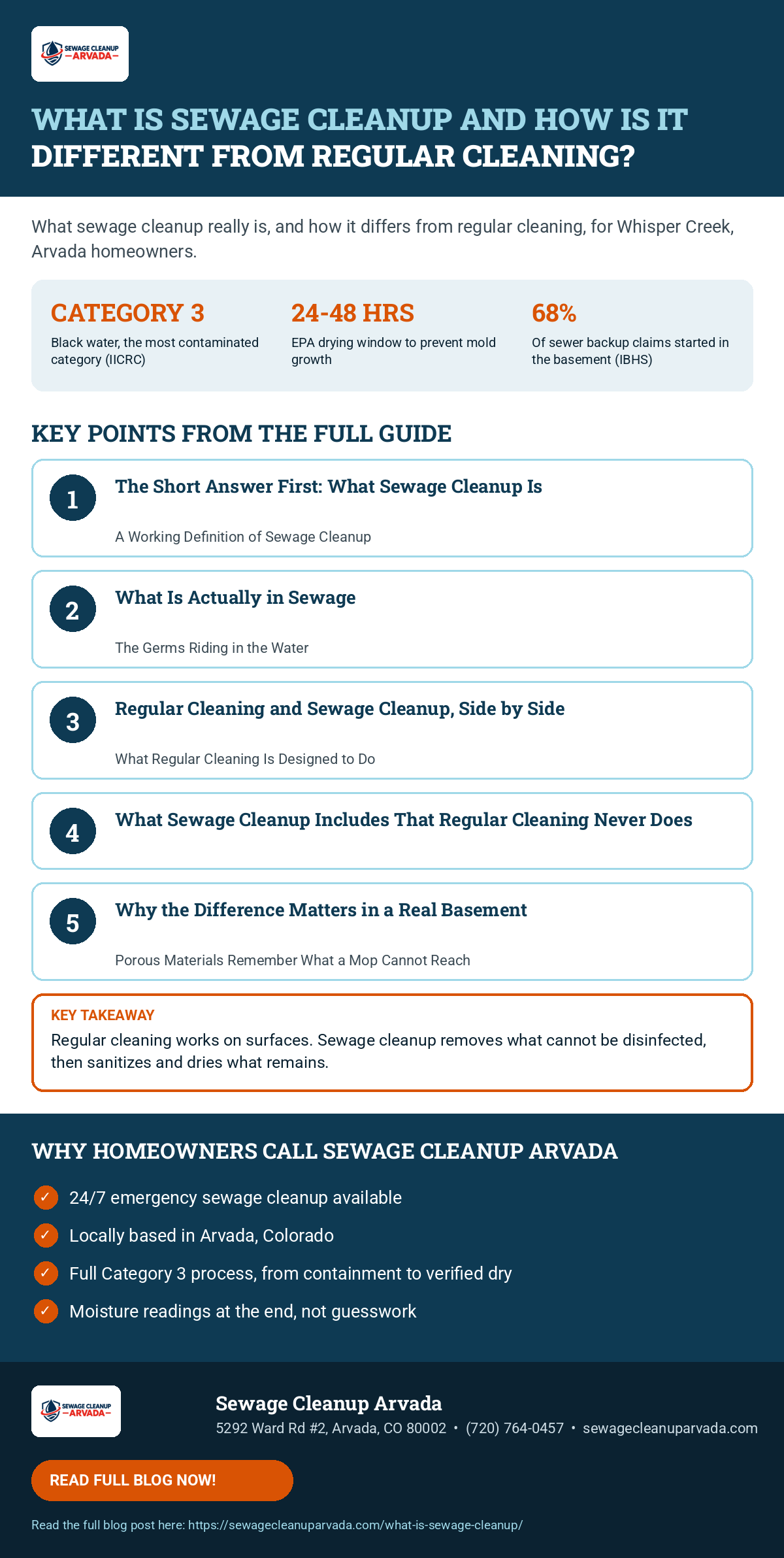
What is sewage cleanup in simple terms?
It is the process of making a space safe after sewage has entered it: removing the sewage and contaminated water, taking out porous materials that cannot be disinfected, cleaning and disinfecting the surfaces that remain, and drying the structure until moisture readings are normal.
Is sewage cleanup the same as deep cleaning?
No. Deep cleaning is still regular cleaning, aimed at dirt and surface germs in a space that is safe to be in. Sewage cleanup is a response to Category 3 black water, with protective gear, containment, removal of contaminated materials, and verified drying. The goal is safety, not appearance.
Why is sewage called black water?
Black water is the industry term for Category 3 water, the most contaminated category in the IICRC classification. The name marks it as water that carries sewage and a heavy load of bacteria, viruses, and parasites, as opposed to clean water or lightly contaminated gray water.
Can household cleaners make a room safe after a sewage backup?
Household cleaners are made for surface soil on hard surfaces, in spaces that are safe to touch. Sewage soaks into porous materials where surface products cannot reach, and it exposes anyone cleaning to Category 3 contamination. That is why the work is done with protective gear, containment, and removal of the materials that hold the contamination inside them.
What should I do first if sewage backs up into my home?
Stop using water and drains, keep children and pets away from the affected area, and stay out of standing water, especially near outlets or appliances. Take photos and notes from a dry, safe spot, and call for professional sewage cleanup help. Do not try to mop, vacuum, or disinfect the sewage yourself.
Sewage Cleanup Arvada, 5292 Ward Rd #2, Arvada, CO 80002. (720) 764-0457
Hours: Open 24 hours, 7 days a week for emergency service
In many cases, yes. When a sewage cleanup is limited to one backed-up area and that area can be sealed off, the rest of the home usually stays safe to live in while the crew works. In other cases, when sewage has spread widely, is still rising, or has reached electrical systems, leaving is the safer choice. This guide explains how that stay or leave decision is made in Arvada, Colorado, and the rules that protect a household either way.
A sewage backup is not a bigger version of a clean water leak. It is a different category of problem entirely.
Clean water from a supply line is mostly a moisture problem. Sewage is a moisture problem and a contamination problem at the same time, and the contamination is what drives every safety decision in this guide.
Sewage water can carry bacteria, viruses, and parasites, along with whatever chemicals and waste went down the drains above it.
Contact with it can irritate skin and make people ill, and the risk is highest for anyone who touches it, walks through it, or breathes the air in a heavily affected room for hours.
That is why the safety question is never just about the room with water in it. It is about contact, air, and who in the household is most vulnerable.
It also explains a point that surprises people: the size of the puddle is not the measure of the risk. A small amount of sewage in the wrong place, near a sleeping area, a play space, or an electrical panel, can matter more than a larger amount sealed inside an unfinished basement corner.
Most stay or leave decisions come down to two questions.
How far did the sewage reach? And can that area be completely sealed off from the rest of the home?
When the answer is one room, sealed behind plastic containment sheeting with its own boundary, the rest of the house usually stays livable. When a Village of Five Parks homeowner calls about sewage cleanup, this reach and containment check is the first thing the crew works through, because it decides how the family lives for the next several days.
Containment is more than a plastic sheet. The crew seals the work area, controls how air moves across the boundary, and treats the opening as a one-way door: people and equipment pass through it carefully, and contaminated material leaves bagged, not carried loose through the house.
That discipline is what makes the rest of the home genuinely separate from the problem. Without it, foot traffic and air currents would slowly carry the affected area into every room the family uses.
It is also why the rules below matter. Containment only works if the household treats the boundary as real.
The affected room itself is off limits, full stop. Nobody sleeps, eats, or spends time in it until the crew has cleaned, sanitized, and verified it.
Rooms the sewage passed through are treated the same way, even if they only held water briefly.
Bathrooms and fixtures connected to the blocked line are also out of use. Every flush or drain on that line can push more sewage into the home, so those fixtures stay unused until the crew says the line is clear.
Unaffected rooms on other floors, or on the far side of the sealed area, usually stay usable.
Kitchens, bedrooms, and living areas the sewage never reached can stay in normal use, with the work zone door kept closed and the containment left untouched.
Knowing what a professional sewage cleanup involves helps here. The sealed doorway is not a warning sign that the whole house is dangerous. It is the system that keeps the rest of the house safe.

Some situations move the answer from stay with rules to leave until it is handled. Three of them come up again and again.
Standing water and electricity do not mix, and this rule has no exceptions.
If sewage has reached outlets, appliances, or the electrical panel, stay out of that area entirely. Do not wade in to reach a switch, and do not touch a panel that water has reached.
When the affected electrical systems serve the whole home, or the water level makes the area impossible to avoid, leaving until an electrician or the utility confirms it is safe is the right call.
A backup that has stopped is a cleanup problem. A backup that is still rising is an ongoing event, and staying in the home while it spreads is a different risk.
Tree roots cause more than 50 percent of sewer blockages, according to research published through the U.S. Forest Service.
A line blocked by roots, grease, or a collapse does not clear itself. Until the blockage is dealt with, every use of water in the home can send more sewage inside, including overnight. If your household cannot realistically stop using water, leaving until the line is addressed is the safer pattern.
Sometimes the question answers itself. If the sewage is in the kitchen, the only bathroom, or the bedrooms, there may be no practical way to live around it.
A home needs working facilities and a clean place to sleep. When the backup removes those, a few nights elsewhere is not an overreaction. It is the plan.
A house can be safe for one person and wrong for another. The crew will usually ask about the household for exactly this reason.
Young children should stay out of the affected area completely, and are often better off staying elsewhere for the first day or two. Children play on floors, touch everything, and put hands in mouths, which is exactly the contact pattern sewage safety rules are built around.
Older adults, anyone who is ill, and anyone with a weakened immune system should also be cautious. The germs in sewage that a healthy adult shrugs off can hit a vulnerable person much harder.
People with asthma or other breathing conditions should weigh the air side of the problem. Odors and airborne particles near a work area can aggravate sensitive lungs even outside the sealed zone.
Pets belong on the cautious list too. A dog or cat that walks through the affected area carries contamination into every clean room it visits afterward.
If anyone in the home is very young, elderly, ill, or immune compromised, lean toward leaving for the active phase of the work.
If the household is healthy adults, the sewage is contained to one sealed area, and the facilities still work, staying is usually reasonable with the ground rules below.
When in doubt, describe your household on the first call. The crew has this conversation every week and will give you a straight answer.
Mention who lives in the home, who has health conditions, where everyone sleeps, and where the pets stay. Those four facts shape the advice more than the size of the backup does, and they cost nothing to share. A crew that knows a toddler sleeps one room away from the work area will plan the containment and the schedule around that child from the first hour.

The overnight question deserves its own section, because it is where most families hesitate.
A sewage smell is not just unpleasant. It is information.
Sewer gas can irritate the eyes, throat, and stomach, and a smell that is strong in a bedroom means the source is close or the air is traveling. Treat a strong smell in a sleeping area as a reason to sleep elsewhere in the home, or to leave, not as something to push through.
The smell also fades only when the source is removed. If a cleaned home still smells days later, something was missed, and that is worth a call back, not a scented candle.
There is one more reason not to spend days deciding. Damp materials do not wait.
The U.S. Environmental Protection Agency advises drying water-damaged areas and items within 24 to 48 hours to prevent mold growth.
A household does not need to panic over that window, because the crew builds drying into the job from the first visit. But a home that sits wet while the family debates is a home where the mold risk quietly grows, and mold in a wall makes the stay or leave question much harder a week later.
One more air rule: never run your own fans in or toward a contaminated area before it is cleaned. Moving air over sewage spreads particles into clean rooms. Drying with fans is the crew’s job, and it starts only after cleaning and sanitization are done.
Staying is safe when it is done deliberately. These are the rules crews ask households to follow.
Keep everyone, including pets, out of the sealed work area. Do not open the containment to check on progress. Ask the crew at the door instead.
Pause water use, or limit it exactly as the crew advises. The fixtures connected to the blocked line stay off limits until the line is confirmed clear.
Wash hands and change shoes after any time near the work zone, and keep children from playing on floors near the boundary.
Do not move drying equipment, switch it off, or open windows around it unless the crew asks. The layout follows moisture readings, and changing it slows the drying that makes the room safe again.
Document from dry ground. Photos and notes taken from outside the affected area help with every later conversation, and they never require stepping into sewage.
Daily life needs a few adjustments while the work runs.
Keep food preparation and eating well away from the work zone, and wash hands before meals, not just after contact. If the kitchen itself is anywhere near the affected area, treat surfaces with extra care and keep food covered and stored away from the boundary.
Do not wash items that touched sewage in the family washing machine, and do not carry them through clean rooms to get there. Bag nothing yourself inside the affected area. Ask the crew what can be saved and how they handle it, because contaminated laundry is part of their process, not a household chore.
Dry belongings near the work area can be moved to a clean room. Wet or touched belongings stay where they are until the crew judges them.
These rules hold across every kind of job, from a single bathroom backup to a full basement. The full range of sewage cleanup services runs on the same containment and safety logic, scaled to the space involved.

The same rules apply in shared buildings, with one complication: the line is often shared too.
In a condo or multifamily building, a backup can come from a shared stack, which means your neighbor’s water use can affect your unit. Tell the building manager or HOA contact early, and tell the crew the building shares lines, because the stay or leave answer may depend on water use you do not control.
Renters should call the landlord or property manager at the same time as they call for cleanup help. Stopping water use and keeping people away are safety steps that never need permission. The decisions about the work itself belong to the owner, and early notice keeps that from becoming a delay.
Homeowners come first, because they make the stay or leave call for everyone under their roof, and they carry the health risk if the call is wrong.
Rentals, condos, and HOA-managed properties come next. The tenant usually discovers the backup, while the owner or manager arranges the response, and both sides need the same clear answer about which rooms are usable and for how long.
Commercial properties follow, and they are never left out. Restaurants, retail spaces, offices, and multifamily buildings in Arvada, Colorado face the same reach and containment questions, with staff and customers added to the list of people the decision protects.
Sewage Cleanup Arvada serves the Village of Five Parks community in Arvada, Colorado, near local landmarks like Meiklejohn Elementary School, for homes close to the crossing of W 84th Ave and Alkire St, at coordinates 39.84872, -105.14777.
Get Sewage Cleanup Village of Five Parks Service Now

Is it safe to stay in a house with a sewage backup?
It depends on the reach of the backup. If the sewage is limited to one area that can be sealed off, the rest of the home usually stays safe to live in. If it has spread widely, is still rising, or has reached electrical systems, leaving is the safer choice until the crew has it contained.
Can I sleep in my house after a sewage backup?
Usually yes, if your bedroom is unaffected, the smell there is faint or absent, and you still have a working bathroom on a clear line. If the backup is in or near the sleeping areas, or the odor is strong in the bedroom, sleeping elsewhere for a night or two is the safer pattern. When the affected area is the basement and the bedrooms are upstairs with doors closed, most households sleep at home through the whole job.
Is the smell from a sewage backup harmful?
Sewer gas can irritate the eyes, throat, and stomach, and a strong smell means you are close to the source. Treat a strong smell in a living or sleeping area as a signal to keep your distance and let the crew remove the source, rather than something to get used to.
Do children and pets need to stay away during a sewage cleanup?
Yes, completely out of the affected area. Children touch floors and surfaces constantly, and pets carry contamination into clean rooms on their paws. Vulnerable family members are often better off staying elsewhere during the active phase of the work.
When is it safe to use the cleaned room again?
After the full process is complete: the sewage removed, unsavable materials taken out, surfaces cleaned and sanitized, and the structure dried to verified moisture levels. The crew confirms the room is finished with readings, and that confirmation is your signal the room is back in normal use.
Sewage Cleanup Arvada, 5292 Ward Rd #2, Arvada, CO 80002. (720) 764-0457
Hours: Open 24 hours, 7 days a week for emergency service
Most sewage cleanup jobs run on two different clocks. The hands-on work, assessment, extraction, removal, and sanitization, is usually finished within the first day or two. The drying that follows takes several more days, and the job is only complete when moisture readings confirm the structure is dry. For a typical home in Arvada, Colorado, the full timeline from the first call to a fully dry room often lands between three and seven days, and this guide shows where each of those days goes.
Homeowners usually picture one long cleaning visit. A real sewage cleanup in Arvada, Colorado looks different.
Think of it as a short burst of intensive work, followed by a longer, quieter stretch where equipment runs and the structure gives up its moisture day by day.
The burst is measured in hours. The drying is measured in days. Confusing the two is why timelines surprise people.
More than 500,000 sewer backups occur each year in the United States, according to the Water Environment Federation.
Because backups are this common, crews work to a well-practiced routine. What changes from one Arvada, Colorado home to the next is not the routine. It is the size of the affected area, the materials the sewage reached, and how long the water sat before the first call.
Day one decides almost everything about the timeline.
The crew starts by walking the affected area and the rooms around it. They map where the sewage entered, how far it spread on the surface, and which materials it touched.
Then the area is sealed off with containment sheeting, and the standing sewage is extracted with industrial equipment.
Assessment and containment usually take a few hours, not a full day.
The moisture checks matter as much as the visible damage. Sewage wicks into drywall, insulation, and under flooring, and the crew has to find those hidden paths before anyone can say how long the rest will take.
Extraction follows once the area is sealed. Removing the contaminated water itself is quick compared to everything after it, but it has to be complete, because every later phase depends on the liquid being gone.
The map drawn on day one decides the scope of removal, the layout of the drying equipment, and the number of drying days to expect.
A small backup caught early, on bare concrete, gives the crew a short map. A backup that sat overnight in a finished basement gives them a much longer one.
That is why an honest timeline can only be given after the first visit, not over the phone.

Once the standing sewage is out, the crew removes the materials that cannot be disinfected.
Carpet padding, affected drywall, and insulation come out because sewage soaks into them and no surface treatment reaches contamination inside a porous material.
After removal, the surfaces that remain are cleaned first and disinfected second, in that order, so the disinfectant works on the surface and not on the dirt covering it.
An unfinished basement is mostly hard surfaces. Concrete and tile can be cleaned and disinfected in place, which keeps this phase short.
A finished basement is built from porous materials. Carpet, padding, drywall, and insulation all hold sewage, and each one has to be cut out, bagged, and removed before sanitization can even start.
According to the Insurance Institute for Business and Home Safety, 68 percent of all drain system sewer backup claims started in the basement.
That figure explains the pattern crews see every week. The lowest room in the house collects the backup, and whether that room is finished or bare concrete is the single biggest factor in how long the hands-on work takes.

When the room looks clean, the longest phase is only starting.
Walls, framing, subfloor, and concrete hold moisture the eye cannot see. Air movers and dehumidifiers are placed in a planned layout, and they run around the clock, pulling that moisture out of the structure and out of the air.
Several days of drying is normal. It is not the crew being slow. It is the materials giving up water at the speed materials do.
Air movers and dehumidifiers do different jobs, and both are needed.
The air movers push air across wet surfaces so moisture evaporates out of the material. The dehumidifiers then pull that moisture out of the air, so it leaves the room instead of settling into the next surface.
A household fan only does the first half of that work, and does it without a plan. Professional drying is a loop: evaporate, capture, measure, adjust. That loop is what runs for several days, and it is why the equipment stays where the crew placed it.
Drying has a deadline built into it, and it starts the moment the water arrives, not the moment the equipment does.
That window is why the first visit happens fast and why drying equipment goes in on the same visit whenever possible. Every hour of delay before drying starts is an hour added to the risk at the other end.
Drying is monitored, not assumed.
The crew returns for short check visits, takes moisture readings across the previously wet materials, and adjusts the equipment layout if any area is drying slowly.
The job ends when those readings match the levels in unaffected parts of the home. Not when the surface feels dry, and not when a set number of days has passed. The readings decide.

Two homes on the same street in Arvada, Colorado can have timelines that differ by days. The reasons are consistent.
Distance is the first factor. Sewage that stayed in one bathroom is a short job. Sewage that crossed a finished basement, wicked up two walls, and ran under flooring is a long one, even if the visible puddle looked similar at first glance.
Hidden travel adds the most time, because it is usually found in stages, and each newly found wet area joins the drying plan.
The timeline does not start when the crew arrives. It starts when the sewage arrives.
Sewage that was extracted within the first hours has had little time to wick upward or soak deep. Sewage that sat through a weekend has reached further into every porous material it touched, and that depth shows up later as extra removal work and extra drying days.
This is the factor homeowners control most. A fast first call is worth more than any other single decision in the whole timeline.
Porous materials slow everything twice. They extend the removal phase, because they have to come out, and they extend the drying phase, because the structure behind them has to dry once they are gone.
Hard surfaces do the opposite. A backup across tile and concrete can move from extraction to drying in a single visit.
Colorado Front Range weather plays a quiet role. Heavy rain and spring snowmelt can saturate the ground around a home, and a structure dries more slowly when the air and soil around it are wet too.
A repeat backup during the same wet period resets the clock entirely, which is why the line problem behind the backup has to be addressed, not just the water inside the home.
Put together, a typical timeline for a sewage cleanup in Arvada, Colorado reads like this.
Day one: assessment, containment, extraction, and the start of removal. By the end of the first visit, the sewage is out, the area is sealed, and the drying equipment is usually running.
Day two: removal is finished if it was not completed on day one, and sanitization is completed. The room is clean. It is not yet dry.
Days three to five: drying, with short check visits for moisture readings. Quiet days for the homeowner, active days for the structure.
The final day: readings confirm the materials are dry, equipment comes out, and the space is handed back. Rebuilding what was removed, such as drywall and flooring, is a separate step that starts after this point.
One caution about that last step: rebuilding on a guessed dry date is how mold problems get built into walls. The verification reading is the gate. However long the drying took, the rebuild waits for the numbers, and a homeowner should be glad it does.
Homeowners arranging sewage cleanup in Leyden Rock or anywhere else in the city will hear this same shape of timeline, with the drying days flexing up or down based on the factors above.
The same backup behaves differently depending on which room it lands in.
A backup in a bathroom or laundry room is usually the shortest version of this job.
These rooms are small, mostly hard surfaced, and built to handle water. Tile, sealed floors, and a single wall or two mean less removal, and the drying area is compact. The hands-on work often fits inside day one, and drying finishes at the shorter end of the range.
The catch is use. That room is out of service for the whole timeline, which matters more in a one-bathroom home than the number of days does.
A finished basement is the long version.
More square footage, more porous materials, and more hiding places for moisture all stack together. Removal takes longer, the drying layout is bigger, and the check visits have more readings to take.
This is the version of the job that most often reaches the five to seven day end of the range, and occasionally passes it when hidden moisture keeps appearing in the walls.
You cannot dry a wall yourself, and you should not try. But the homeowner controls the first hours, and the first hours set the total.
Call as soon as you notice the problem. Every hour sewage sits, it soaks deeper, and deeper soaking means more removal and more drying days.
Stop using water and drains. Every flush travels through the same blocked line and can add to the backup while you wait.
Keep people and pets out of the affected area, and take photos and notes from a dry, safe spot. Documentation takes minutes and protects you in every conversation that follows.
Acting on the warning signs you need professional sewage cleanup early is the single biggest timeline saver there is. A backup caught at the slow-drain stage rarely becomes a five-day job.
Once drying starts, leave the equipment alone. Switching it off overnight or moving it to a quieter corner restarts the clock on the area it was drying.
Small practical things help more than people expect. Clear a path from the door to the affected area before the crew arrives, moving only dry items from clean rooms. Make sure the crew can reach the driveway, the gate, and the water shutoff. Decide where pets will spend the first day. Each of these removes a delay on day one, and day one delays echo through the whole schedule.
Also write down what you noticed and when: which drain backed up first, when the water appeared, and whether it is still rising. Two minutes of notes on day one can save the crew an hour of detective work, and that hour comes straight off your total.
Homeowners come first, because the timeline runs through their daily life. Knowing that the noisy part lasts a day or two and the quiet part lasts several days makes the week plannable.
Rentals, condos, and HOA-managed properties come next. A tenant needs to know how long the space will be out of use, and an owner or manager needs the same answer to plan around it. The phases are identical, only the scheduling conversations multiply.
Commercial properties follow, and they are never left out. A restaurant, shop, or office in Arvada, Colorado runs on the same two clocks, with the added pressure that the drying days are also closed or partially closed days for the business.
The full range of sewage cleanup services follows this same pattern, scaled to the size of the space and the materials involved.
Sewage Cleanup Arvada serves the Leyden Rock community in Arvada, Colorado, near local landmarks like Rocky Flats National Wildlife Refuge, for homes close to the crossing of Indiana St and W 82nd Ave, at coordinates 39.84514, -105.16528.
Get Sewage Cleanup Leyden Rock Service Now

How long does sewage cleanup take in total?
For most homes, the hands-on work takes one to two days, and drying takes several more days after that. A total of three to seven days from the first call to a verified dry room is typical, with small, unfinished areas at the short end and large finished basements at the long end.
Can a sewage cleanup be finished in one day?
The cleaning part sometimes can, when the backup is small and the surfaces are hard. The job itself cannot, because drying takes days and the final moisture readings have to confirm the structure is dry before the work is considered complete.
How long does the drying part take after sewage cleanup?
Several days is normal. Air movers and dehumidifiers run around the clock, the crew checks moisture readings along the way, and drying ends when the readings match the dry parts of the home, not when a fixed number of days has passed.
Can I use the room while the drying equipment is running?
It is better to stay out of the work area while equipment runs. The layout is planned around moisture readings, and moving or switching off a machine slows the drying for that whole area. The rest of the home stays usable as normal.
What happens if my home needs more drying days than expected?
The crew adjusts the equipment layout and keeps checking readings. Extra days usually mean a hidden wet pocket was found, in a wall or under flooring. Drying it properly then is far better than closing up a damp wall and dealing with mold later.
Sewage Cleanup Arvada, 5292 Ward Rd #2, Arvada, CO 80002. (720) 764-0457
Hours: Open 24 hours, 7 days a week for emergency service
Professional sewage cleanup is a staged process, not a single cleaning visit. It starts with assessment and containment, moves through extraction, removal of contaminated materials, cleaning and sanitization, and ends with structural drying that is verified with moisture readings. Each stage exists because sewage is Category 3 black water, and each stage has to finish before the next one can work.
The phrase gets used loosely, so it helps to pin it down.
Sewage cleanup means removing contaminated water and waste from a home, removing the materials that sewage has soaked into and cannot be disinfected, cleaning and disinfecting what remains, and drying the structure until measured moisture levels are back to normal.
That is a longer list than most people expect when they picture the job.
It is also why a sewage cleanup in Arvada, Colorado looks nothing like a normal house cleaning, even when the affected area is one basement room.
Three words appear in almost every search on this topic, and they are not quite the same thing.
Cleanup is the whole job, start to finish. Removal is one part of it: taking out standing sewage and the porous materials it has ruined. Remediation is the broader fix, which includes dealing with the effects of the event, such as contaminated materials, odors, and moisture inside walls.
When a homeowner in Arvada, Colorado searches for sewage cleanup, they usually mean all three, whether or not they know the separate words.
The stages below cover all of them, in the order a professional crew works through them.
Clean water and sewage sit at opposite ends of the water damage scale.
The IICRC (Institute of Inspection, Cleaning and Restoration Certification) sorts water into three categories. Category 1 is clean water from a supply line. Category 2 is used water with some contamination. Category 3 is sewage.
Sewage is Category 3 black water, the most contaminated of the three water damage categories defined by the IICRC.
That single classification drives the entire process. It is why the crew wears full protective gear, why porous materials come out instead of being wiped down, and why the area is sealed off before work starts.
Sewage can carry bacteria, viruses, and parasites. Anything it soaks into has to be judged against that fact, not against how dirty it looks.
A professional job starts before anyone reaches your door.
It starts with the call, the questions, and the equipment decisions that follow from your answers. By the time the crew arrives at a home in Ralston Valley or anywhere else in Arvada, Colorado, the first stage is already planned.
More than 500,000 sewer backups occur each year in the United States, according to the Water Environment Federation.
Backups are common enough that crews follow a set routine for them. What changes from home to home is the size of the affected area, the materials involved, and how far the water traveled.
On the call, expect to describe what happened in plain terms.
Which drain or fixture backed up first. When you noticed it. Whether the water is still rising or has stopped. Which rooms are affected, and whether the area is a finished space or bare concrete.
Expect questions about safety too. Whether the water reached outlets or appliances. Whether anyone in the home is ill, elderly, or has a weakened immune system. Whether pets are in the house.
Those answers decide what the crew loads onto the truck, so a clear description saves real time later.
The equipment list follows from the stages.
Extraction pumps and hoses for the standing sewage. Containment sheeting and tape to seal the work area. Protective suits, respirators, gloves, and boots for every person who will enter it.
Then the second wave: cleaning and disinfecting agents made for contaminated water, air movers and dehumidifiers for drying, and moisture meters for the checks that close the job.
None of it is decorative. Each item maps to a stage below.
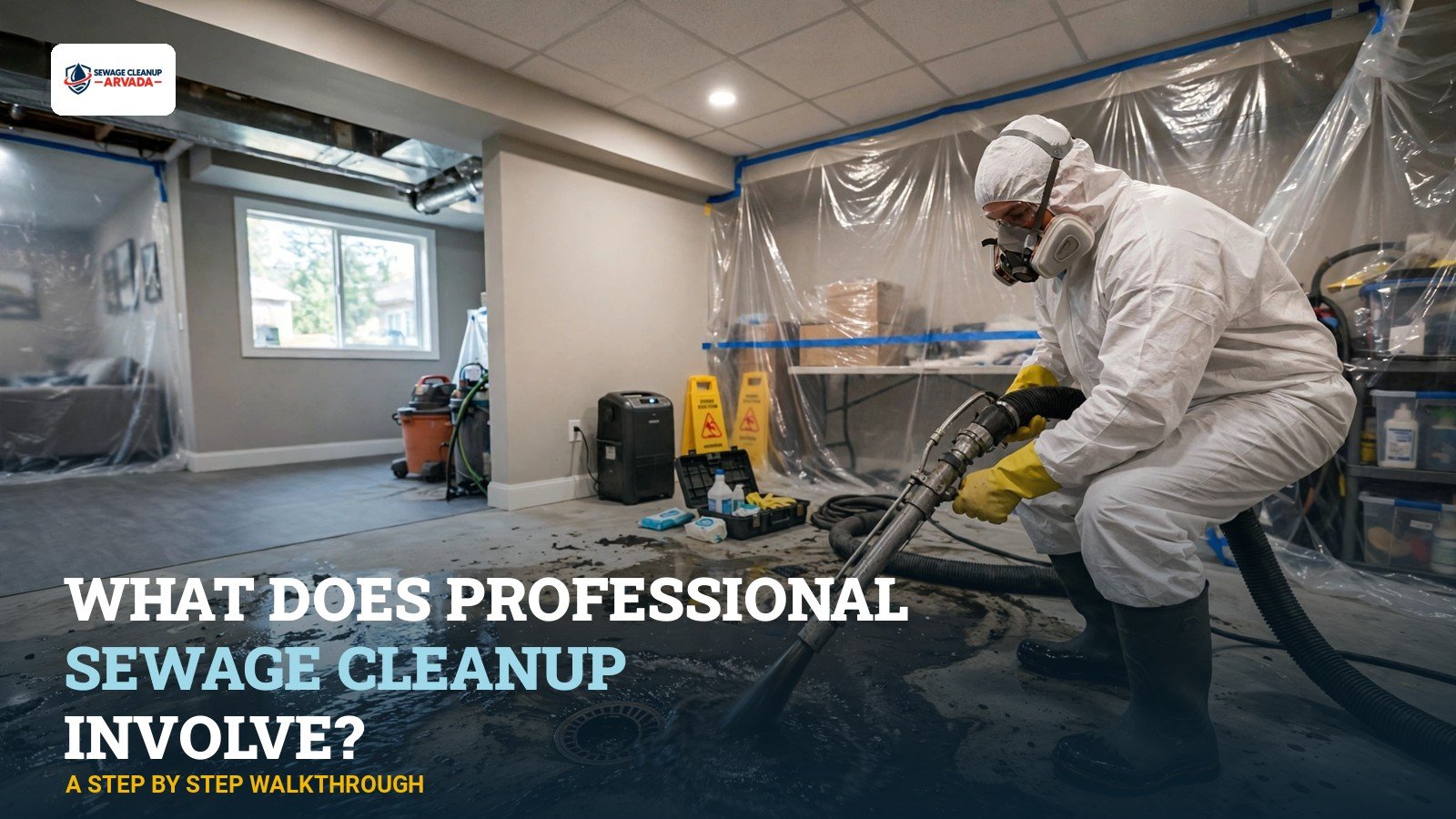
The crew does not start by removing water. It starts by understanding the job.
A technician walks the affected area and the rooms around it, looking at where the sewage entered, how far it spread on the surface, and which materials it touched. Floors, baseboards, drywall, insulation, carpet, and stored belongings all get noted.
Then the area is sealed. Plastic containment sheeting closes off the work zone from the clean parts of the home, so that everything that happens next stays inside it.
The visible puddle is only part of the map.
Sewage wicks upward into drywall and insulation, runs under flooring, and follows the slope of a slab into rooms that look untouched. A floor can look dry two rooms away while the base of the wall between them is soaked.
Assessment means checking those hidden paths, including moisture readings in walls and floors at the edges of the visible damage. The line the crew draws at this stage decides what gets cleaned, what gets removed, and what gets left alone.
In a Ralston Valley basement, that check often reaches further than the homeowner expected, because finished basements hide the travel paths behind drywall and under carpet.
Containment is the least visible stage and one of the most important.
Without it, every later step risks spreading contamination. Foot traffic carries residue. Air movement carries particles. Hoses and equipment move in and out through doorways.
The sealed zone gives the crew a clean boundary: contaminated items stay in, clean rooms stay clean, and people and pets in the home can use the rest of the house safely while work goes on.
This is also the stage where the crew confirms the source has stopped. Cleaning an area that is still receiving sewage is wasted work, so the line problem behind the backup is confirmed addressed, or at least no longer flowing, before extraction begins.
With the area assessed and sealed, the standing sewage comes out.
Industrial extraction equipment removes the water and waste far faster and far more completely than any household tool. The goal is not a floor that looks dry. The goal is removing the contaminated liquid itself, including what has pooled in low spots, along wall bases, and inside the floor drain area.
Speed matters here, but completeness matters more. Every hour sewage sits, it soaks deeper into porous materials and the removal list grows.
Homeowners sometimes ask why the crew does not scrub first and extract later.
The answer is simple. You cannot disinfect a puddle. Cleaning agents do their work on surfaces, and a surface covered in standing sewage is not reachable.
Extraction also protects the rest of the structure. Liquid sewage keeps spreading and wicking for as long as it sits. Removing it stops the clock on new damage and lets the crew see the true edges of the affected area, often for the first time.
Only after extraction does the real condition of floors, walls, and belongings become clear.
This is the stage homeowners find hardest, and it is the stage that defines professional work.
Porous materials that sewage has soaked into cannot be disinfected reliably. The contamination is inside the material, not on its surface, and no surface treatment reaches it. Those materials are removed and disposed of as contaminated waste.
The removal is surgical, not sweeping. Crews cut and take out only what the assessment and the water line show was reached, and they re-check as they open walls, because the inside of a wall sometimes tells a different story from its surface.
Carpet and carpet padding are at the top of the list. Padding in particular holds contaminated water like a sponge and sits at the top of the removal list on almost every job.
Affected drywall and insulation come out up to above the water line, because both wick moisture upward beyond what the eye can see. Baseboards usually follow, since water collects behind them.
Upholstered furniture, mattresses, and soft stored items that sewage reached are generally removed as well. So are cardboard boxes and paper goods stored on a basement floor, which absorb contamination instantly.
Hard, non-porous surfaces are the other side of the line.
Concrete floors, tile, sealed stone, metal, and glass can be cleaned and disinfected in place. Structural framing, once exposed, cleaned, and dried, normally stays. Appliances need individual judgment, depending on whether water reached motors, insulation, or controls.
This split is why two homes with the same sized backup can have very different jobs. A backup across a bare concrete floor in an unfinished Arvada, Colorado basement is mostly extraction, cleaning, and drying. The same backup in a finished basement adds a removal stage, because the room itself is built from porous materials.

Once contaminated materials are out, the surfaces that remain get cleaned, then disinfected. The order is deliberate, and reversing it is a common misunderstanding about how this stage works.
Cleaning removes the soil and residue. Disinfecting then treats the cleaned surface. A disinfectant sprayed onto a dirty surface spends itself on the dirt and does far less work on the germs beneath it.
Crews work through the zone methodically: floors, wall bases, exposed framing, fixtures, and any salvageable hard surfaces, with dwell time allowed for the products to do what they are rated to do.
Think of it as washing before treating, the same logic as washing a cut before dressing it.
This stage also covers the drain area and any fixtures the sewage passed through, since residue there can keep producing odor and contamination long after the floor looks clean.
For homes arranging sewage cleanup help, this is the stage that turns a room from emptied to genuinely clean, and it cannot be rushed without undoing its purpose.
A sewage smell that lingers after a backup almost always means a source remains: residue in a drain, contamination inside a wall base, or a porous item that should have come out.
That is why odor work belongs inside the cleaning stage rather than after it. Proper sanitization of every reached surface, plus removal of the materials that hold odor, is what ends the smell. Covering it with fragrance does not, and the smell returns within days when the source is still present.
Homes that still smell a week after a cleanup usually skipped something in this stage or in the removal stage before it.
The room now looks clean. It is not finished.
Walls, framing, subfloor, and concrete hold moisture that the eye cannot see, and damp building materials are an open invitation to mold. The drying stage runs air movers and dehumidifiers in a planned layout, moving air across wet surfaces and pulling the moisture out of the air as it evaporates.
Drying is measured in days, not hours, and it ends with readings, not opinions.
That window is the reason cleanup and drying are treated as one continuous job. A perfectly cleaned basement that stays damp inside its walls has traded one problem for another.
A household fan moves air. It does not remove moisture from the room, and on a contaminated or just-cleaned surface, uncontrolled airflow can push particles where they do not belong.
Professional drying pairs air movement with dehumidification and containment, so moisture leaves the structure and then leaves the air, instead of relocating into the next room. Equipment placement follows the moisture map from the assessment, and readings are taken again as drying progresses to confirm the plan is working.
If readings stall, the layout changes or a hidden wet pocket gets opened. The numbers lead.
The job closes with verification.
The crew takes moisture readings across the previously wet materials and compares them with readings from unaffected parts of the home. When the numbers match normal levels, the structure is dry, and the family can use the space again with the problem actually behind them.
This final check is the difference between a cleanup that was performed and a cleanup that was proven. It is worth asking any crew how they verify dryness, because “it feels dry” is not a measurement.
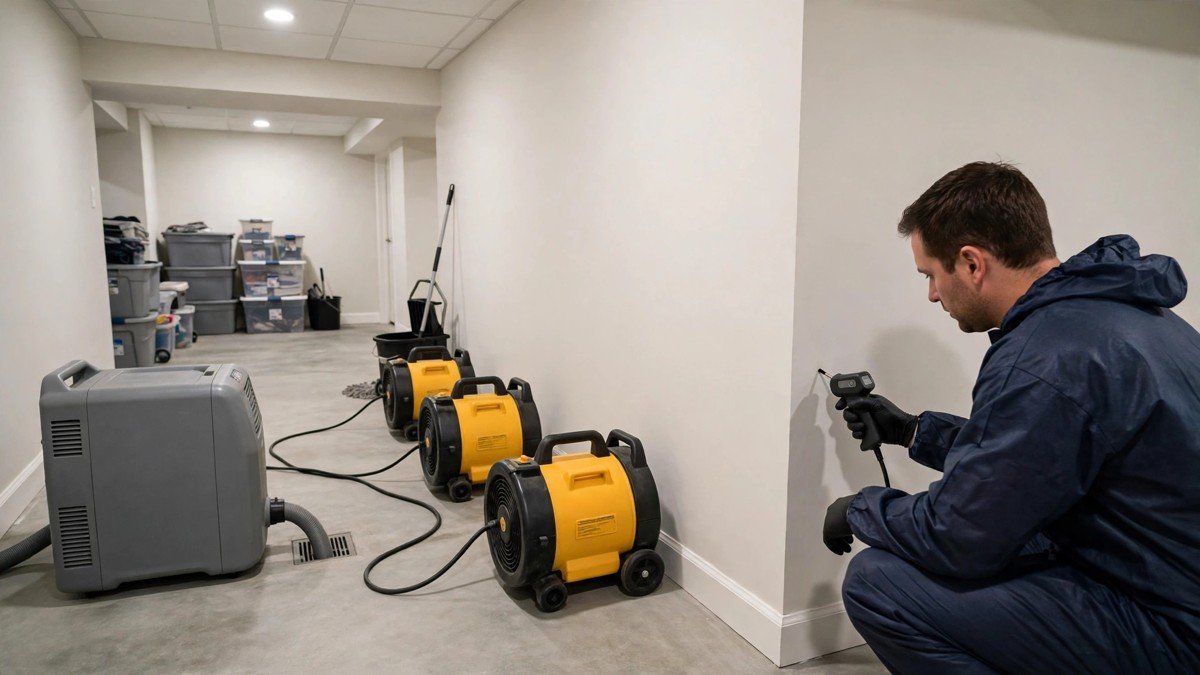
Homeowners ask this on almost every call, and the honest answer is that the stages have different clocks.
Assessment, containment, and extraction usually happen on the first visit. Removal and sanitization follow in the same visit or the next, depending on how much material is involved.
Drying is the long stage. Several days of equipment running is normal, with short check visits for readings. Rebuilding what was removed, such as drywall and flooring, is a separate step that starts only after the final moisture check passes.
What stretches a timeline is rarely the cleaning. It is how far the sewage traveled before the first call, which is why the warning signs you need professional sewage cleanup are worth knowing before a small problem becomes a five-stage job.
Your part of this process is small, and it is mostly about not adding to the problem.
Do keep people and pets out of the sealed area. Do keep water use paused or limited as the crew advises, since every flush still travels through the same line. Do ask questions at each stage; a good crew explains what is happening and why.
Do not enter the work zone to retrieve belongings. Do not move drying equipment, switch it off, or open the containment to peek. Do not pour bleach or chemicals into drains or onto floors in the work area; it interferes with the crew’s products and does not disinfect a structure.
And do not throw away damaged items before they are documented. Photographs and a simple list protect you in every conversation that follows a backup.
Homeowners come first, because they carry the health risk and every decision the process involves.
Rentals, condos, and HOA-managed properties come next. A tenant usually finds the backup, while an owner or manager arranges the response, and a clear description of the stages helps everyone understand what will happen inside the property and how long it will take.
Commercial properties follow, and they are never left out. Restaurants, retail spaces, offices, and multifamily buildings across Arvada, Colorado run through the same five stages, with containment mattering even more when part of a building stays open during the work.
The full range of sewage cleanup services follows this same staged approach, scaled to the space involved.
Sewage Cleanup Arvada serves the Ralston Valley community in Arvada, Colorado, near local landmarks like Ralston Central Park, for homes close to the crossing of W 64th Ave and Simms St, at coordinates 39.8127, -105.12844.
Get Sewage Cleanup Ralston Valley Service Now
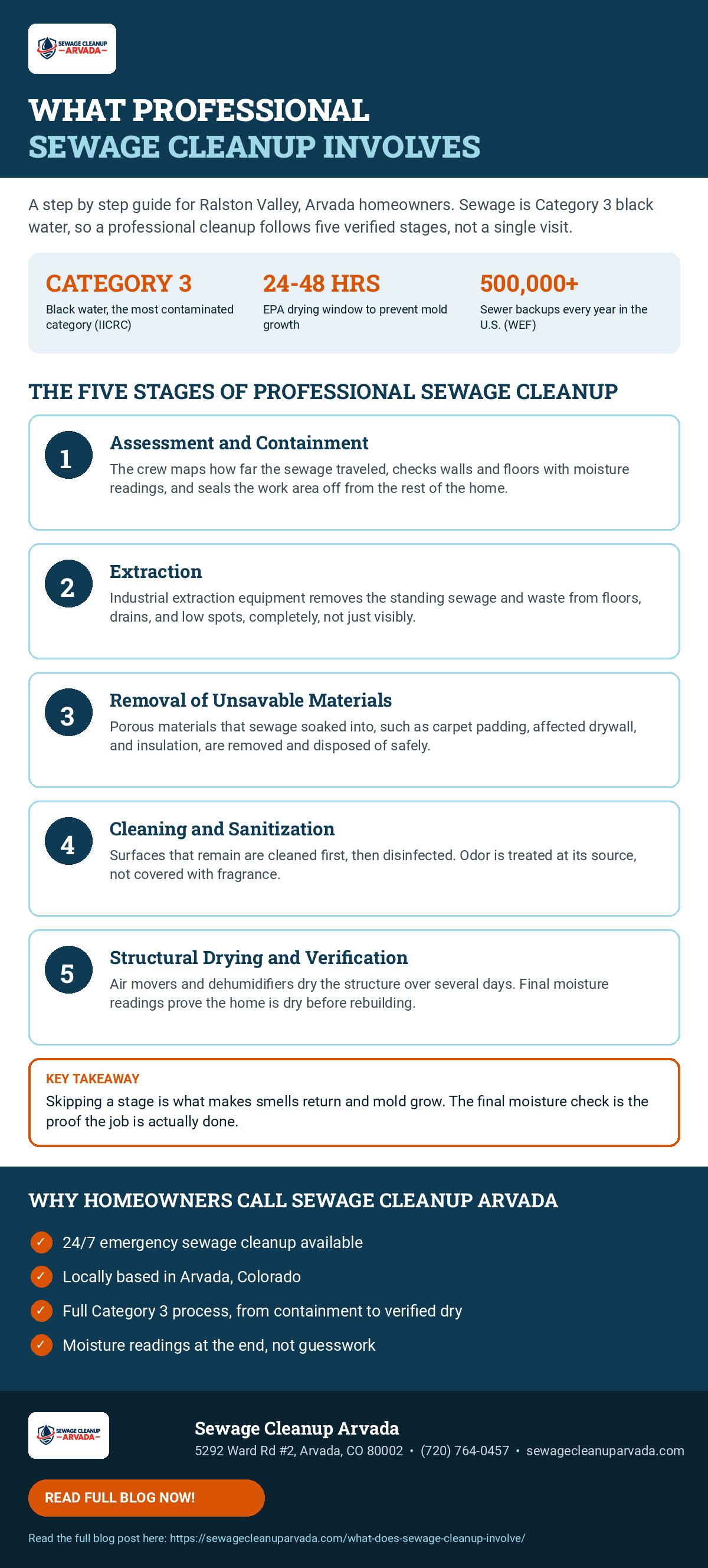
What does professional sewage cleanup involve, in short?
Five stages: assessment and containment, extraction of the standing sewage, removal of porous materials that cannot be disinfected, cleaning and sanitization of what remains, and structural drying that ends with moisture readings. Each stage prepares the next, and skipping one weakens the rest.
How long does sewage cleanup take from start to finish?
The first stages usually happen on the first visit: assessment, containment, extraction, and most removal. Drying is the long part and normally runs for several days with check visits, and rebuilding starts only after the final moisture check passes.
Can I stay in my home during a sewage cleanup?
Usually yes, outside the sealed work area. Containment exists so the rest of the home stays usable. If the backup is extensive, or if water reached electrical systems, the crew may advise staying elsewhere until those risks are cleared.
Why does some of my flooring or drywall have to be removed?
Because sewage soaks into porous materials, and contamination inside carpet padding, drywall, or insulation cannot be disinfected reliably from the surface. Hard surfaces such as concrete and tile are cleaned and disinfected in place instead.
What should I do while waiting for the crew to arrive?
Stop using water and drains, keep people and pets away from the affected area, and take photos and notes from a dry, safe spot. Do not try to mop, vacuum, or disinfect the sewage yourself, and do not discard damaged items before they are documented.
Sewage Cleanup Arvada, 5292 Ward Rd #2, Arvada, CO 80002. (720) 764-0457
Hours: Open 24 hours, 7 days a week for emergency service
A sewage backup is bad enough on its own. When the water reaches an outlet, a switch, or your electrical panel, it becomes a different kind of problem. Water and electricity do not mix, and sewage water makes the mix worse, because it carries bacteria and waste along with the current risk.
This guide explains what happens when sewage water reaches your electrical system, why cleanup crews wait for an electrical all clear before they start, and what you should do in the meantime. It covers homeowners first, then rentals, condos and HOA properties, and commercial properties, because the same risk shows up in all of them.
Clean water is already a conductor. Sewage water is worse, because dissolved waste and salts help current travel further and more easily through it. That means a puddle that looks shallow can still carry current to anything it touches, including a person standing in it.
Wet skin makes the risk higher again. Dry skin resists current, but wet skin lets far more of it through. That is why the same outlet that seems harmless on a dry day becomes a serious hazard when the floor around it is wet with sewage.
The other danger is hidden. Water creeps behind baseboards, under flooring, and inside wall cavities, where it can reach wiring you cannot see. A room can look mostly dry at the doorway while the wall behind an outlet is soaked. That hidden reach is why crews treat every wet electrical point as a risk until it is checked, not just the ones with visible water.
An outlet sits low on the wall, often just above the floor. In a basement or a ground floor room, it is usually one of the first electrical points the water reaches. Once water enters the outlet box, it can bridge the live parts inside and trip a breaker, or it can sit there quietly and corrode the connections over days.
Switches are similar, but people notice them less. A light switch near a wet wall can carry current through damp plaster or a wet switch plate. If the switch feels warm, buzzes, or sparks, that is a sign to leave the room alone and call for help, not a sign to keep testing it.
Appliances plugged into low outlets add another path. A washing machine, a freezer, or a furnace standing in sewage water can become energized through its cord or its metal case. Unplugging it by hand while standing in the water is exactly the wrong move. The safe move is to stay out and let a qualified electrician or your utility handle the power.
Electrical problems are not a rare footnote in home fires. They are one of the main causes, which is why crews take the electrical check so seriously before any other work begins.
Electrical distribution and lighting equipment was involved in an estimated 13 percent of home fires in the United States between 2014 and 2018, according to research published by the National Fire Protection Association.
That figure covers all home fires, not just sewage cases. It matters here because a sewage backup adds water to an electrical system that already causes a large share of fires. Wet wiring, wet outlets, and wet panels raise a risk that is already real.
Sometimes the signs are obvious. A breaker trips and will not reset. Lights flicker in a room that has water in it. An outlet smells hot or looks discoloured. A GFCI outlet trips and stays tripped. Any one of these after a backup is a reason to stop and stay out of the room.
Sometimes the signs are quieter. A faint buzzing near a switch. A warm patch on a wall. A breaker panel in a room next to the wet area that feels damp to the air. These are easy to miss, and they are easy to explain away. Do not explain them away. A backup changes what normal means in that room, and anything electrical that behaves oddly after one deserves a professional look.
One more sign matters: water that has reached the height of an outlet, even if the outlet looks fine. Height is the warning, not appearance. If the waterline touched an outlet, a switch, or the bottom of a panel, treat that circuit as unsafe until a qualified electrician says otherwise.
Your first job is to keep people safe, not to save the room. Stop using drains and toilets, so no more water enters the backed up line. Keep children, pets, and anyone who is ill away from the wet area. Do not walk through sewage water to reach anything, including the panel.
If water has reached outlets, switches, or the electrical panel, stay out of the room entirely. Do not enter standing water to switch off a breaker. If you can switch off power from a dry location, such as a main switch in a dry part of the home, that is different from wading in to reach it. If you cannot do it from a dry place, leave it and call an electrician or your utility for help.
If you smell gas, leave the home and call 911. Do not switch lights on or off on your way out. If anyone has had contact with sewage water, they should wash up and see a doctor if they feel unwell or have open cuts. Then call a professional cleanup service, so the cleanup can be arranged once the electrical risk is handled.
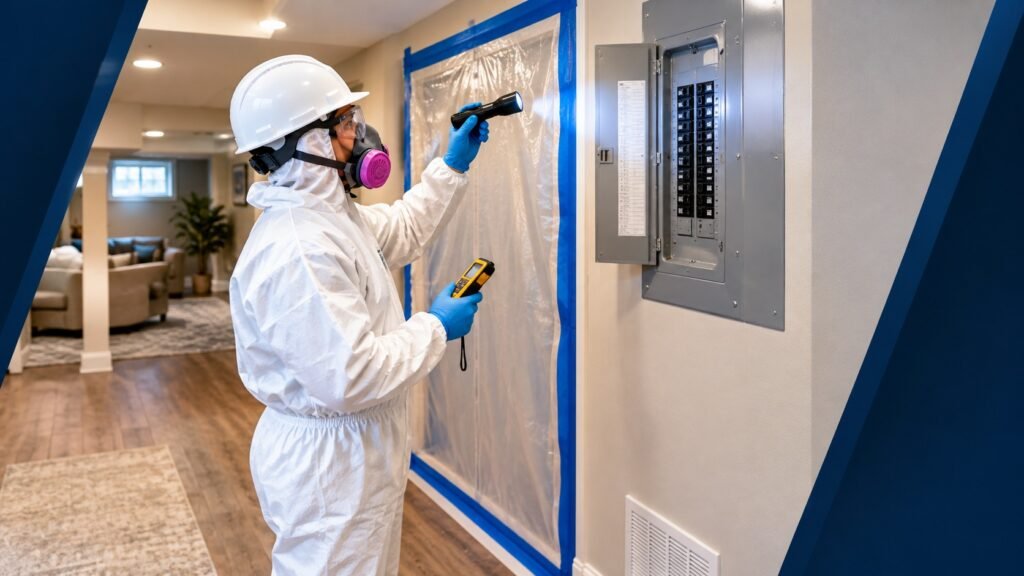
Homeowners often ask why a crew will not just start cleaning while the power question is sorted out. The answer is simple: extraction, removal, and drying all put people into the wet area, and people in a wet area with live electrical points are at risk. No cleanup step is worth that risk.
A qualified electrician checks which circuits are affected, whether the panel itself is safe to touch, and whether any wiring, outlets, or fixed appliances need to stay off. Sometimes the answer is one circuit. Sometimes it is the whole lower floor. Sometimes the panel needs work before anything else can run, including drying fans. That waiting time feels slow, but it is the step that keeps the rest of the job safe.
GFCI outlets help, and they are worth understanding here. A GFCI outlet watches for current leaking where it should not go and shuts the circuit off in a fraction of a second. In wet rooms like bathrooms, kitchens, and basements, that fast shutoff is a real layer of protection.
GFCI protection was found to be 81 to 95 percent effective in preventing electrocution deaths, according to a study by Underwriters Laboratories cited by the United States Consumer Product Safety Commission.
A GFCI outlet is not a guarantee, and it does not make a sewage backup safe to walk through. It is one layer of protection in a system that still needs a professional check after sewage exposure. A tripped GFCI after a backup is information, not an invitation to reset it and carry on.
A professional cleanup starts with assessment, and the electrical check is part of that assessment. Crews look at where the water went, how high it reached, and which electrical points sit in or near that path. They work from dry areas where they can, and they keep containment barriers in place so clean rooms stay clean.
Extraction comes only after the electrical risk is understood. Standing sewage water is pumped out with equipment made for contaminated water, and the crew wears full protective gear throughout. Contaminated porous materials, such as soaked carpet and padding, wet insulation, and drywall that took on sewage water, are removed and bagged, because sewage contamination cannot be dried out of them safely.
Sanitization follows removal. Hard surfaces that remain are washed and treated, so bacteria and other contaminants are addressed before drying begins. Then structural drying starts, with air movers and dehumidifiers running until moisture readings show the structure is dry, not just dry to the touch. Drying equipment itself needs power, which is another reason the electrical check comes first: fans plugged into a wet circuit would create the very risk the crew is trying to avoid.
The check is not just the panel. Crews and electricians look at the whole path the water took. Low outlets in the wet room come first, then switches on wet walls, then any outlet in the room next door if water travelled under a wall or through a doorway.
The panel gets its own attention. If water reached the panel, or the room holding it, the panel stays untouched until a qualified electrician clears it. A wet panel can hide corrosion inside, and corrosion can cause heat, arcing, or failure later, even after the room looks dry. That later failure is why a quick visual check is not enough.
Fixed appliances matter too. A furnace, a water heater, or a washer standing in sewage water needs a professional look before it runs again. So do hardwired smoke alarms and any equipment in a utility room that flooded. Anything with a motor, a heating element, or a control board that sat in sewage water is suspect until it is checked, and some of it will need replacing rather than cleaning.
Air ducts deserve a mention here. If sewage water reached a return vent or a duct run, contamination can travel through the system when the fan runs. That is why crews ask about the HVAC system during assessment, and why the fan stays off until the duct question is answered. Running the system early can spread contamination to rooms that were never wet.
Water leaves more than a stain behind. Sewage water leaves residue on connections, and residue leads to corrosion. Corroded connections run hotter than clean ones, and hotter connections are a fire risk that can show up weeks after the room looks finished. That delayed risk is the reason electricians take sewage exposure seriously even when everything appears to work again.
Some things can be cleaned and kept. A hard surface outlet cover that was wiped and checked is different from wiring inside a soaked wall. Some things cannot be kept safely. Wiring, outlets, and devices that sat in sewage water for hours, or that show corrosion, are usually replaced. The decision belongs to a qualified electrician, who can open the box and see what the water actually did.
Keep every report and photo from the electrical check. If an insurance claim follows, the claim will ask what was affected, what was replaced, and why. A clear record, with dates and photos, makes that conversation much easier. It also helps the next person who works on the home, because they will know which circuits were exposed and what was done about them.
Drying is where patience pays off. A room that looks dry can still hold moisture inside walls, under flooring, and in framing. Moisture meters tell the crew what eyes cannot, and drying continues until readings match dry areas of the home. Rushing this step invites mold and odor, and it can hide damage that shows up later.
Dry water damaged areas and items within 24 to 48 hours to help prevent mold growth, according to guidance from the United States Environmental Protection Agency.
That window starts when the water arrives, not when the crew arrives, which is why calling early matters even when the power question delays the start. The electrical check and the cleanup call should happen in parallel, not one after the other. While the electrician is on the way, the cleanup can be arranged, so no time is lost once the all clear is given.
Drying equipment also needs a safe power source. Air movers and dehumidifiers run for days in a typical job, and they must run on circuits that are dry and cleared. A crew that plugs drying gear into a wet circuit has traded one problem for another. The safe circuit check is a small step that protects the whole drying phase.
Do not enter a flooded room to reach a breaker, an outlet, or an appliance. Do not reset a tripped breaker while the room is still wet, and do not keep resetting it if it trips again. A breaker that trips repeatedly is telling you something, and the message is to leave it alone.
Do not use wet appliances, wet power strips, or wet extension cords, even if they look fine after a wipe. Do not run the furnace fan or the air conditioning if sewage water reached a vent or a duct. Do not mix cleaning chemicals, and do not pour anything down a drain that is already backed up. Each of these feels like helping, and each of them adds risk or makes the cleanup harder.
Do not wait for the room to dry on its own before calling. Air drying a sewage affected room without extraction, removal, sanitization, and checked drying leaves contamination and moisture in place. The right sequence is safety first, then professional assessment, then cleanup and drying in order.
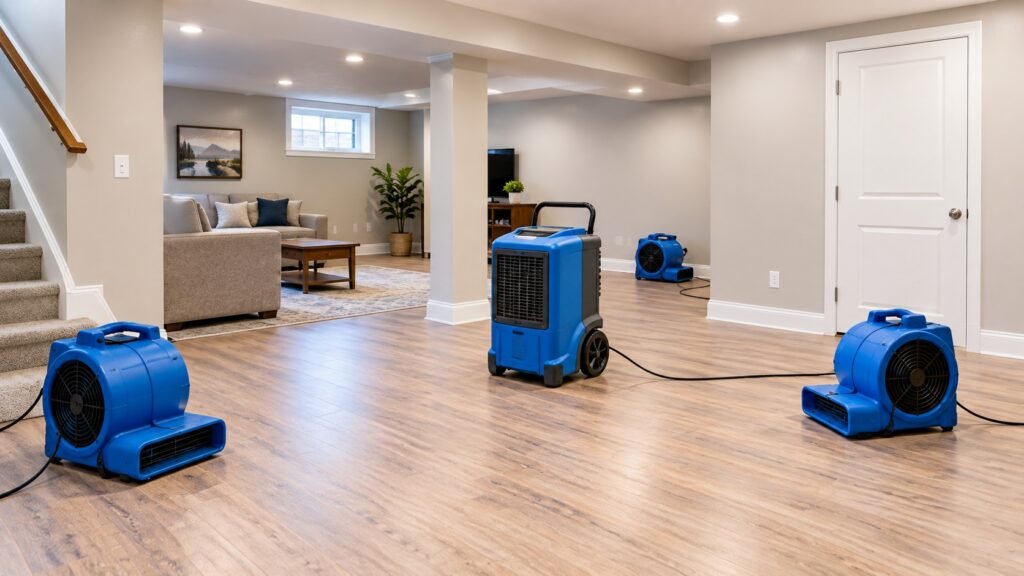
Homeowners face this most often, since they own both the home and the decisions about it. A homeowner who knows to stay out of a wet electrical room, and to call an electrician and a cleanup service in parallel, protects both the household and the home.
Rentals, condos, and HOA properties come next, because a backup in one unit can reach shared panels, shared walls, and neighboring units. Early notice to the building manager and to neighbors matters, since one unit’s wet outlet can sit on a circuit that serves more than one home.
Commercial properties matter too. A shop, restaurant, or office with a wet panel or wet equipment room faces the same electrical risk, plus staff and customers who may not know the room is unsafe. Closing the affected area and getting a professional check protects everyone in the building, not just the owner.
Sewage Cleanup Arvada serves homeowners, rentals, condos, HOA properties, and commercial properties across Arvada, Colorado, including the Village of Five Parks community. The service connects people with independent local technicians for sewage cleanup around the clock, so help can be arranged whenever a backup happens.
Homes in Village of Five Parks sit near Leyden Park, and many are reached from W 86 Pkwy. That local detail matters when a crew is finding the home, and it matters when a homeowner is describing where the problem is. The coordinates for this area are 39.852494595358316, -105.14814486901.
Get Sewage Cleanup Village of Five Parks Service Now
If you want to be ready before the crew arrives, read how to prepare your home before the crew arrives. Stop using water, keep people and pets away, stay out of any room where water has reached outlets or the panel, and let the electrician and the cleanup crew do their checks in order. Safety first is not a delay. It is the job done right.
Can I reset a tripped breaker after a sewage backup?
Not while the room is still wet, and not repeatedly if it trips again. A breaker that trips after a backup is protecting a circuit that may have water in it. Leave it off and let a qualified electrician check the circuit before it is switched back on.
Why can cleanup not start until the power is checked?
Cleanup puts people into the wet area, and live electrical points in that area put those people at risk. Extraction, removal, sanitization, and drying all need a safe electrical situation first, including safe circuits to run drying equipment on.
What if sewage water reaches my electrical panel?
Stay out of the room and do not touch the panel. Call an electrician or your utility for help with the power, and call a professional cleanup service in parallel, so cleanup can start as soon as the panel is cleared.
Do GFCI outlets make a sewage backup safe to walk through?
No. A GFCI outlet is a valuable layer of protection that shuts a circuit off quickly when current leaks, but it does not make sewage water safe to enter. Stay out of the wet area and let professionals check the circuits.
Who checks the electrical system after sewage cleanup?
A qualified electrician checks panels, circuits, outlets, and fixed appliances that were exposed to sewage water. The cleanup crew handles extraction, removal, sanitization, and drying, and the electrician handles the electrical all clear. Both checks matter before a room returns to normal use.