
A dark, foul-smelling wet patch spreading across the lawn is almost never a lawn problem. Sewage surfacing in the yard means the sewer line leaving the house is blocked or broken, and wastewater that cannot move forward is escaping at the surface instead. Everything that follows starts from one fact: treat that patch exactly like a sewage cleanup indoors, keep everyone off it, and let professionals deal with it.
Start Here: What To Do in the First Hour
The first hour sets up everything else, and almost all of it is about distance.
Get people off the affected ground and keep them off. Do not walk through the patch to inspect it, do not send someone across it for a closer look, and do not let anyone retrieve toys, tools, or garden items sitting in it. Anything that has to come out of the area can wait for the crew, who will cross it in protective gear.
Photograph the patch from dry ground at the edge if you want a record, note when you first noticed it, and note whether it is growing. Then make the calls.
Keep Children and Pets Off the Affected Ground
This is the step that matters most, because a yard does not look like a hazard to a child or a dog.
Children read a wet patch as a puddle. Dogs read it as interesting. Both will cross it without hesitation, and both can carry contamination back across clean grass, onto patios, and into the house on feet and paws.
Bring pets inside and keep them in. Move outdoor play somewhere the water has not reached, on the far side of the house if possible. If a pet has already crossed the patch, keep it off furniture and wash its paws with soap and clean water at the door, from the clean side.
Stop Water Use Inside the House as Well
Outdoor sewage is an indoor plumbing event that ran out of room.
Every flush, shower, and laundry load sends more water into a line that is already failing. Some of that water is what is rising in the yard. Pausing water use does not fix the line, but it slows the surfacing and keeps the affected area from growing while you wait for help.
Tell everyone in the house, out loud. One unaware flush at a time is how a small patch becomes half the lawn.
If sewage is also appearing in the street, bubbling from a manhole, or flowing toward a storm drain, call the city utility as well as a cleanup crew. That pattern points at the city main, which is the utility’s responsibility, and they need to know about it promptly.
Document the Patch From Dry Ground
From the edge of the dry lawn, take a few photos showing the size of the patch, the cleanout if it is involved, and anything the sewage has reached, like a walkway or a garden bed.
Note the time you found it and whether it is still growing. That record helps the crew judge how long the line has been surfacing, and it protects you in any later conversation with the city or a neighbor about where the problem started.
Stay on dry ground for all of it. The documentation is useful precisely because it does not require anyone to stand in the patch.
How to Tell It Is Sewage and Not a Sprinkler Leak
Homeowners hesitate here, because a sprinkler leak is common and harmless, and nobody wants to overreact to wet grass.
The differences are clear once you know them. Sewage carries a unmistakable sewer odor that clean irrigation water never has. The water is gray to dark, and it often carries visible solids, paper, or grease. The patch grows on its own schedule, unrelated to when the sprinklers run, and it often sits along the buried path of the sewer line between the house and the street, or pools around the sewer cleanout.
A sprinkler leak, by contrast, is clear, odorless, and appears when the system runs.
When the signs point to sewage, act on that reading. The same backup usually sends signals inside the house first, and the warning signs you need professional sewage cleanup are worth knowing, because by the time sewage reaches the lawn, the line has been struggling for a while.

Where Sewage in the Yard Usually Comes From
Sewage reaches the surface at the weakest available point: a cleanout with a loose cap, a cracked section of line, or low ground above a failing pipe. Underneath all three is the same short list of causes.
Most of those backups stay inside the house. The ones that surface outdoors usually involve the main line itself rather than a single fixture drain, which is why a yard event deserves the same seriousness as a basement full of water.
Tree Roots Are the Usual Suspect
If the line passes anywhere near a tree or large shrub, roots belong at the top of the suspect list.
Research published through the U.S. Forest Service links tree roots to more than 50 percent of sewer blockages.
Roots find the moisture at pipe joints, work their way in through hairline openings, and keep growing inside the line until flow slows, catches solids, and backs up. In a neighborhood like Candelas in Arvada, Colorado, where newer homes sit near maturing landscaping, root intrusion is a pattern crews see again and again.
Cracked and Aging Lines
Roots need an opening, and age provides plenty of them.
Older clay and cast iron lines develop cracks, offset joints, and corroded sections over decades of soil movement and freeze and thaw cycles. A cracked line leaks sewage into the surrounding soil with every use, and the first visible sign is often exactly this: a patch of lawn above the line that stays wet, grows suspiciously lush, and eventually starts to smell.
The surfacing is the symptom. The break in the pipe is the cause, and it is why the ground above a cleaned patch stays off limits until the line itself has been dealt with.
When the Problem Is the City Main, Not Your Line
Sometimes the line from the house is fine and the pressure comes from the other direction.
During heavy rain or rapid snowmelt, a city main can surcharge, taking on more water than it can move. Flow then pushes back toward homes and can surface at cleanouts and low points in yards along the street. The giveaway is company: if neighbors on the same street have the same problem at the same time, or sewage is moving in the street itself, the main is involved.
That distinction decides who you call first. A surcharging main is the city utility’s job to relieve. The contamination already on your property is still yours to clean up, and it still needs a professional crew.
Sewage on Soil Is Still Category 3
There is a tempting idea that sewage outdoors is somehow less serious, diluted by open air and absorbed by the ground.
It is not.
Sewage is Category 3 black water, the most contaminated of the three water damage categories defined by the IICRC.
Outdoors changes the setting, not the contents. The bacteria, viruses, and parasites are the same ones a basement backup carries.
Soil makes the problem different rather than smaller. Contamination soaks into the topsoil and stays there instead of drying on a hard floor. Rain can spread it across a wider area and wash it toward drains. Sunlight does not reliably sanitize a contaminated patch, and shoes, paws, and mower wheels track the problem well beyond the wet edge.
That is why the cleanup of an outdoor spill is a removal job, not a rinse.
What a Professional Outdoor Cleanup Involves
Outdoor sewage cleanup follows the same logic as indoor work, adapted to soil and weather: contain the area, remove the contamination, sanitize what can be sanitized, and confirm the ground is clean before the yard goes back to normal use.
One difference comes first. The source has to stop. A crew will confirm the surfacing has ended, or is controlled, before removal begins, because cleaning ground that is still receiving sewage wastes the entire effort.
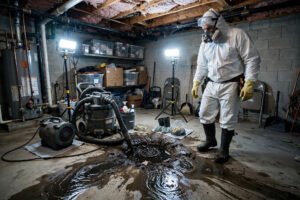
The crew also works in full protective gear outdoors, exactly as it would indoors. Sewage does not become safer because it is on grass, and neither do the bacteria it carries, so suits, respirators, gloves, and boots are standard at every stage of the work.
Containment on Grass: Fencing the Work Zone
The crew marks and barriers the affected area so people, pets, and foot traffic stay out of it for the whole job.
Outdoors, containment also means controlling spread. Absorbent barriers go down along the downhill edge of the patch so liquid cannot creep further across the lawn or reach a driveway, sidewalk, or storm drain while work is underway.

Removing the Liquid and the Soil It Soaked Into
Pooled sewage is extracted with the same industrial equipment used indoors.
Then comes the part that makes outdoor work distinct: the topsoil the sewage soaked into is removed. Contamination lives in that upper layer, and no surface treatment reaches through soil the way it reaches across concrete. Debris, saturated mulch, and anything else the sewage saturated comes out with it, and all of it is disposed of as contaminated material.
The crew works outward from the worst area and re-checks the edges as they go, the same way they would follow a water line indoors.
Sanitizing Hard Surfaces and Checking the Ground
Hard surfaces the sewage crossed are cleaned and disinfected in place: concrete walkways, driveway edges, patio slabs, and the cleanout surround.
The remaining ground is then checked across the whole affected area, including the edges where the visible patch faded out, because the wet outline on grass is not a reliable map of where contamination stopped. Only when the checks are clean does the crew clear the area for use.
What Never to Do When Sewage Surfaces in the Yard
Good intentions cause most of the avoidable damage in an outdoor spill.
Do not dig into the area to find the pipe or the problem. Digging spreads contaminated soil, can damage the line further, and puts you in direct contact with sewage. Locating the cause is professional work done with proper equipment and protective gear.
Do not hose the patch down. Water pushes contamination deeper into the soil, spreads it across clean ground, and can carry it into storm drains, which is the one place it must never go.
Do not mow over it, drive over it, or let a landscaping crew work through it. Wheels and blades scatter contamination across the whole yard. Do not pour bleach or other chemicals onto the ground either; they do not sanitize soil, and the runoff goes exactly where it should not.
Keep the area fenced off from children and pets until the crew says otherwise, even after the visible water is gone. The surface can look normal while the topsoil is still contaminated.
Do not cover the patch with fresh mulch, soil, or sod to make it look better, either. Burying contamination does not remove it, and it hides the exact area the crew needs to find, check, and clear.
When the Yard Is Safe to Use Again
The yard goes back to normal use when the cleanup is verified, not when it dries.
In practical terms that means the pooled sewage is gone, the contaminated topsoil and debris have been removed, hard surfaces have been sanitized and checked, and the crew has confirmed the source is no longer surfacing. After that, fresh soil and reseeding or sod can go in as ordinary yard work.
Ask the crew directly before the barriers come down. If the cause in the line has not been addressed yet, expect the area near the cleanout to stay off limits until it has, because one more backup would put the yard back at the start.
Once the area is cleared, expect some restoration. The section where topsoil came out will need fresh soil and either seed or sod, and it should be treated like new planting rather than walked straight back into service. That part is ordinary yard work. Everything before it was not.

Who This Matters For in Arvada, Colorado
Homeowners come first. A yard spill sits on the property they are responsible for, next to the places their children and pets use daily, and the safe response starts with them.
Rentals and HOA-managed properties come next. Tenants are usually the first to spot surfacing sewage in a shared yard or common area, while owners and the HOA carry the responsibility for the response, and a fast call protects every household the line serves.
Commercial properties follow, and they are never left out. Restaurants, retail sites, and offices in Arvada, Colorado deal with the same event at parking edges, landscaped areas, and drainage low points, where customers as well as staff have to be kept clear of the affected ground.
The full range of sewage cleanup services covers outdoor surfacing with the same staged approach used indoors.
Sewage Cleanup Arvada Serving the Candelas Community and Beyond in Arvada
Sewage Cleanup Arvada serves the Candelas community in Arvada, Colorado, near local landmarks like Big Sky Park, for homes close to the crossing of Indiana St and Candelas Pkwy, at coordinates 39.85985, -105.16535.
Get Sewage Cleanup Candelas Service Now
Navigate from Candelas to Sewage Cleanup Arvada Now

Frequently Asked Questions About Sewage Cleanup in Arvada, Colorado
What should I do first when sewage comes up in my yard?
Keep everyone, especially children and pets, off the affected ground, stop using water inside the house, and call a professional cleanup crew. If sewage is also in the street or coming from a manhole, call the city utility too, because that points to the city main.
Is sewage in the yard dangerous for children and pets?
Yes. Sewage is Category 3 black water and carries bacteria, viruses, and parasites, and contaminated topsoil stays hazardous after the surface water is gone. Keep children and pets off the area until it has been professionally cleaned and cleared.
Can I just hose the sewage off the lawn?
No. Hosing spreads the contamination across clean ground, pushes it deeper into the soil, and can wash it into storm drains. The pooled sewage and the topsoil it soaked into need to be removed, and hard surfaces need proper sanitizing.
Who do I call for sewage in the yard, a cleanup crew or the city?
Often both. The cleanup crew handles the contamination on your property. The city utility handles a surcharging city main, which is the likely cause if neighbors have the same problem at the same time or sewage is in the street.
How long until my yard is safe to use again?
Once the pooled sewage and contaminated soil are removed, hard surfaces are sanitized, and the crew confirms the source has stopped and the ground checks clean. The timeline depends on how much soil was affected, so ask the crew to confirm before letting children and pets back onto the area.
Sewage Cleanup Arvada, 5292 Ward Rd #2, Arvada, CO 80002. (720) 764-0457
Hours: Open 24 hours, 7 days a week for emergency service