
A basement sewage backup leaves two problems behind it. The first is the water on the floor. The second is everything the water touched: the sofa, the carpet, the boxes of keepsakes, the books on the bottom shelf. In the first minutes after a backup, the hardest question is not how the water got in. It is what can be saved and what has to go. This guide answers that question for a finished basement, room by room and item by item, so you can make the call safely and without guessing.
The First Decision Is Not About Stuff
The first decision after a basement sewage backup is not about your belongings. It is about whether it is safe to go downstairs at all.
Safety Comes Before Salvage
Sewage is Category 3 black water, and it carries bacteria, viruses, and parasites that can make people sick on contact. No item in a basement is worth stepping into standing sewage to reach. Keep children and pets upstairs, and stay out of the water yourself.
If the water has reached an outlet, a power strip, an appliance plug, or the furnace and water heater connections, stay out of the basement completely. Do not step into water to flip a breaker or unplug a freezer. Water and electricity together are a danger you cannot see.
The Water Line Tells the Story
Before anything is moved, look at the water line. It is the dark mark on the wall, the baseboards, and the furniture legs that shows how high the water rose. Everything below that line touched sewage. Everything above it may be clean.
Photograph the water line from dry ground, and note the time. That one photo does more than any list to show what the backup reached.
What Sewage Does to a Finished Basement
A finished basement is not an unfinished one. It has carpet, drywall, baseboards, furniture, and storage, and every one of those holds water differently.
Why Finished Basements Take the Worst of It
An unfinished basement is concrete and open studs. Water can be extracted, the surfaces can be cleaned, and drying is straightforward. A finished basement hides the water behind drywall, under carpet pad, and inside furniture. The damage you see on the surface is only part of it.
That is why finished basements take the longest to sort out. The crew is not only removing water. They are opening up the layers the water hid in.
The Water Line on the Wall
Drywall soaks up sewage water like a sponge, and it wicks upward past the visible water line. The stain on the wall shows where the water stopped. The wet drywall above the stain shows how far it wicked.
The Save or Remove Rule, in Plain Words
Every item in a flooded basement falls into one of three groups: save, clean, or remove. The rule that sorts them is simple, and it comes down to one question.
Hard Surfaces Can Usually Be Cleaned
Hard, non-porous surfaces can usually be cleaned and disinfected in place. Glass, ceramic, sealed metal, and hard plastic do not absorb sewage water, so a professional cleaning can make them safe to keep.
Porous Materials Usually Cannot
Porous materials absorb sewage water into their fibers, and no surface cleaning reaches inside them. Carpet and pad, mattresses, upholstered furniture, drywall, and cardboard all fall into this group. When sewage soaks through them, they are usually removed.
The One Question to Ask About Every Item
For each item, ask one question: did the sewage water soak into it, or did it only touch the surface. If the water soaked in, the item goes. If it only touched a hard surface, the item can usually be cleaned. That one question settles most of the decisions in a basement.
Sewage is Category 3 black water, the most contaminated of the 3 IICRC water damage categories.
That classification is the reason the save or remove rule is strict. Category 3 means the water is treated as contaminated from the first minute, and porous materials it soaked are treated as unsalvageable in most cases.
What to Save: The Keep List
The keep list is shorter than most homeowners hope, and longer than most fear. These are the items that usually survive a basement sewage backup.
Hard Furniture and Metal Items
Metal shelving, metal filing cabinets, and solid wood furniture with sealed finishes can usually be cleaned and disinfected. The test is the finish: if the surface is sealed and the water did not soak into the wood, the piece can be wiped down and kept.
Glass, Ceramic, and Sealed Plastics
Glass jars, ceramic dishes, sealed plastic storage bins, and glassware can be cleaned and disinfected. Their surfaces do not absorb water, so professional cleaning reaches the contamination.
Photographs and Papers, With Care
Photographs and papers are the hardest call in the whole basement, because they are often the most valuable and the most fragile. Loose papers that soaked through are usually removed. Photographs that were in frames or albums may be saved if the water only touched the edges. Do not try to peel apart wet photographs yourself. They stick together, and peeling tears them.
What to Remove: The Let Go List
The let go list is the painful one. These items usually go, not because anyone wants them gone, but because sewage water soaked into them in a way cleaning cannot reverse.
Carpet, Pad, and Rugs
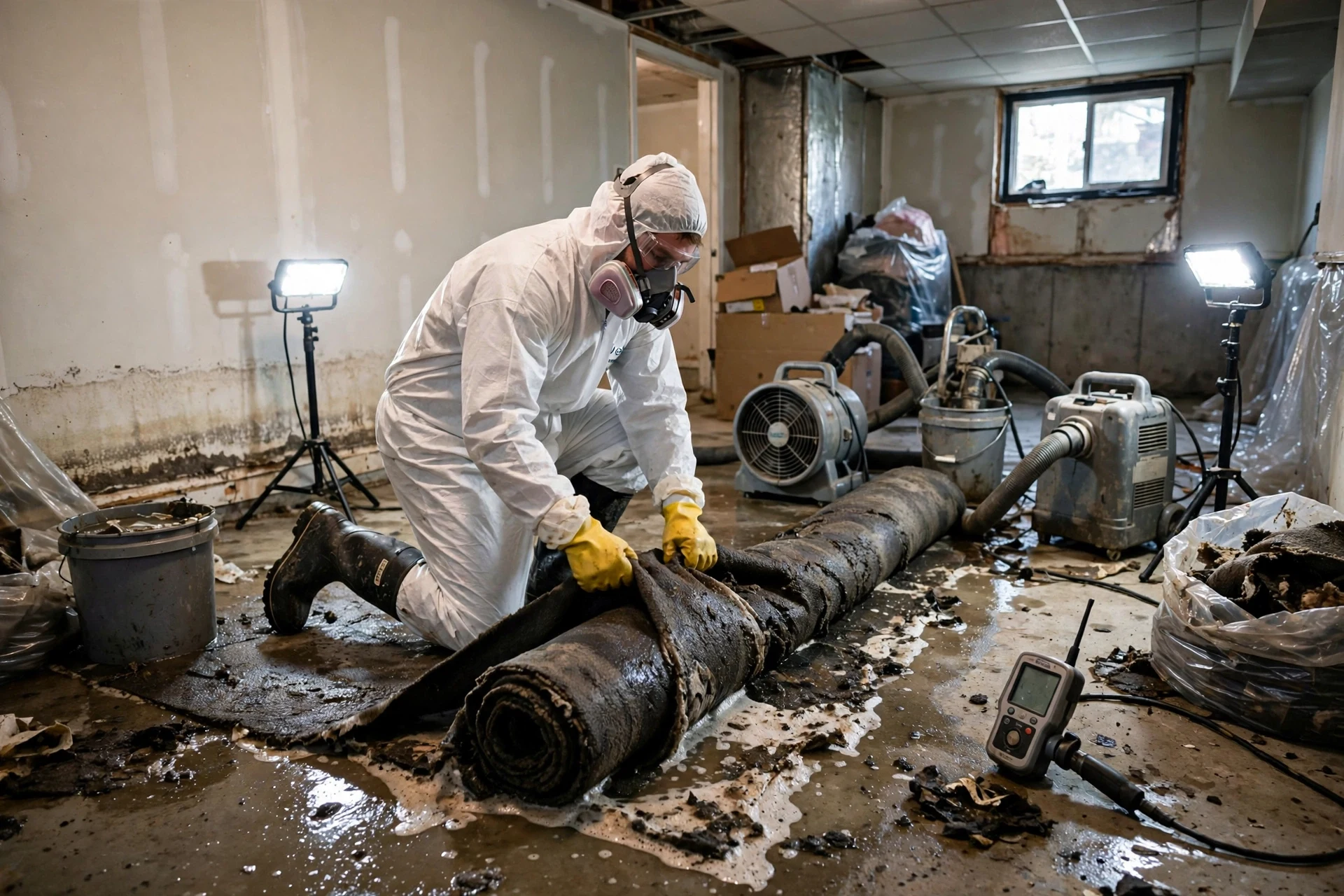
Carpet and pad are the first things to go in a finished basement. Both absorb sewage water all the way through, and the pad underneath holds it like a sponge. Area rugs that soaked through go with them.
Small rugs that only caught a splash at the edge may be different, but a rug that sat in standing water is removed.
Drywall and Baseboards Below the Water Line
Drywall below the water line is removed, usually a foot or two above the visible line to catch the wicking. Baseboards in the affected area go with it. The studs behind them can be cleaned and dried, and the drywall is replaced after the space is dry.
Mattresses, Upholstered Furniture, and Stuffed Items
Mattresses, sofas, armchairs, and stuffed toys that soaked in sewage water are removed. Their foam and stuffing absorb water deep inside, and no surface cleaning reaches it. A sofa that only had water touch its feet is a different case, but a sofa that sat in standing water is not saved.
Cardboard Boxes and Paper Goods
Cardboard boxes soak through in minutes, and their contents soak with them. Books, magazines, and loose papers in cardboard boxes are usually removed along with the boxes.
Clothing That Soaked Through
Clothing that sat in sewage water is usually removed. Some hard items of clothing can be professionally cleaned, but everyday clothes that soaked through are not worth the risk. The crew can advise on anything unusual, like a leather jacket or a formal outfit, but the default for soaked clothing is to let it go.
Mold can begin to grow on wet materials within 24 to 48 hours, according to the U.S. EPA.
That window is the reason sorting cannot wait. Porous items that stay wet past the first day or two start growing mold on top of the contamination. That is the practical meaning of the EPA guidance: wet materials need to be dried or removed quickly, and what happens when sewage cleanup is delayed is mostly a story about moisture left behind.

The Gray Zone: Items You Are Unsure About
Not every item is a clear save or a clear remove. The gray zone is where homeowners lose the most time, and where a few simple tests help.
Electronics and Small Appliances
A television, a game console, or a small appliance that sat above the water line can usually be kept, once it is checked. Anything that sat in the water, or whose vents and openings took in water, is usually removed. Electronics hold contamination inside their cases, where cleaning cannot reach.
Books and Keepsakes
Books on a low shelf that wicked water up from the bottom are usually removed. Books on a higher shelf that stayed dry are fine. Keepsakes follow the same rule as everything else: hard surfaces can be cleaned, porous surfaces that soaked through cannot.
How the Crew Sorts a Basement, Step by Step
Sorting a basement is not a matter of carrying things upstairs and deciding later. It is a staged job, and the order matters.
Stage 1: Stop and Assess
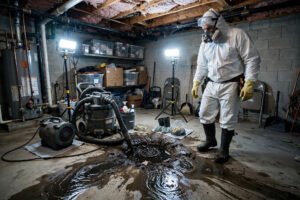
When the crew arrives, they start by confirming the source has stopped and mapping how far the sewage traveled. They check which rooms the water reached, which materials it soaked, and whether water is near any outlet or appliance. They work in full protective gear, suit, gloves, respirator, and boots, because every surface the water touched is treated as contaminated until it is cleaned.
They also look at the water line on the walls and the furniture. That line sets the boundary for everything that follows.
Stage 2: Extract the Standing Water
Extraction removes the standing sewage and contaminated water from the floor. Professional extraction equipment moves far more water, far faster, than anything a homeowner has at home. The crew works from the edges inward, keeping clean areas clean.
Do not try to extract sewage yourself. A household wet vacuum spreads contamination through its exhaust and its hose.
Stage 3: Sort, Remove, and Sanitize
Once the standing water is gone, the crew sorts the contents. Items to keep are moved to a clean area, on plastic sheeting, away from the affected floor. Items to remove are bagged and taken out. Porous materials that cannot be saved, carpet and pad, soaked drywall at the base, and soft items that absorbed the water, are removed. Then the crew cleans and disinfects the hard surfaces that remain.
This is the stage where the save or remove rule does its work, item by item, in protective gear, with the water line as the guide.
Stage 4: Dry and Verify
Drying equipment runs on the floors, wall bases, and any cavities the water entered. It stays in place until moisture readings show the materials are dry. Readings, not appearances, decide when the basement returns to normal use. How professionals test sewage cleanup complete explains that verification step in detail.
One in five households in the United States relies on a septic system, according to the U.S. EPA.
That scale is worth knowing. A basement sewage backup is a normal homeowner problem, not a rare one, and the systems behind it fail in predictable ways. Sewage cleanup after a sump pump failure and Sewage cleanup after a main sewer line clog are two of the most common causes, and both follow the same sorting rules as this guide.
After the Sorting: What Happens to What You Saved
Saving an item is not the end of its story. What happens next decides whether it is safe to bring back into the house.
Cleaning Hard Items the Right Way
Hard items that were kept are cleaned and disinfected by the crew, with products and methods suited to the material. Glass, ceramic, sealed metal, and hard plastic are wiped down and disinfected. The cleaning happens in the clean area, away from the affected floor, so the items do not pick up contamination again.
Drying Before Storage
Items that were kept are dried before they go back into storage or back upstairs. A hard item that looks dry on the outside may still hold moisture in a joint, a seam, or a hollow base.
What to Do With Items You Removed
Items that were removed are bagged, sealed, and taken out of the house. They are not piled in the garage or the yard to sort later, because wet, contaminated items keep spreading contamination and growing mold while they sit.
Five Mistakes That Cost Homeowners Their Belongings
Most of the belongings lost after a basement sewage backup are not lost to the sewage. They are lost to the homeowner trying to save them the wrong way.
Mistake 1: Walking Through the Water to Rescue Things
The temptation is strong. The photo albums are on the bottom shelf, the water is only ankle deep, and it will only take a minute.
It is not worth it. Sewage is Category 3 black water, and wading through it to reach a shelf spreads contamination onto your skin, your clothes, and every dry surface you touch afterward.
Mistake 2: Piling Wet Items in a Dry Room
Carrying wet items upstairs and piling them in a dry room moves the contamination with them. The wet items soak the dry floor and the dry carpet underneath. Keep sorting in the basement, on plastic sheeting, in the clean area the crew sets up.
Mistake 3: Keeping Soaked Carpet to Dry Out
Soaked carpet and pad do not dry back to clean. They hold sewage water in their fibers and in the pad underneath, and they start growing mold within a day or two.
Mistake 4: Washing Contaminated Clothes With the Rest of the Laundry
Clothing that touched sewage water should never go into a washing machine with the rest of the laundry. It spreads contamination to the machine and to everything else in the load. Clothing that soaked through is usually removed, and anything unusual should be discussed with the crew first.
Mistake 5: Throwing Away the Photos Before They Are Checked
In the rush to clear the basement, photographs are sometimes thrown away before anyone checks whether they can be saved. Photographs in frames or albums, or on a shelf above the water line, may be fine. Check them before they go, and leave wet photographs stuck together for the crew to handle rather than peeling them apart.

Documenting What You Lost, From Dry Ground
Sorting is also a record. What you removed, and what you kept, should be written down before the basement is cleared.
Photograph Before You Move Anything
Photograph each area before anything is moved, then photograph the items as they are sorted. The water line photo, the carpet photo, and the furniture photos together show what the backup reached.
Make a Simple List
A simple list is enough: the item, the room, and whether it was kept or removed. Do not try to write a perfect inventory in the middle of a cleanup.
Keep Damaged Items Until They Are Recorded
Do not throw removed items away before they are photographed and listed. Once an item leaves the house, the photo and the list are the only record of it. The crew can advise on how long to keep bagged items before disposal.
Who This Matters For in Arvada, Colorado
Homeowners come first. A basement sewage backup arrives in their home, on their floors, and in their belongings.
Rentals and HOA-managed properties come next. Tenants spot the water first, owners carry the responsibility for the response, and in shared buildings one blocked line can report itself in several basements at once.
Commercial properties follow, and they are never left out. Restaurants and offices in Arvada, Colorado face the same backup mechanics in their lower levels and storage rooms. For a home in Ralston Valley, the local page for basement sewage cleanup for Ralston Valley homes covers the neighborhood. The full picture of sewage cleanup in Arvada, Colorado explains how the pieces fit together for all three, and the basement sewage cleanup service page covers the service itself. The full range of sewage cleanup services covers basement backups with the same staged approach.
Sewage Cleanup Arvada Serving the Ralston Valley Community and Beyond in Arvada
Sewage Cleanup Arvada serves the Ralston Valley community in Arvada, Colorado, near local landmarks like Ralston Valley High School, for homes close to the crossing of W 80th Ave & Alkire St, at coordinates 39.84339, -105.15053.
Get Basement Sewage Cleanup Ralston Valley Service Now
For a basement sewage cleanup for Ralston Valley homes after a backup, call (720) 764-0457.
Navigate from Ralston Valley to Sewage Cleanup Arvada Now
Frequently Asked Questions About Basement Sewage Cleanup in Arvada, Colorado
What should I save after a basement sewage backup?
Hard, non-porous items that only touched the surface can usually be cleaned and kept: glass, ceramic, sealed metal, and hard plastic. Porous items that soaked through, like carpet, mattresses, and upholstered furniture, are usually removed.
Can carpet be saved after a sewage backup in the basement?
No. Carpet and pad absorb sewage water all the way through, and no surface cleaning reaches inside the fibers. Soaked carpet and pad are removed.
Can furniture be saved after a basement sewage backup?
It depends on the material. Metal and sealed wood furniture can usually be cleaned and disinfected. Upholstered furniture and mattresses that sat in sewage water are removed, because their foam and stuffing absorb the water deep inside.
Should I go into the basement to save my belongings?
No. Do not step into standing sewage to reach belongings, and do not go downstairs at all if water has reached an outlet or an appliance. Keep children and pets away, document from dry ground, and call professionals.
What should I do with items I am not sure about?
Leave them for the crew to assess. Hard items can usually be cleaned, porous items that soaked through usually cannot, and the crew can advise on anything unusual, like photographs, electronics, or keepsakes.
Sewage Cleanup Arvada, 5292 Ward Rd #2, Arvada, CO 80002. (720) 764-0457
Hours: Open 24 hours, 7 days a week for emergency service