Sewage sanitization and odor removal in an Arvada home after a sewage backup

Sewage Sanitization & Odor Removal in Arvada, CO

Sewage Sanitization & Odor Removal
in Arvada, CO

Getting the sewage out is only half the job. What it leaves behind — bacteria in the flooring, contamination wicked into drywall, a smell that settles into porous material — is what sanitization is for. We clean, disinfect and deodorize sewage-affected areas so the space is safe to use again.

  • Sewage-contaminated water specialists
  • Residential & commercial
  • Options before work
✓
Clean, dry & safeExtraction, drying & sanitizing
01
Local Arvada teamServing neighborhoods across Arvada
02
Trained teamSkilled cleanup technicians
03
Clear optionsScope explained before work
04
Clean finishProtect, repair, test, tidy
05
Documented workWritten record for your claim

Sewage Sanitization & Odor Removal in Arvada, CO

Sewage Sanitization & Odor Removal in Arvada

A sewage backup ends in two stages, and most homeowners only see the first one. The standing water gets pumped out, the solids are removed, the room looks empty again — and yet it still smells, and the surfaces the sewage touched are still contaminated. Drying alone does not fix either problem. Sewage carries bacteria and viruses that survive in carpet pad, subfloor seams and the bottom edge of drywall long after the visible water is gone.

Sanitization is the second stage: the cleaning, disinfection and deodorizing work that makes a sewage-affected area safe to live with again. This page explains what sewage contamination actually means inside a home, how a proper sanitization runs step by step, why the odor outlasts the water, and how you can tell the work was done completely. If a backup has already been pumped out but the smell — or the worry — is still there, call (720) 764-0457.

Why Sanitization Comes After the Sewage Is Gone

Disinfectant cannot do its work through standing sewage. Antimicrobial products need a surface that has already been cleared of water, solids and sludge; applied too early, they are diluted and blocked by the contamination itself. That is why every sewage job runs in order: extraction first, then removal of material that cannot be saved, then cleaning, then disinfection, then drying and odor treatment.

The extraction stage — pumping out black water and removing sewage solids — is covered in detail on our Raw Sewage Removal page. This page starts where that one ends: the moment the area is empty but not yet clean. Skipping or rushing this stage is the most common reason a "cleaned" basement or bathroom keeps smelling weeks later, and why contamination quietly spreads into materials that were salvageable at the start. If sewage is still standing or still coming in, that is an active event — see our Emergency Sewage Removal page for how those are handled before sanitization can begin.

What Sewage Contamination Actually Means in a Home

Sewage is Category 3 water — what the restoration industry calls black water. It carries bacteria, viruses and other pathogens from the sewer line, along with whatever chemicals were poured down household drains. Contact can cause illness, and the risk does not end when the water dries: organisms remain in the materials the water touched.

What matters is where the sewage went, and that depends on the material:

01

Porous materials hold contamination deep

Carpet and pad, drywall, insulation, upholstered furniture and particle board absorb sewage below the surface. They generally cannot be disinfected through their full depth, which is why they are usually removed rather than treated.

02

Semi-porous materials can often be cleaned

Wood framing, subfloor and concrete absorb some contamination but can be washed, disinfected and dried, then checked.

03

Non-porous surfaces are the most straightforward

Tile, sealed stone, metal and glass can be cleaned and disinfected in place once the sewage itself is gone.

04

Hidden routes spread it further

Sewage wicks upward inside drywall, runs along subfloor seams, pools under cabinets and can be drawn into HVAC returns, which is how one room's backup becomes a whole-house smell.

Children and pets change the urgency of that map. Toddlers play on the floor that flooded, pets walk through a room and then groom themselves, and both come into contact with residue an adult would never touch. A room that looks and feels dry can still carry that residue in the carpet backing or along the baseboards. That is why sanitization is verified surface by surface rather than judged by whether the room smells better — the standard is not comfort, it is whether the surfaces a family actually touches are clean.

A sanitization plan is built on that map: what the sewage touched, what each material is, and how far it traveled. The event that caused it matters too — a basement backup spreads contamination across a floor slab and wall bases, while a crawl space event contaminates soil, piers and the underside of the floor system. The disinfection discipline is the same; the map is different.

How We Sanitize a Sewage-Affected Area

01

Assessment and containment

The affected area is inspected and mapped — which rooms, which materials, how high the water wicked. The work area is contained so cleaning does not spread contamination into unaffected parts of the home.

02

Removal of contaminated material

Porous material the sewage reached — carpet and pad, wicked drywall and insulation, swollen baseboards, damaged contents — is removed and bagged out. This is not optional decoration: material that cannot be disinfected through its depth cannot be made safe by spraying it.

03

Cleaning and washing

Remaining surfaces are washed to remove the soil load — dried sewage residue, silt and organic matter. Disinfectant applied over dirt fails; the wash is what lets the next step work.

04

Disinfection

Antimicrobial disinfectant is applied to the cleaned surfaces — slab, subfloor, framing, tile, fixtures — and left for its full contact time. This is the step that addresses the bacteria and viruses the water left behind.

05

Drying

Air movers and dehumidifiers dry the structure, and moisture readings are taken in the slab edges, framing and wall cavities. A disinfected area that stays damp is a mold problem waiting to start, so drying is verified by meter, not by feel.

06

Final check and odor treatment

The area is re-inspected, readings are confirmed, and deodorizing treatment is applied where odor has settled into remaining materials. The results are documented for your records.

The same sequence applies after a septic backup, where the contamination source is the home's own system rather than the city line — the map changes, the discipline does not.

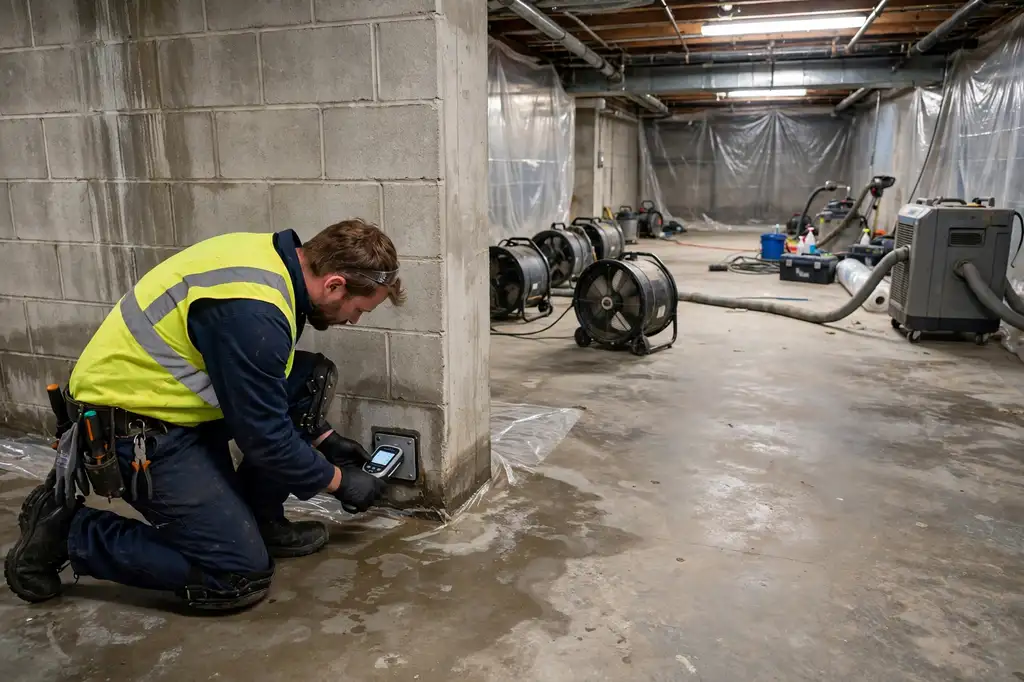
Applying antimicrobial disinfectant to sewage-affected surfaces during sanitization in Arvada, CO Drying and moisture verification with air movers and dehumidifiers after sewage sanitization in Arvada, CO

Odor Removal: Why the Smell Stays After the Water Is Gone

Homeowners are often surprised that the smell survives the pump-out. It does, for physical reasons. Sewage odor comes from gases and organic residue, and both lodge in the same porous materials that hold the contamination: carpet pad, the bottom plate of framed walls, subfloor seams, insulation, even the dust inside ductwork. Air fresheners and surface sprays sit on top of that reservoir without touching it.

Real odor removal therefore follows the same order as sanitization itself. First the source is removed — contaminated porous material comes out, because no treatment reliably deodorizes sewage-soaked pad or drywall in place. Then the remaining surfaces are cleaned and disinfected, since residue keeps producing odor. Then deodorizing treatment is applied to the cleaned structure, and air scrubbing clears what the work itself stirs up. Where framing or subfloor has absorbed odor deeply, a sealant coat can lock in what cleaning cannot lift.

Odor also travels. A backup in a basement can register upstairs because the HVAC system moves air from the affected zone through the house, and because warm air rises through the same cavities the water wicked into. That is why an odor inspection covers the rooms above and around the event, not just the room where the water stood. Our homepage describes the full cleanup service; this page is the part of that work concerned with what you can smell — and what you cannot.

Odor removal and deodorizing treatment in a sewage-affected room in Arvada, CO

Cleanup vs Repair — What We Do, and What a Plumber Does

This page exists because the two trades are often confused, so the line is worth drawing plainly.

01

What we do is cleanup

Extraction of sewage and contaminated water, removal of material the sewage ruined, washing, disinfection, drying and odor removal. Everything on this page is cleanup work.

02

What a plumber does is repair

Diagnosing and fixing the sewer line itself, replacing damaged pipe, clearing the line so it flows again — that is plumbing work, and it is not a service we offer. We do not clean drains as a plumbing service and we do not repair pipes.

Most backups need both trades, in the right order: the cleanup makes the area safe and stops the damage from spreading, and the repair stops it from happening again. When you call, we will tell you plainly which parts of your situation are ours and which parts belong to a plumber — and a sanitization cannot be finished properly until the source has stopped, which is why an active leak or a still-backing-up line is dealt with first.

Sanitization Across Arvada — Scenic Heights & Beyond

Arvada's older neighborhoods carry the highest sanitization workload, because their sewer laterals are the oldest. In Scenic Heights, around the Majestic View Nature Center at 7030 Garrison St (39.82413, -105.09955), near the Garrison St & W 68th Ave crossing, many homes date from an era of cast-iron and clay sewer lines — the materials most prone to root intrusion, cracking and the slow narrowing that turns into a backup. When a line like that fails, the event is rarely the first water the pipe has leaked, and the contamination map in the basement is usually wider than the visible spill.

We sanitize sewage-affected areas across Arvada — Scenic Heights, Olde Town, Candelas, Ralston Valley and every neighborhood between — as part of complete sewage cleanup, and as a follow-up stage when a backup was pumped out but never properly disinfected. The wider service fits under our Water Damage Restoration hub; sanitization is the sewage-specific discipline within it. Whatever part of the city the event is in, the questions are the same: what did the sewage touch, what has to come out, and what can be proven clean afterward.

Arvada neighborhoods we serve:

and surrounding Arvada areas.

Check my address→
1234
Arvada & the northwest Denver metroArvada neighborhoods and nearby cities across the northwest Denver metro.

Questions before we arrive

Frequently Asked Questions

How is sewage sanitized after a backup?

In order: the standing sewage and solids are extracted, porous material the sewage reached is removed, the remaining surfaces are washed to clear the soil load, antimicrobial disinfectant is applied and left for its full contact time, and the structure is dried and verified with moisture readings. Skipping the wash or the removal is what makes a sanitization fail.

Does sanitization remove the sewage smell completely?

In most cases, yes — provided the odor sources are removed rather than covered. Sewage-soaked carpet pad, drywall and insulation cannot be reliably deodorized in place, so they come out; the remaining structure is cleaned, disinfected and treated. If an odor source is hidden — inside a wall cavity or under a floor — it has to be found and addressed, and we will tell you honestly if that is what your situation involves.

Is it safe to stay in the house while sanitization is happening?

Usually, yes, with the work area avoided. The affected rooms are contained while cleaning and disinfection are underway, and disinfectant needs its contact time undisturbed. Living areas outside the contained zone are generally fine to occupy. If the contamination is extensive or involves the HVAC system, we will tell you plainly if a night elsewhere is the sensible choice.

What gets removed vs what gets disinfected?

As a rule: porous materials the sewage touched are removed — carpet and pad, wicked drywall, insulation, swollen baseboards and damaged upholstered or particle-board items. Materials that can be cleaned through — concrete, tile, metal, sealed surfaces, and usually wood framing and subfloor — are washed, disinfected and dried in place, then checked. The material and how deeply the sewage penetrated decide each item, not a blanket rule.

How do I know the area is actually clean afterwards?

Three checks: a visual inspection of every surface the sewage reached, moisture readings confirming the structure is dry, and the odor check — a properly sanitized area does not smell of sewage. The work and the readings are documented, so you have a record of what was removed, what was treated and what the final readings were.

Can sewage odors come back after sanitization?

They can if a source was left behind — a section of contaminated pad under a floor, residue inside a wall cavity, or a new event from a line that was never repaired. Odor returning is information: it points at a remaining source, and the fix is to find and remove that source, not to mask it. This is also why the repair side matters; cleanup cannot hold if the line keeps failing.

Does homeowners insurance cover sewage sanitization?

It depends on the policy. Sewage damage is commonly handled under a specific water-backup or sump endorsement rather than the base policy, and coverage for the cleanup stages varies. We cannot promise what an insurer will pay — that decision is theirs. What we provide is documentation: photographs, the contamination map, what was removed, and moisture readings, so your claim is filed on evidence. Checking your endorsement before an event is the one step that removes the guesswork.

Call for sewage sanitization in Arvada

Call for Sewage Sanitization in Arvada

If a backup has been pumped out but the smell is still there — or if you are not sure the area was ever properly disinfected — that is exactly the stage this page describes. Call Sewage Cleanup Arvada at (720) 764-0457 and describe what happened; we will tell you plainly what sanitization your situation needs and what it does not.

Sewage Cleanup Arvada · 5292 Ward Rd #2, Arvada, CO 80002 · (720) 764-0457

Talk with the local team

Get in Touch with Us

We invite you to reach out for any sewage sanitization concerns. Our team is available to assist you.

5292 Ward Rd #2, Arvada, CO 80002Dispatch office · technicians serve the full area